

Research can be an act of service to a community. Peter van Hardenberg, lab director of Ink & Switch, spent his early days in oceanographic research, collecting and sharing data we rely on to track and mitigate climate change. That sort of research is an act of service to us all. Our work on tools for thought is a similar kind of service: creating new tools, techniques, and technologies that researchers in other fields can depend on to do their best work. In this talk, Peter shares this and other facets of how we approach our research, and how this approach has changed over the ten years that Ink & Switch has existed. Presenter: Peter van Hardenberg Recording: Moat Studio (https://www.moat-studio.com), Joey Bania, Josh Meany & Cormac Dunne Editing: Ivy Reese Graphics: Todd Matthews Presented live at Local First Conf 2026 in Berlin. To watch more of these talks check @localfirstconf and @inkandswitch.
Ink & Switch
An independent research lab exploring the future of tools for thought.

How to Do Ambitious Research in the Modern Era
How to Do Ambitious Research in the Modern Era
Connecting Researchers & Practitioners to Catalyze Actionable Research
Expert Working Group Report
Midjourney
An independent research lab exploring new mediums of thought and expanding the imaginative powers of the human species.
In an era where research evaluation methods are evolving, the Research Contribution Claim Network makes trustworthy tracking of non-traditional research output easy!
In this whitepaper, Patrick Hochstenbach (Ghent University Library), Thomas van Himbergen (SURF), Laurents Sesink (SURF) and Herbert Van de Sompel (DANS) introduce the...
Why we built the Journal of Research on Research and what it cost us - LSE Impact
Gemma Derrick, Bart Penders, Serge Horbach & Tony Ross-Hellauer reflect on the choices, challenges & compromises of launching the Journal of Research on Research

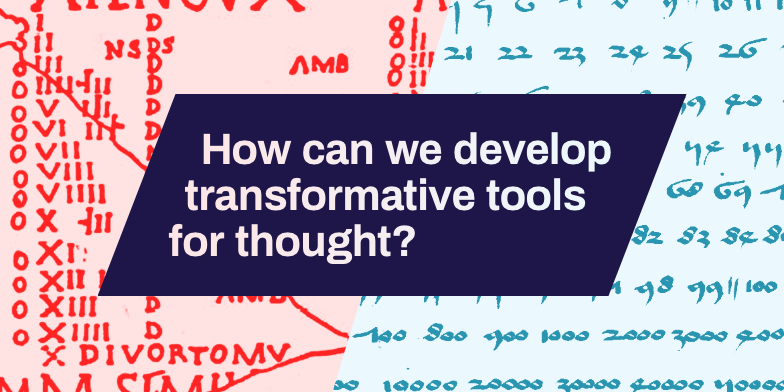
PRISM: Capturing the Invisible Art of Scientific Practice
A New Tool for Recording and Scaling Laboratory Expertise

Qualitative Research in an Era of Artificial Intelligence: A Pragmatic Approach to Data Analysis, Workflow, and Computation
Computational developments—particularly artificial intelligence—are reshaping social scientific research and raising new questions for in-depth methods such as ethnography and qualitative interviewing. Building on classic debates about computers in qualitative data analysis, we revisit possibilities and dangers in an era of automation, large language model chatbots, and big data. We introduce a typology of contemporary approaches to using computers in qualitative research: streamlining workflows, scaling up projects, hybrid analytical methods, the sociology of computation, and technological rejection. Drawing from scaled team ethnographies and solo research integrating computational social science alongside in-depth observation, we describe methodological choices across study life cycles, from literature reviews through data collection, coding, text retrieval, and representation. We argue that new technologies hold potential to address long-standing methodological challenges when deployed with knowledge, purpose, and ethical commitment. Yet, a pragmatic approach—moving beyond technological optimism and dismissal—is essential given rapidly changing tools that are both generative and dangerous. Computation now saturates research infrastructure, from algorithmic literature searches to scholarly metrics, making computational literacy a core methodological competence in and beyond sociology. We conclude that when used carefully and transparently, contemporary computational tools can meaningfully expand, rather than displace, the irreducible insights of qualitative research.

From Tools to Adoption: A Path to Modular and Interactive Scientific Publishing | ICOR
Tracy Teal, openRxiv Rowan Cockett, Continuous Science Foundation Monica Granados, Creative Commons Jason Priem, OpenAlex Paul Shannon, eLife

Research tools 🔬

Interesting tools that assist with the research process.
Scholary infrastructure and the research nexus

The research nexus is "a rich and reusable open network of relationships connecting research organisations, people, things, and actions; a scholarly record that the global community can build on forever, for the benefit of society." (crossref.org/documentation/research-nexus/)
Paperclip

Ronen Tamari (@ronentk.me)

Crossmark - Crossref
Crossmark - Crossref
Plaudit · Open endorsements from the academic community
Introducing the Elicit API - Elicit
How Grobid uses Crossref metadata to enrich bibliographic information - Crossref
Schema 5.5 now available: adding CRediT, new record types for blogs and posters, and more - Crossref
Scholarly blogs and their place in the research nexus - Crossref
Rogue Scholar
SemRepo.org

Science discussions of retracted articles on Bluesky: public scrutiny or misinformation spreading?