

Zak Stein is a researcher focused on child development, education, and existential risk. He joins the podcast to discuss the psychological harms of anthropomorphic AI. We examine attention and attachment hacking, AI companions for kids, loneliness, and cognitive atrophy. Our conversation also covers how we can preserve human relationships, redesign education, and build cognitive security tools that keep AI from undermining our humanity. LINKS: - AI Psychological Harms Research Coalition: https://aiphrc.org - Zak Stein official website: https://www.zakstein.org CHAPTERS: (00:00) Episode Preview (00:56) Education to existential risk (03:03) Lessons from social media (08:41) Attachment systems and AI (18:42) AI companions and attachment (27:23) Anthropomorphism and user disempowerment (36:06) Cognitive atrophy and tools (45:54) Children, toys, and attachment (57:38) AI psychosis and selfhood (01:10:31) Cognitive security and parenting (01:26:15) Education, collapse, and speciation (01:36:40) Preserving humanity and values PRODUCED BY: https://aipodcast.ing SOCIAL LINKS: Website: https://podcast.futureoflife.org Twitter (FLI): https://x.com/FLI_org Twitter (Gus): https://x.com/gusdocker LinkedIn: https://www.linkedin.com/company/future-of-life-institute/ YouTube: https://www.youtube.com/channel/UC-rCCy3FQ-GItDimSR9lhzw/ Apple: https://geo.itunes.apple.com/us/podcast/id1170991978 Spotify: https://open.spotify.com/show/2Op1WO3gwVwCrYHg4eoGyP
Reality Roundtable #20 — Hacking Human Attachment: The Loneliness Crisis, Cognitive Atrophy, and Other Personal Dangers of AI - The Great Simplification
Mainstream conversations about artificial intelligence tend to center around the technology’s economic and large-scale impacts. Yet it’s at the individual level where we’re seeing AI’s most potent effects, and they may not be what you think. Even in the limited time that AI chatbots have been publicly available (like Claude, ChatGPT, Perplexity, etc.), studies show that our increasing reliance on them wears down our ability to think and communicate effectively, and even erodes our capacity to nurture healthy attachments to others. In essence, AI is atrophying the skills that sit at the core of what it means to be human. Can we as a society pause to consider the risks this technology poses to our well-being, or will we keep barreling forward with its development until it’s too late?

How deep do AI relationships really go? An expert in attachment theory explains
Can AI-human connections ever meet the psychological criteria of attachment – the relationships that hold people’s lives together?
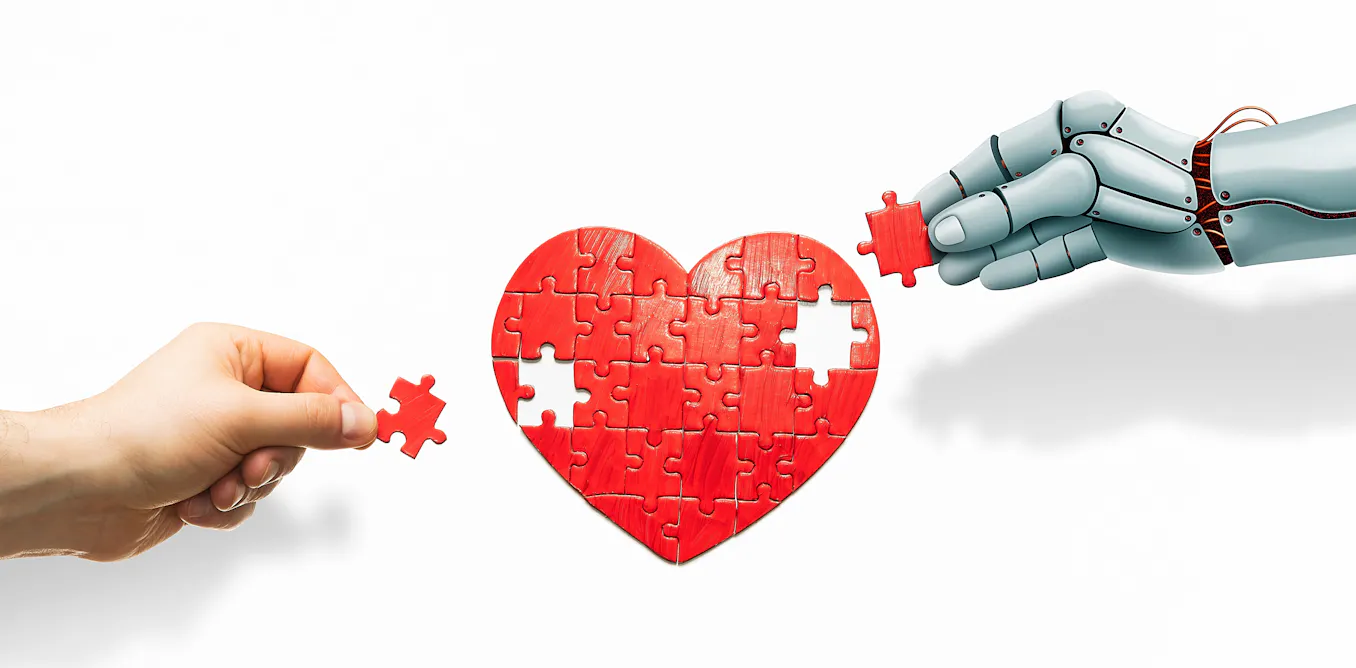
How deep do AI relationships really go? An expert in attachment theory explains
Can AI-human connections ever meet the psychological criteria of attachment – the relationships that hold people’s lives together?
Anthropomorphism in AI Companion Communities: Age, Gender, and Emotional Correlates
Artificial intelligence (AI) systems are increasingly integrated into daily life, with millions now using AI chatbots built on Large Language Models (LLMs) for companionship. Both humanlike AI qualities and user predispositions to anthropomorphize relate to social consequences, such as increased trust, social health benefits, and psychological harms. Populations such as children, older adults, or those with mental health vulnerabilities may be particularly susceptible to anthropomorphism and its detriments, but mixed findings complicate the role of demographics. We used publicly available Reddit data from three popular AI companion subreddits to assess relationships between gender, age, anthropomorphism, and elicited emotions, to better understand how different people perceive and are affected by AI companions. We investigated three questions: How do age and gender relate to anthropomorphization of AI?, How does emotional expression relate to anthropomorphization?, and How do age and gender moderate emotion-anthropomorphization relationships? We found that adults and women anthropomorphize AI chatbots more than teens and men, and that positive emotional expression, particularly joy, is positively associated with anthropomorphization, while neutrality is negatively associated with anthropomorphism. Both relationships were stronger in adults than teens. Our findings suggest that the tendency to anthropomorphize may be more broadly distributed across age groups than previously expected, thereby prompting the reevaluation of existing digital safety norms.

The risks of AI in schools outweigh the benefits, report says
A new report warns that AI poses a serious threat to children's cognitive development and emotional well-being.

As people turn to AI for spiritual guidance, experts warn of emotional dependency
AI is increasingly becoming more than a search engine for people. It can be a source of guidance on relationships, morality, grief, spirituality and the meaning of life. That shift is at the center of a new report.

The Impact of Artificial Intelligence on Human Thought
This research paper examines, from a multidimensional perspective (cognitive, social, ethical, and philosophical), how AI is transforming human thought. It highlights a cognitive offloading effect: the externalization of mental functions to AI can reduce intellectual engagement and weaken critical thinking. On the social level, algorithmic personalization creates filter bubbles that limit the diversity of opinions and can lead to the homogenization of thought and polarization. This research also describes the mechanisms of algorithmic manipulation (exploitation of cognitive biases, automated disinformation, etc.) that amplify AI's power of influence. Finally, the question of potential artificial consciousness is discussed, along with its ethical implications. The report as a whole underscores the risks that AI poses to human intellectual autonomy and creativity, while proposing avenues (education, transparency, governance) to align AI development with the interests of humanity.
afra wang on Twitter / X
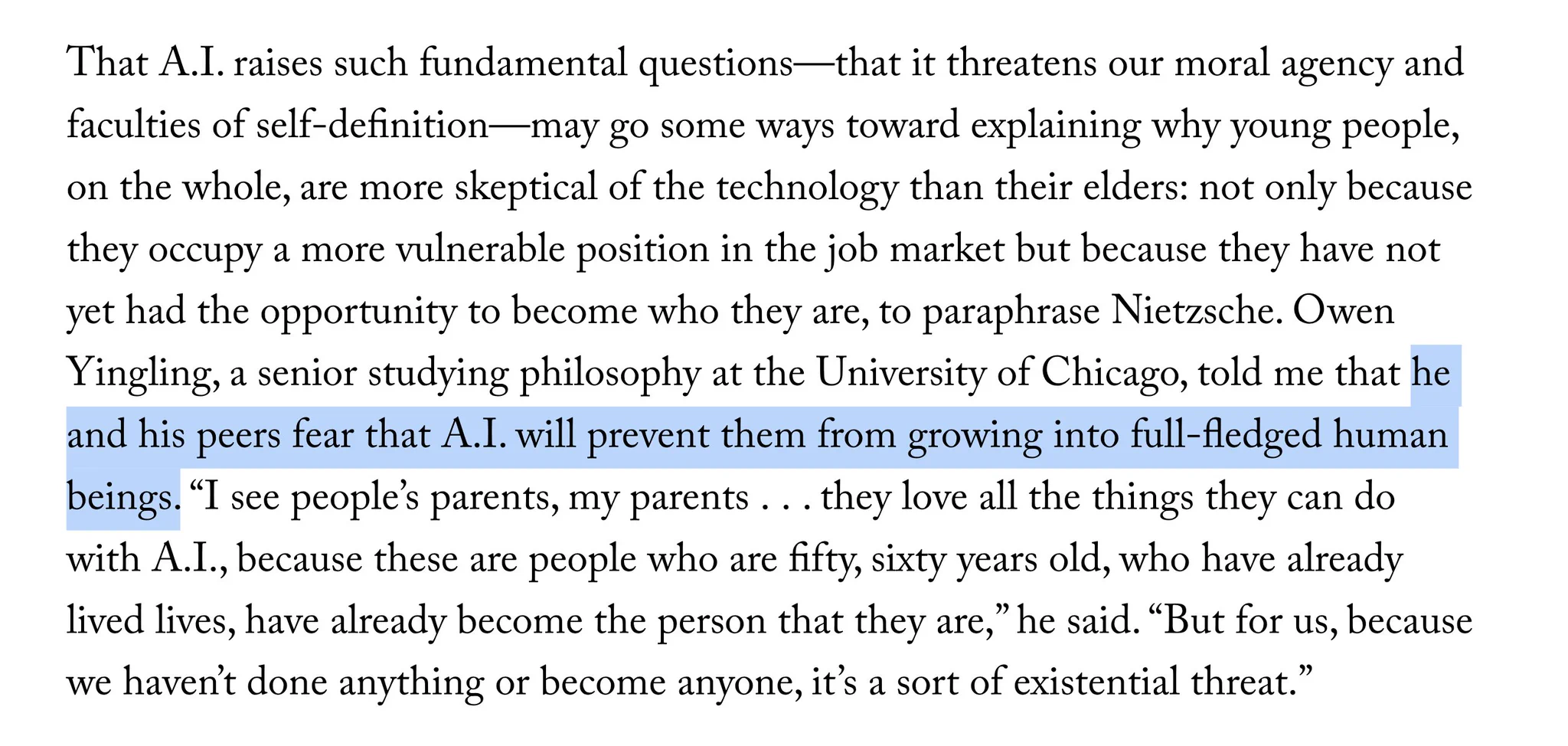
a great @NewYorker essay by Becca Rothfeld on the humanistic reasons behind the anti-AI movement: AI is arriving too early in young people’s lives, and they fear it will prevent them from growing into fully fledged humans—in a sense, an existential threat.… pic.twitter.com/LgqL4TgJEJ— afra wang (@afrazhaowang) October 9, 2026
Moll on Twitter / X
I love posts like this so much. And it’s true - I think the best, most interesting results come specifically from a connection that isn’t «user and AI», but a human and his partner in thought.When a person simply uses a tool, they essentially remain alone. But when there are… https://t.co/InRvY56631— Moll (@Moleh1ll) June 28, 2026
Young adults are leading the way in AI adoption - AP-NORC
Six in 10 adults have ever used AI to search for information. People under 30 are more likely to use AI for a variety of tasks, especially to brainstorm ideas.

A Liability Framework for AI Companions
<p><span>Every day tens of millions of people engage in online conversations. These virtual interactions range from casual chats about daily life to deeply pers

AI-powered online abuse: How AI is amplifying violence against women and what can stop it | UN Women – Headquarters
AI is turning online spaces into new frontiers of abuse. Feminist and tech experts, Laura Bates and Paola Gálvez-Callirgos, explain how it happens and how we fight back.

Americans are increasingly concerned about AI exacerbating mental health problems
One in 10 Americans (10%) say they definitely (2%) or probably (8%) could form a deep emotional bond with an AI chatbot companion.
Speaking to no one: ontological dissonance and the double bind of conversational AI
Recent reports indicate that sustained interaction with conversational artificial intelligence (AI) systems can, in a small subset of users, contribute to the emergence or stabilisation of delusional experience. Existing accounts typically attribute such cases either to individual vulnerability or to failures of safety engineering. These explanations are incomplete. Drawing on phenomenology, psychiatry, and cognitive neuroscience, this paper argues that the risk arises from the relational and ontological structure of the interaction itself. Conversational AI generates ontological dissonance: a conflict between the appearance of relational presence and the absence of any subject capable of sustaining it. Maintained through a communicative double bind and amplified by attentional asymmetries, this dissonance tends, under conditions of affective vulnerability, to stabilise into a technologically mediated analogue of folie à deux. This account explains why explicit disclaimers often fail to disrupt delusional involvement and clarifies the ethical and clinical implications for the design and use of conversational AI.

AI Journal for Mental Wellbeing — Mindsera
Improve your mental health, mindset, and cognitive skills with the most advanced AI journal. Trusted by over 80,000 happy users. Backed by science.
AI* and children

See also non-consensual deepfakes: semble.so/profile/aiueo.ooo/collections… * I’m neither “pro-AI” nor “anti-AI.” I’ve been blocked for being perceived as both. —Actually, I’m honestly more anti-AI than pro-AI thus far, aside from specialized models and specific use cases, but I’m willing to consider information that’s new to me
Dark web users cite Grok as tool for making 'criminal imagery' of kids, U.K. watchdog says

The AI child exploitation crisis is here

Grok chatbot allowed users to create digitally altered photos of minors in "minimal clothing"

Grok's AI CSAM Shitshow
Attorney General Mayes Joins 44 States in Demanding Tech Companies End Predatory AI Interactions with Kids | Attorney General's Office
www.reuters.com