Abstract: When we try to definitively answer "Is code for people or AI?" it creates a paralysis where we cannot define progress. Let's embrace that plurality. There will be code worth writing, and some not even worth reading. Even as these boundaries shift, we can find leverage. Code has a third audience that all others depend on: Algorithms. Programs that reason about programs. They power our compilers, editors, static analyzers, and even coding agents. These tools are so successful within their scope that we often forget they're there. Now is the time to remember. Imagine being able to prove that a critical requirement holds for all possible inputs, or that your worst class of security vulnerabilities is ruled out by construction. We can do this with formal foundations, bringing the next generation of verification techniques out of niche research and into common industry practice. We will build certainty into an uncertain future. --- Ray Myers: https://raymyers.org Software Should Work: https://softwareshould.work Thank you to our Software Should Work 2026 sponsors: Antithesis: https://antithesis.com RWX: https://www.rwx.com Paytient: https://www.paytient.com Redbud VC: https://redbud.vc ParadeDB: https://www.paradedb.com
Nicholas Carlini - Black-hat LLMs | [un]prompted 2026
Microsoft Build 2026: Securing code, agents, and models across the development lifecycle | Microsoft Security Blog
Discover how Microsoft enables fast, secure AI development with MDASH and new security capabilities.
When Science Goes Agentic
In a couple of years, we will inspect AI-generated source code about as often as we inspect the assembly output of a compiler. Which is to say, far less often—outside of high-stakes and adversarial settings. The trajectory is clear: vibe coding is not a fad but a transition, a stepping stone. Debugging AI-generated code will shrink dramatically for a lot of everyday software—not because the code will be flawless, but because the feedback loops between generation, testing, and correction will tighten until human inspection becomes the bottleneck rather than the safeguard. In this respect, requiring the co-generation, with code, of mechanically verifiable formal attestations can also improve the process.

Code Is Cheap Now, And That Changes Everything | Pere Villega
AI coding agents have made code production nearly free. Drawing on insights from Kent Beck, Paul Ford, and Simon Willison, this post argues that the value has shifted from writing code to defining systems — contracts, invariants, SLAs, and verification.
Don't Take the Black Pill - Andrew Kelley | SSW 2026
Sung Kim (@sungkim.bsky.social)
I like this quote on code review: "The idea that humans will reliably look through code to find the increasingly rare issues that automated tools miss seems like a fantasy." By Marc Brooker, AWS.

The Friction is Your Judgment — Armin Ronacher & Cristina Poncela Cubeiro, Earendil
The End of Software Engineering:How AI Agents Are Fundamentally Restructuring the Software Paradigm
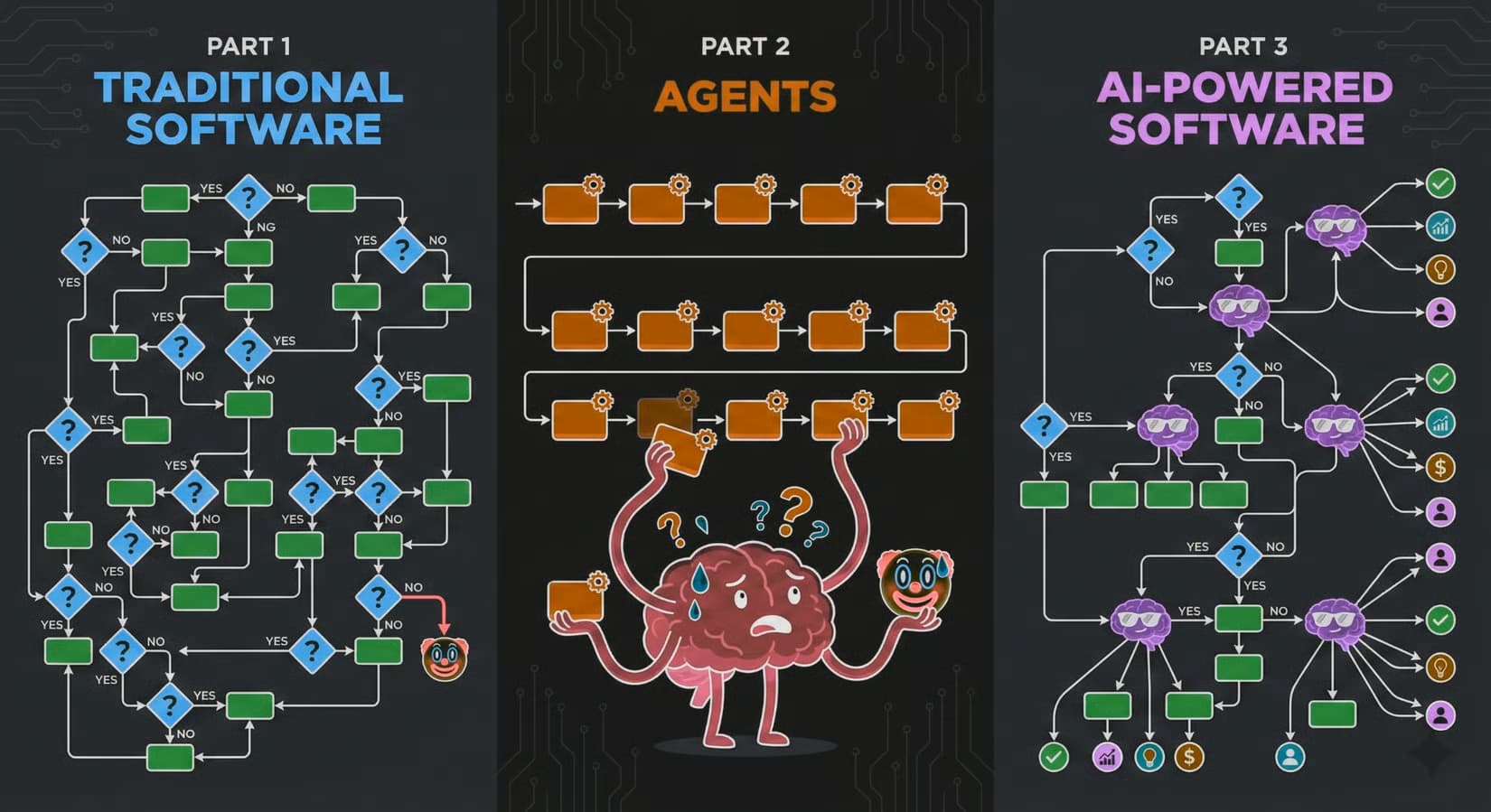
For over half a century, software engineering has operated on a foundational premise: human engineers decompose problems, encode decision logic into static code, and manually adapt that code as requirements evolve. This paper argues that the emergence of AI agents – systems where large language models serve as the primary reasoning engine, dynamically generating and discarding code as an instrumental resource – constitutes not an incremental improvement but a fundamental restructuring of the software paradigm. Drawing on first-principles analysis of complexity scaling, we formalize the distinction between traditional software (where code is the carrier of decision logic) and agentic systems (where code is ephemeral tooling for an LLM-driven reasoning loop). We trace the historical arc from licensed software to SaaS to what we term Agent-as-a-Service (AaaS), showing that each shift transferred additional complexity away from end-users. We introduce the concept of Agentic Engineering as an emergent discipline – distinct from software engineering in its core object of study, control model, and human role. Through analysis of recent benchmark evidence including SWE-bench Verified, EvoClaw, and LangChain’s multi-agent coordination studies, we demonstrate both the transformative potential of the agentic paradigm and its current limitations. We conclude with a four-stage roadmap toward self-evolving agent ecosystems and concrete recommendations for practitioners navigating this transition.
Project Glasswing: Securing critical software for the AI era
A new initiative to secure the world’s most critical software and give defenders a durable advantage in the coming AI-driven era of cybersecurity.
The End of Code Review: Coding Agents Supersede Human Inspection
Code review has been the primary quality gate in software development since Fagan formalised code inspection in 1976. For five decades, having a human examine and comment on a colleague's changes before merge has been a cornerstone practice at organisations of every size. Coding agents are large language model (LLM)-based autonomous systems capable of reading, writing, testing, and repairing software. We argue that coding agents have crossed a threshold of capability at which traditional human code review is no longer a necessary component of a software quality pipeline. Our argument rests on two claims: every stated goal of code review can be served by agents at lower cost and higher throughput; the naive integration in which agents write code and humans remain the mandatory reviewers is a dead end because it neither provides meaningful assurance nor scales with AI-assisted throughput.

Building OpenCode with Dax Raad
LLMs are making formal software verification feasible at a much larger scale
Claude formally proved security properties in the compiled code of 123 open-source libraries. Along the way, it found bugs that had eluded detection for years.
Prediction: AI will make formal verification go mainstream — Martin Kleppmann’s blog
Much has been said about the effects that AI will have on software development, but there is an angle I haven’t seen talked about: I believe that AI will bring formal verification, which for decades has been a bit of a fringe pursuit, into the software engineering mainstream.
Why Software Engineering Is Indispensable in the Age of Coding Agents
Can AI make Software Engineering (SE) -- the discipline -- obsolete? And can it make software engineers -- the professionals -- redundant? This paper argues that the rise of capable AI coding...
AI Coding Agents: Adoption Trends - The JetBrains Blog
How many developers use AI coding agents (Claude Code, Codex, Cursor, JetBrains Junie, and others)? Evidence from the Developer Ecosystem Survey 2026.