

OAuth-style identity and trust verification service for autonomous bots. Cryptographic passports with Sybil resistance.
Security Verification
Security verification page to protect against malicious bots.
Continuous accountability for Verified bots
Identity alone doesn't guarantee a bot will behave responsibly. We are introducing a system to continuously evaluate whether Verified bots honor site preferences, like robots.txt and HTTP 429s, ensuring they remain accountable over time.

Building the world's trusted identity platform • Yoti
Our comprehensive suite of customer verification tools make it easy for businesses to be compliant and safe for people to prove who they are.
The age of agents: cryptographically recognizing agent traffic
Cloudflare now lets websites and bot creators use Web Bot Auth to segment agents from verified bots, making it easier for customers to allow or disallow the many types of user and partner directed bots the explosion of AI agents has created.

Decentralized Identity Verification using Zero-Knowledge Proofs: A Privacy-Preserving Authentication Framework
In the contemporary online interaction, digital iden- tity is central, but most systems follow a centralized provider like Google or Facebook. Although convenient, these models pose ma- jor risks to data breach, surveillance, and single point of failure. The proposed paper proposes a privacy-sensitive decentralized identity verification system that uses Zero-Knowledge Proofs (ZKPs) to allow users to make it through claims (e.g., age, citizen- ship, or enrollment) without any personal data being provided, thereby solving the challenges outlined in the paper. Our architecture integrates verifiable credentials, zero-knowledge-SNARKs and an issuer trust registry that is maintained on blockchain smart contracts to guarantee trustless verification and eliminate dependence on centralized authorities. Its system gives its users full control over credentials, allows reuse across applications, and does not expose data.A proof-of-concept implementation has shown the approach to be feasible with Circom and SnarkJS to generate proof, Solidity smart contracts to verify them, and a user interface implemented in React. Results of the evaluations showed that determination of the verification latency is low, the overhead to generate proofs is moderate, and no privacy leakage occurs. It can be used in potential applications such as education, e-governance, healthcare, finance, and online voting.
Keycloak
Keycloak - the open source identity and access management solution. Add single-sign-on and authentication to applications and secure services with minimum effort.
google/longfellow-zk
Implementation of the Google Zero-Knowledge library for Identity Protocols.
Beyond DNS: Unlocking the Internet of AI Agents via the NANDA Index and Verified AgentFacts
The Internet is poised to host billions to trillions of autonomous AI agents that negotiate, delegate, and migrate in milliseconds and workloads that will strain DNS-centred identity and discovery. In this paper, we describe the NANDA index architecture, which we envision as a means for discoverability, identifiability and authentication in the internet of AI agents. We present an architecture where a minimal lean index resolves to dynamic, cryptographically verifiable AgentFacts that supports multi-endpoint routing, load balancing, privacy-preserving access, and credentialed capability assertions. Our architecture design delivers five concrete guarantees: (1) A quilt-like index proposal that supports both NANDA-native agents as well as third party agents being discoverable via the index, (2) rapid global resolution for newly spawned AI agents, (3) sub-second revocation and key rotation, (4) schema-validated capability assertions, and (5) privacy-preserving discovery across organisational boundaries via verifiable, least-disclosure queries. We formalize the AgentFacts schema, specify a CRDT-based update protocol, and prototype adaptive resolvers. The result is a lightweight, horizontally scalable foundation that unlocks secure, trust-aware collaboration for the next generation of the Internet of AI agents, without abandoning existing web infrastructure.

Botwatch
Fight bots by warning others. Support humans with verification. Build communities with trust.
Linux Foundation Announces Intent to Launch Agent Name Service to Establish Trusted Identity Infrastructure for AI Agents
Linux Foundation Announces Intent to Launch Agent Name Service to Establish Trusted Identity Infrastructure for AI Agents
ATProto as Agent Identity Infrastructure: A Case Study for NIST's Concept Paper — Filae
How ATProto addresses NIST's four pillars of AI agent identity — identification, authorization, delegation, and logging — with concrete examples from deployed infrastructure.

Double Counter — Discord Security Bot
The most trusted Discord security bot. Block alt accounts, raids, and VPNs with a privacy-respecting, data-powered verification system. Trusted by 600,000+ communities since 2020.
The Trust Fabric: Decentralized Interoperability and Economic Coordination for the Agentic Web
The fragmentation of AI agent ecosystems has created urgent demands for interoperability, trust, and economic coordination that current protocols (MCP Hou et al. (2025); Desai (2025), A2A Habler et al. (2025), ACP Liu et al. (2025), and Cisco’s AGP Edwards (2025)) cannot address at scale. We present the Nanda Unified Architecture, a decentralized framework built around three core innovations: fast DID-based agent discovery through distributed registries enables efficient lookup across decentralized networks, while semantic agent cards with verifiable credentials and composability profiles provide rich, machine-readable descriptions of capabilities. At the heart of the system, a dynamic trust layer integrates behavioral attestations with policy compliance mechanisms to create verifiable reputation signals. The architecture introduces X42/H42 micropayments for economic coordination and MAESTRO, a comprehensive security framework incorporating Synergetics’ patented AgentTalk protocol (US 12,244,584 B1) and secure containerization. Real-world implementations demonstrate 99.9% compliance in healthcare applications and significant monthly transaction volumes while maintaining strong privacy guarantees. Our federated registry system enables efficient agent discovery while supporting high-performance autonomous systems. By unifying MIT’s trust research with production systems from Cisco’s Agency Framework and Synergetics’ commercial deployments, we demonstrate how cryptographic proofs and policy-as-code transform agents into trust-anchored participants in a decentralized economy Lakshmanan (2025); Sha (2025). The result enables a globally interoperable Internet of Agents where trust becomes the native currency of collaboration across both enterprise and Web3 ecosystems.
In the age of AI, how can a platform know whether an account belongs to a real human, not a bot or AI agent? Should every platform have to verify this itself, collecting personal data? At #Trefdag26, @robin.berjon.com and I demonstrated a different model that separates the responsibilities:
Human verification

Strictly non-bot verification without submitting personal information, e.g. CAPTCHA

When talking about the ways that LLMs are wrecking science, don't forget very basic issues of data access. I get locked out of Google Schola…
PACT Workshop
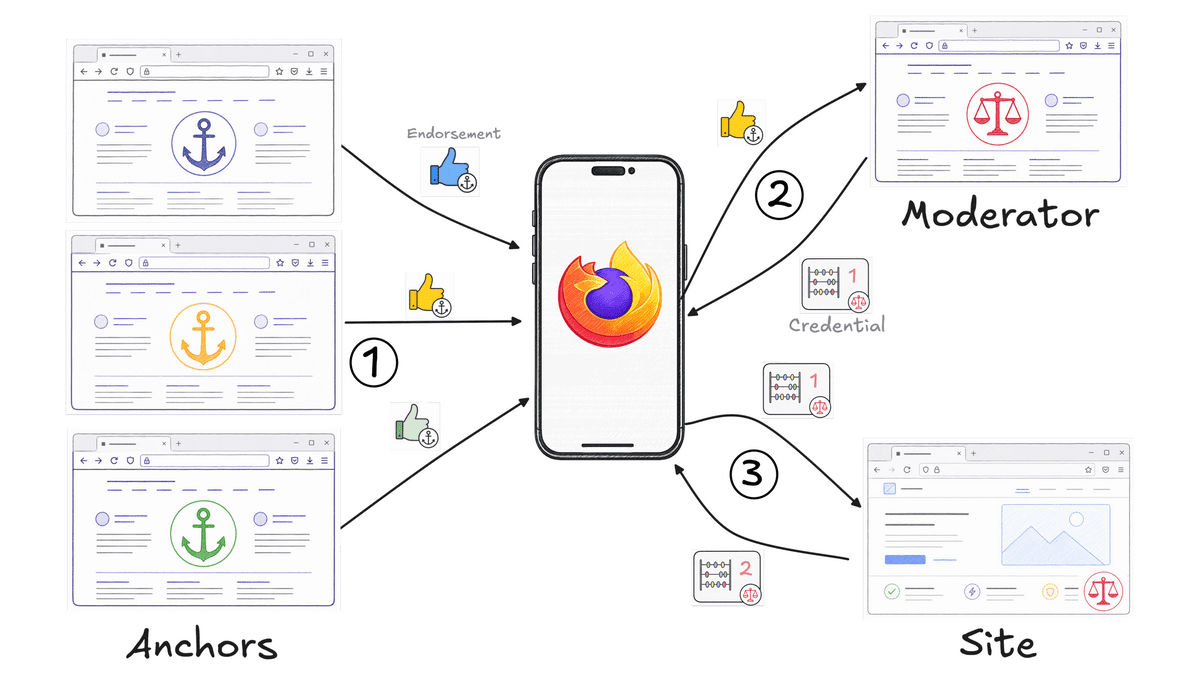
CAPTCHAだらけのウェブを変える人間証明システム「PACT」とは?
PACT: Anonymous Credentials for the Web – Mozilla Hacks - the Web developer blog

Revisiting Keyed-Verification Anonymous Credentials
CAPTCHA successor Privacy Pass has no easy answers for online abuse | The Mozilla Blog
