Curate your research trails. Collect interesting links, add notes, and organize them into shareable collections. Build trails others can explore and extend.
Connect with peers. See what your peers are sharing and find new collaborators with shared interests. Experience research rabbit holes, together.
Own your data. Built on ATProto, new apps will come to you. No more rebuilding your social graph and data when apps pivot and shut down.
See the bigger picture. Find what's relevant through your network. Get the extra context that matters before you dive into content.
Highlights from our community
ExploreSembleIt: Semble Without the Distractions
Semble is two apps in a trench coat. SembleIt is just the quiet one.

Chimpanzees in Uganda locked in vicious 'civil war', say researchers
The once close-knit community of Ngogo chimpanzees have been at loggerheads for the last eight years.

Semble Multi-User Graph Explorer
On filing the corners off my MacBooks
I file the sharp corners off my MacBooks. People like to freak out about this, so I wanted to post it here to make sure that everyone who wants to freak out about it gets the opportunity to do so.
NLnet; Nanoarguments
Scientific knowledge is currently scattered across papers, repositories, and disconnected platforms, with no structured way to trace how claims connect to evidence or how arguments develop. Nanoarguments builds a framework and tools for creating, browsing, and contributing to a global, federated graph of scientific discourse and evidence. Researchers and their communities can collaboratively structure claims, evidence chains, and discussion as nanopublications, which are small, cryptographically signed Linked Data snippets with precise provenance and authorship, published to a decentralized peer-to-peer network. The project builds upon the Nanodash interface to help users browse, edit, and aggregate discourse and evidence graphs, and integrates with dokieli to enable in-context authoring of nanopublications as inline annotations while reading or writing a document. A bidirectional ActivityPub connector bridges the nanopublication network and the fediverse, allowing discourse threads to start as social exchanges and crystallize into persistent, machine-readable evidence records. The project will be piloted with early adopter research groups in discourse and evidence modeling. All components will be released as open-source modules that other systems can build upon.
Introducing TRIBE v2: A Predictive Foundation Model Trained to Understand How the Human Brain Processes Complex Stimuli
Understanding how the human brain processes the world around us is one of the greatest open challenges in neuroscience. Breakthroughs here could transform how we understand and treat neurological conditions affecting hundreds of millions of people β and improve AI systems by directly guiding their development from neuroscientific principles.

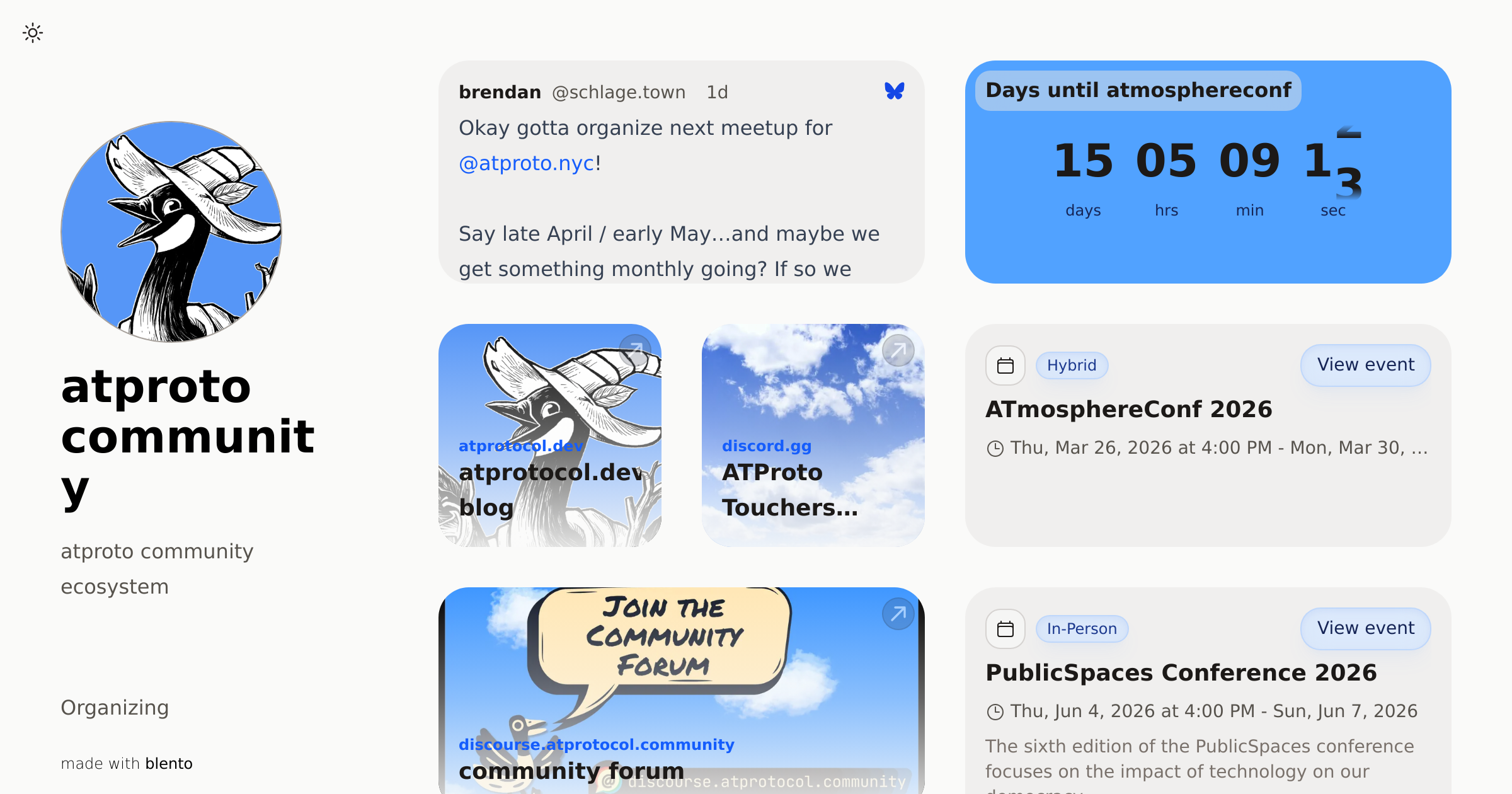
atproto community
atproto community ecosystem Organizing [https://atmosphereconf.org](https://atmosphereconf.org), sharing community news, and AT Community Fund leads.

intents and panproto lenses
Blaine
I was going to go for a walk, but @rude1.blacksky.team nerd-sniped me into writing this, instead. I'm not upset, though. It turns out collective governance questions are a great lens for grounding/scrupling how we might do on-protocol collective governance.