Collection
Open
Post-Quantum

Updated 6mo
Information about & solutions for problems that could exist once humanity has developed advanced quantum computers
Collection
Updated 6mo
Information about & solutions for problems that could exist once humanity has developed advanced quantum computers
More on whether useful quantum computing is “imminent”
These days, the most common question I get goes something like this: A decade ago, you told people that scalable quantum computing wasn’t imminent. Now, though, you claim it plausibly is immi…

Quantum Leap: Google Claims Its New Quantum Computer Provides Evidence That We Live In A Multiverse
Google's quantum computer, Willow, suggests evidence for a multiverse by leveraging computations across parallel universes.
A Cryptography Engineer’s Perspective on Quantum Computing Timelines
The risk that cryptographically-relevant quantum computers materialize within the next few years is now high enough to be dispositive, unfortunately.

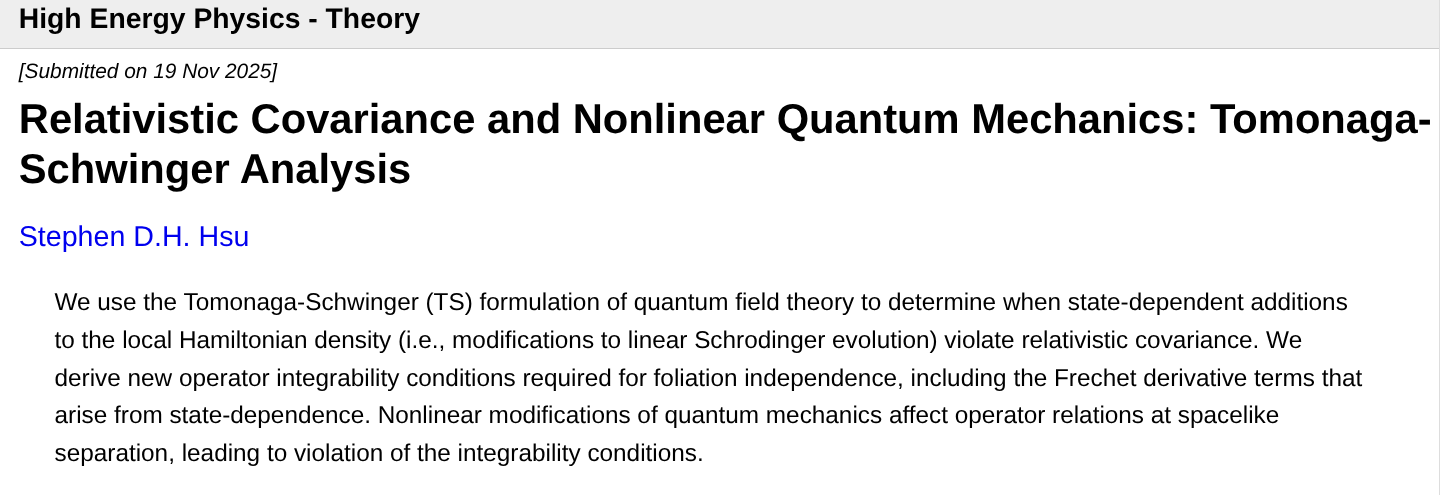
steve hsu on Twitter / X
I think I’ve published the first research article in theoretical physics in which the main idea came from an AI - GPT5 in this case. The physics research paper itself (on QFT and state-dependent quantum mechanics) has been published in Physics Letters B.I've written an… pic.twitter.com/6IYDTS2JAt— steve hsu (@hsu_steve) December 3, 2025
A Post-Quantum Future for Let's Encrypt
Let’s Encrypt is committed to a post-quantum-safe Web PKI. The path we’re planning to take is Merkle Tree Certificates (“MTCs”), a new approach that adds post-quantum authentication to the web without sacrificing the speed and reliability that have made TLS universal. This post is about these plans and why we believe MTCs are worth pursuing as a key to a post-quantum future. An increasingly urgent problem For much of the last several years, the conversation about post-quantum cryptography has been a conversation about encryption. The reasoning was straightforward: an attacker who records encrypted traffic today might be able to decrypt it years from now once quantum computers can break the underlying math. Authentication, the part of TLS that indicates a server is who it says it is, has been a less urgent problem. A quantum computer needs to forge a signature in real time, not retroactively, so threats to authentication hinge on the existence of a cryptographically relevant quantum computer (CRQC).

DEF CON 33 - Post Quantum Panic: When Will the Cracking Begin, & Can We Detect it? - K Karagiannis
QBism: Quantum Theory as a Hero's Handbook
This paper represents an elaboration of the lectures delivered by one of us (CAF) during "Course 197 -- Foundations of Quantum Physics" at the International School of Physics "Enrico Fermi" in Varenna, Italy, July 2016. Much of the material for it is drawn from arXiv:1003.5209, arXiv:1401.7254, and arXiv:1405.2390. However there are substantial additions of original material in Sections 4, 7, 8 and 9, along with clarifications and expansions of the older content throughout. Topics include the meaning of subjective probability; no-cloning, teleportation, and quantum tomography from the subjectivist Bayesian perspective; the message QBism receives from Bell inequality violations (namely, that nature is creative); the import of symmetric informationally complete (SIC) quantum measurements for the technical side of QBism; quantum cosmology QBist-style; and a potential meaning for the holographic principle within QBism.

Meet Willow, our state-of-the-art quantum chip
Our new quantum chip demonstrates error correction and performance that paves the way to a useful, large-scale quantum computer.

Hybrid Constructions: The Post-Quantum Safety Blanket - Dhole Moments
The funny thing about safety blankets is they can double as stage curtains for security theater. Art: CMYKat “When will a cryptography-relevant quantum computer exist?” is a question ma…

Collapse Theories
Quantum mechanics, with its revolutionary implications, has posedinnumerable problems to philosophers of science. In particular, it hassuggested reconsidering basic concepts such as the existence of aworld that is, at least to some extent, independent of the observer,the possibility of getting reliable and objective knowledge about it,and the possibility of taking (under appropriate circumstances) atleast some properties to be objectively possessed by physical systems.It has also raised many others questions which are well known to thoseinvolved in the debate on the interpretation of this pillar of modernscience. One can argue that most of the problems are not only due tothe intrinsic revolutionary nature of the phenomena which have led tothe development of the theory. They are also related to the fact that,in its standard formulation and interpretation, quantum mechanics is atheory which is excellent (in fact it has an unprecedented success inthe history of science) in telling us everything about what weobserve, but it meets with serious difficulties in telling uswhat there is. We are making here specific reference to thecentral problem of the theory, usually referred to as themeasurement problem, which is accompanying quantum theory sinceits birth. It is just one of the many attempts to overcome thedifficulties posed by this problem that has led to the development ofCollapse Theories, i.e., to the Dynamical ReductionProgram (DRP). As we shall see, this approach consists inaccepting that the dynamical equation of the standard theory should bemodified by the addition of stochastic and nonlinear terms. The nicefact is that the resulting theory is capable, on the basis of a singledynamics which is assumed to govern all natural processes, to accountat the same time for all well-established facts about microscopicsystems as described by the standard theory, as well as for theso-called postulate of wave packet reduction (WPR), which accompaniesthe interaction of a microscopic system with a measuring device. As iswell known, such a postulate is assumed in the standard scheme just inorder to guarantee that measurements have outcomes but, as weshall discuss below, it meets with insurmountable difficulties if onetries to derive it by assuming the measurement itself to be a processgoverned by the linear laws of the theory. Finally, the collapsetheories account in a completely satisfactory way for the classicalbehavior of macroscopic systems.
Ushering in the Next Frontier of Quantum Innovation
By the authority vested in me as President by the Constitution and the laws of the United States of America, it is hereby ordered: Section 1. Purpose.

Information: the Measure of All Things? Part I: Communication, Code and Computation - 3 Quarks Daily
by Yohan J. John
Humanities in the Machine - Blain Smith
There is something quietly remarkable about the people who built the foundations of modern computing. Not their technical achievements, though those are extraordinary. What is remarkable is where they came from before they ever touched a machine.
2026 Cosmos HAI Lab Lecture with Jack Clark, Co-founder of Anthropic
Technological

Posts about the future of the internet, AI, and anything technological. Hence the name.

Take back the web. Make it weird again - soulcruzer
Social Media and Anti-Social Pluralism - Aaron Ross Powell
Technorealists, the silent majority? - open self
Skyreader Vision - Skyreader Dev Log

Road to a book lexicon (Part 2) - Nick The Sick

The Turing Collapse | Jason G. Butterfield | Offprint