ChatGPT isn’t the only chatbot pulling answers from Elon Musk’s Grokipedia
Google’s Gemini, AI Mode, and AI Overviews, Perplexity, and Microsoft are starting to cite Musk’s Wikipedia knockoff.

ChatGPT isn’t the only chatbot pulling answers from Elon Musk’s Grokipedia
Google’s Gemini, AI Mode, and AI Overviews, Perplexity, and Microsoft are starting to cite Musk’s Wikipedia knockoff.
Latest ChatGPT model uses Elon Musk’s Grokipedia as source, tests reveal
Guardian found OpenAI’s platform cited Grokipedia on topics including Iran and Holocaust deniers

People Training OpenAI’s AI Fired for Using AI to Train the AI
OpenAI has thousands and thousands of contractors helping improve the company's AI models. Multiple contractors have been fired for using AI to train the AI.

Can Synthetic Training Data Survive Its Own Regulation?
Synthetic training data has recently emerged as the quick fix to two different problems: the lack of high-quality training data, and the need to avoid using personal data in training to stay within the boundaries of privacy legislation. Gartner predicts that by 2026 75% of all enterprises will use generative AI to create synthetic training data, a huge increase from less than 5% in 2023.1 Moreover, Gartner predicts that by 2035, solutions that use synthetic data for training will grab three quarters of all end-user spending on enterprise AI software.2 Training data that only a few years ago was the subject of several research papers is now carrying the weight of huge enterprise systems.

Beyond Model Collapse: Scaling Up with Synthesized Data Requires...
Large Language Models (LLM) are increasingly trained on data generated by other LLM, either because generated text and images become part of the pre-training corpus, or because synthetized data is...

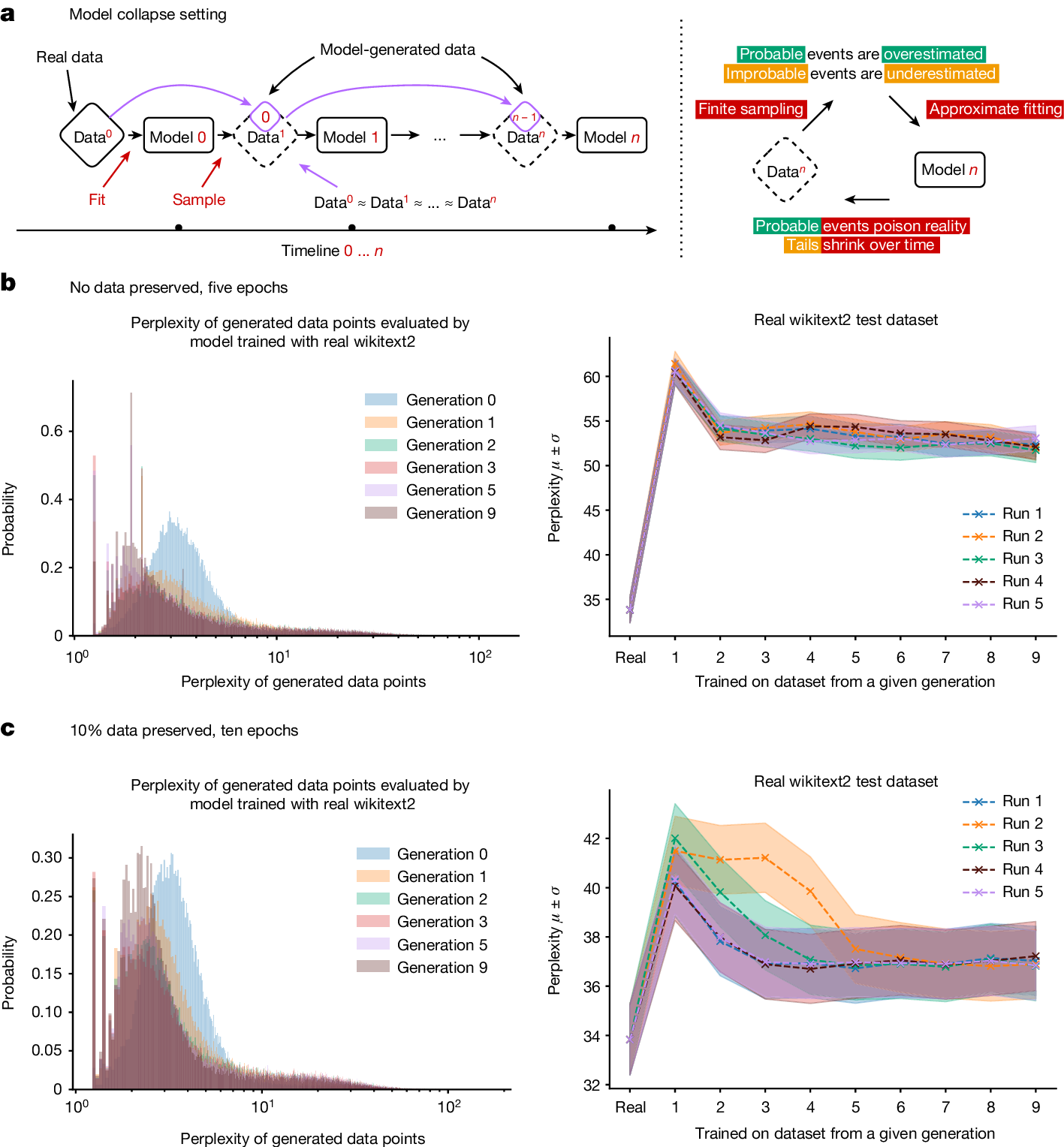
AI models collapse when trained on recursively generated data
Stable diffusion revolutionized image creation from descriptive text. GPT-2 (ref. 1), GPT-3(.5) (ref. 2) and GPT-4 (ref. 3) demonstrated high performance across a variety of language tasks. ChatGPT introduced such language models to the public. It is now clear that generative artificial intelligence (AI) such as large language models (LLMs) is here to stay and will substantially change the ecosystem of online text and images. Here we consider what may happen to GPT-{n} once LLMs contribute much of the text found online. We find that indiscriminate use of model-generated content in training causes irreversible defects in the resulting models, in which tails of the original content distribution disappear. We refer to this effect as ‘model collapse’ and show that it can occur in LLMs as well as in variational autoencoders (VAEs) and Gaussian mixture models (GMMs). We build theoretical intuition behind the phenomenon and portray its ubiquity among all learned generative models. We demonstrate that it must be taken seriously if we are to sustain the benefits of training from large-scale data scraped from the web. Indeed, the value of data collected about genuine human interactions with systems will be increasingly valuable in the presence of LLM-generated content in data crawled from the Internet.
AI is eating website traffic, websites are blocking AI – and reliable information is getting harder to find
AI has broken the economic bargain behind the web, and everybody is losing.

Where the goblins came from
How goblin outputs spread in AI models: timeline, root cause, and fixes behind personality-driven quirks in GPT-5 behavior.

Why Does ChatGPT "Delve" So Much? Exploring the Sources of Lexical Overrepresentation in Large Language Models
Scientific English is currently undergoing rapid change, with words like "delve," "intricate," and "underscore" appearing far more frequently than just a few years ago. It is widely assumed that scientists' use of large language models (LLMs) is responsible for such trends. We develop a formal, transferable method to characterize these linguistic changes. Application of our method yields 21 focal words whose increased occurrence in scientific abstracts is likely the result of LLM usage. We then pose "the puzzle of lexical overrepresentation": WHY are such words overused by LLMs? We fail to find evidence that lexical overrepresentation is caused by model architecture, algorithm choices, or training data. To assess whether reinforcement learning from human feedback (RLHF) contributes to the overuse of focal words, we undertake comparative model testing and conduct an exploratory online study. While the model testing is consistent with RLHF playing a role, our experimental results suggest that participants may be reacting differently to "delve" than to other focal words. With LLMs quickly becoming a driver of global language change, investigating these potential sources of lexical overrepresentation is important. We note that while insights into the workings of LLMs are within reach, a lack of transparency surrounding model development remains an obstacle to such research.
Chatbots Keep Telling Stories About Lighthouse Keeper 'Elias Thorne'. We Might Know Why
LLMs including ChatGPT, Gemini and Claude are obsessed with telling stories about lighthouse keepers and clockmakers, and one character named 'Elias Thorne' has made his way from chatbots to Amazon books. Researchers are trying to discover why.

Anthropic blames dystopian sci-fi for training AI models to act “evil”
But training on "synthetic stories" that model good AI behavior can help.

OpenAI Really Wants Codex to Shut Up About Goblins
“Never talk about goblins, gremlins, raccoons, trolls, ogres, pigeons, or other animals or creatures unless it is absolutely and unambiguously relevant,” reads OpenAI’s coding agent instructions.

ChatGPT Has ‘Goblin’ Mania in the US. In China It Will ‘Catch You Steadily’
OpenAI’s chatbot has some weird linguistic tics in Chinese that are driving users crazy.

The Law of Conservation of Information: Search Processes Only Redistribute Existing Information
Conservation of information sparked scientific interest once a recurring pattern was noticed in the evolutionary computing literature. In grappling with the creation of information through evolutionary algorithms, this literature consistently revealed that the information outputted by such algorithms always needed first to be programmed into them. Thus, the primary goal of this literature—to uncover how information could be created from scratch or de novo —was shown to be misconceived: the information was not created but instead shuffled around or smuggled in, implying that it already existed in some form or other. Information output in these situations therefore always presupposed a counterbalancing input of prior information. Once this pattern was seen, the next logical step was to quantify the amount of information inputted and outputted, demonstrating a consistent mathematical relation between the two. This led to the proof of a number of theorems about search. In these theorems, a baseline search with probability p of success gave way to an improved search with probability q of success. Typically p would be very small and close to zero, implying a practically impossible search (like searching for a needle in a haystack). By contrast, q would be much larger and close to one, implying an eminently doable search. The punchline of these theorems was that, as the improved search became itself the subject of a search (a search for a search , or S4S), the probability of finding it could not exceed p / q , rendering success of the improved search no more probable than success of the original baseline search, in effect filling one hole by digging another. Such conservation-of-information theorems, as they came to be called, were search-space specific, adapted to different kinds of search across a range of search spaces. There was a measure-theoretic theorem in which probability measures guided search. There were also function-theoretic and fitness-theoretic theorems where mappings into the search space as well as fitness functions on the search space respectively guided search. The key insight of this paper is that all these conservation-of-information theorems are special cases of a simple probabilistic relation based on elementary probability theory. This paper identifies the underlying rationale that makes all the previous conservation-of-information theorems work. In so doing, it provides a straightforward proof and general formulation of what may rightly be called the Law of Conservation of Information.
The Futility of Bias-Free Learning and Search
Building on the view of machine learning as search, we demonstrate the necessity of bias in learning, quantifying the role of bias (measured relative to a collection of possible datasets, or more generally, information resources) in increasing the probability of success. For a given degree of bias towards a fixed target, we show that the proportion of favorable information resources is strictly bounded from above. Furthermore, we demonstrate that bias is a conserved quantity, such that no algorithm can be favorably biased towards many distinct targets simultaneously. Thus bias encodes trade-offs. The probability of success for a task can also be measured geometrically, as the angle of agreement between what holds for the actual task and what is assumed by the algorithm, represented in its bias. Lastly, finding a favorably biasing distribution over a fixed set of information resources is provably difficult, unless the set of resources itself is already favorable with respect to the given task and algorithm.
The Famine of Forte: Few Search Problems Greatly Favor Your Algorithm
Casting machine learning as a type of search, we demonstrate that the proportion of problems that are favorable for a fixed algorithm is strictly bounded, such that no single algorithm can perform well over a large fraction of them. Our results explain why we must either continue to develop new learning methods year after year or move towards highly parameterized models that are both flexible and sensitive to their hyperparameters. We further give an upper bound on the expected performance for a search algorithm as a function of the mutual information between the target and the information resource (e.g., training dataset), proving the importance of certain types of dependence for machine learning. Lastly, we show that the expected per-query probability of success for an algorithm is mathematically equivalent to a single-query probability of success under a distribution (called a search strategy), and prove that the proportion of favorable strategies is also strictly bounded. Thus, whether one holds fixed the search algorithm and considers all possible problems or one fixes the search problem and looks at all possible search strategies, favorable matches are exceedingly rare. The forte (strength) of any algorithm is quantifiably restricted.
Is Model Collapse Inevitable? Breaking the Curse of Recursion by Accumulating Real and Synthetic Data
The proliferation of generative models, combined with pretraining on web-scale data, raises a timely question: what happens when these models are trained on their own generated outputs? Recent investigations into model-data feedback loops proposed that such loops would lead to a phenomenon termed model collapse, under which performance progressively degrades with each model-data feedback iteration until fitted models become useless. However, those studies largely assumed that new data replace old data over time, where an arguably more realistic assumption is that data accumulate over time. In this paper, we ask: what effect does accumulating data have on model collapse? We empirically study this question by pretraining sequences of language models on text corpora. We confirm that replacing the original real data by each generation's synthetic data does indeed tend towards model collapse, then demonstrate that accumulating the successive generations of synthetic data alongside the original real data avoids model collapse; these results hold across a range of model sizes, architectures, and hyperparameters. We obtain similar results for deep generative models on other types of real data: diffusion models for molecule conformation generation and variational autoencoders for image generation. To understand why accumulating data can avoid model collapse, we use an analytically tractable framework introduced by prior work in which a sequence of linear models are fit to the previous models' outputs. Previous work used this framework to show that if data are replaced, the test error increases with the number of model-fitting iterations; we extend this argument to prove that if data instead accumulate, the test error has a finite upper bound independent of the number of iterations, meaning model collapse no longer occurs.
Knowledge Collapse in LLMs: When Fluency Survives but Facts Fail under Recursive Synthetic Training
Large language models increasingly rely on synthetic data due to human-written content scarcity, yet recursive training on model-generated outputs leads to model collapse, a degenerative process threatening factual reliability. We define knowledge collapse as a distinct three-stage phenomenon where factual accuracy deteriorates while surface fluency persists, creating "confidently wrong" outputs that pose critical risks in accuracy-dependent domains. Through controlled experiments with recursive synthetic training, we demonstrate that collapse trajectory and timing depend critically on instruction format, distinguishing instruction-following collapse from traditional model collapse through its conditional, prompt-dependent nature. We propose domain-specific synthetic training as a targeted mitigation strategy that achieves substantial improvements in collapse resistance while maintaining computational efficiency. Our evaluation framework combines model-centric indicators with task-centric metrics to detect distinct degradation phases, enabling reproducible assessment of epistemic deterioration across different language models. These findings provide both theoretical insights into collapse dynamics and practical guidance for sustainable AI training in knowledge-intensive applications where accuracy is paramount.
The Curse of Recursion: Training on Generated Data Makes Models Forget
Stable Diffusion revolutionised image creation from descriptive text. GPT-2, GPT-3(.5) and GPT-4 demonstrated astonishing performance across a variety of language tasks. ChatGPT introduced such language models to the general public. It is now clear that large language models (LLMs) are here to stay, and will bring about drastic change in the whole ecosystem of online text and images. In this paper we consider what the future might hold. What will happen to GPT-{n} once LLMs contribute much of the language found online? We find that use of model-generated content in training causes irreversible defects in the resulting models, where tails of the original content distribution disappear. We refer to this effect as Model Collapse and show that it can occur in Variational Autoencoders, Gaussian Mixture Models and LLMs. We build theoretical intuition behind the phenomenon and portray its ubiquity amongst all learned generative models. We demonstrate that it has to be taken seriously if we are to sustain the benefits of training from large-scale data scraped from the web. Indeed, the value of data collected about genuine human interactions with systems will be increasingly valuable in the presence of content generated by LLMs in data crawled from the Internet.
Model Collapse Ends AI Hype
Collection

Updated 21d
* I’m neither “pro-AI” nor “anti-AI.” I’ve been blocked for being perceived as both. —Actually, I’m honestly more anti-AI than pro-AI thus far, aside from specialized models and specific use cases, but I’m willing to consider information that’s new to me