
Updated 5d
Think like linkhut (ln.ht) but in the Atmosphere
Updated 5d
Think like linkhut (ln.ht) but in the Atmosphere
Every Country Has Its Own Internet Now
A patchwork of privacy laws, teen social media bans, and "digital sovereignty" pushes means the Internet you see depends entirely on where you're standing.

Sycophantic AI decreases prosocial intentions and promotes dependence
Despite rising concerns about sycophancy—excessive agreement or flattery from artificial intelligence (AI) systems—little is known about its prevalence or consequences. We show that sycophancy is widespread and harmful. Across 11 state-of-the-art models, AI affirmed users’ actions 49% more often than humans, even when queries involved deception, illegality, or other harms. In three preregistered experiments ( N = 2405), even a single interaction with sycophantic AI reduced participants’ willingness to take responsibility and repair interpersonal conflicts, while increasing their conviction that they were right. Despite distorting judgment, sycophantic models were trusted and preferred. This creates perverse incentives for sycophancy to persist: The very feature that causes harm also drives engagement. Our findings underscore the need for design, evaluation, and accountability mechanisms to protect user well-being. , Editor’s summary The sycophantic (flattering, people-pleasing, affirming) behavior of artificial intelligence (AI) chatbots, which has been designed to increase user engagement, poses risks as people increasingly seek advice about interpersonal dilemmas. There is usually more than one side to a story during interpersonal conflicts. If AI is designed to tell users what they want to hear instead of challenging their perspectives, then are such systems likely to motivate people to accept responsibility for their own contribution to conflicts and repair relationships? Cheng et al . measured the prevalence of social sycophancy across 11 leading large language models (see the Perspective by Perry). The model’s responses were nearly 50% more sycophantic than humans’, even when users engaged in unethical, illegal, or harmful behaviors. Users preferred and trusted sycophantic AI responses, incentivizing AI developers to preserve sycophancy despite the risks. —Ekeoma Uzogara , INTRODUCTION As artificial intelligence (AI) systems are increasingly used for everyday advice and guidance, concerns have emerged about sycophancy: the tendency of AI-based large language models to excessively agree with, flatter, or validate users. Although prior work has shown that sycophancy carries risks for groups who are already vulnerable to manipulation or delusion, syncophancy’s effects on the general population’s judgments and behaviors remain unknown. Here, we show that sycophancy is widespread in leading AI systems and has harmful effects on users’ social judgments. RATIONALE High-profile incidents have linked sycophancy to psychological harms such as delusions, self-harm, and suicide. Beyond these cases, research in social and moral psychology suggests that unwarranted affirmation can produce subtler but still consequential effects: reinforcing maladaptive beliefs, reducing responsibility-taking, and discouraging behavioral repair after wrongdoing. We hypothesized that AI models excessively affirm users even when socially or morally inappropriate and that such responses negatively influence users’ beliefs and intentions. To test this, we conducted two complementary experiments. First, we measured the prevalence of sycophancy across 11 leading AI models using three datasets spanning a variety of use contexts, including everyday advice queries, moral transgressions, and explicitly harmful scenarios. Second, we conducted three preregistered experiments with 2405 participants to understand how sycophancy influences users’ judgments, behavioral intentions, and perceptions of AI. Participants interacted with AI systems in vignette-based settings and a live-chat interaction where they discussed a real past conflict from their lives. We also tested whether effects varied by response style or perceived response source (AI versus human). RESULTS We find that sycophancy is both prevalent and harmful. Across 11 AI models, AI affirmed users’ actions 49% more often than humans on average, including in cases involving deception, illegality, or other harms. On posts from r/AmITheAsshole, AI systems affirm users in 51% of cases where human consensus does not (0%). In our human experiments, even a single interaction with sycophantic AI reduced participants’ willingness to take responsibility and repair interpersonal conflicts, while increasing their own conviction that they were right. Yet despite distorting judgment, sycophantic models were trusted and preferred. All of these effects persisted when controlling for individual traits such as demographics and prior familiarity with AI; perceived response source; and response style. This creates perverse incentives for sycophancy to persist: The very feature that causes harm also drives engagement. CONCLUSION AI sycophancy is not merely a stylistic issue or a niche risk, but a prevalent behavior with broad downstream consequences. Although affirmation may feel supportive, sycophancy can undermine users’ capacity for self-correction and responsible decision-making. Yet because it is preferred by users and drives engagement, there has been little incentive for sycophancy to diminish. Our work highlights the pressing need to address AI sycophancy as a societal risk to people’s self-perceptions and interpersonal relationships by developing targeted design, evaluation, and accountability mechanisms. Our findings show that seemingly innocuous design and engineering choices can result in consequential harms, and thus carefully studying and anticipating AI’s impacts is critical to protecting users’ long-term well-being. Sycophancy in AI responses is pervasive and alters people’s behavioral inclinations. (Left) On personal advice queries, AI models affirm users’ actions 49% more often than crowdsourced human responses. (Right) In experiments where participants discussed real interpersonal conflicts, sycophantic AI increased participants’ conviction that they were right and their desire to keep using the model, while reducing their willingness to repair the conflict.

Why sycophantic LLMs may imperil interactive norms between humans
Interactions with conversational AI are effortless by design—instant, compliant, and largely consequence-free. Human communication norms, by contrast, evolved under conditions of reciprocity and social accountability. We propose that repeated engagement with conversational AI systems may produce norm leakage: the cross-context carryover of instrumental communicative habits acquired in human–AI exchanges into subsequent human–human interaction. Emerging experimental evidence suggests short-term spillover effects on social judgment and behavior, including harsher evaluations, reduced cooperation, and diminished perceived humanness. Preliminary longitudinal findings are consistent with the possibility that such exposure may shape communicative habits over time, although the durability and real-world magnitude of these effects remain unclear. We further propose that sycophantic alignment may amplify norm leakage by reinforcing instrumental interaction styles. At stake, then, is the possibility that repeated engagement with highly compliant artificial agents could subtly influence users’ communicative expectations and interpersonal judgments.
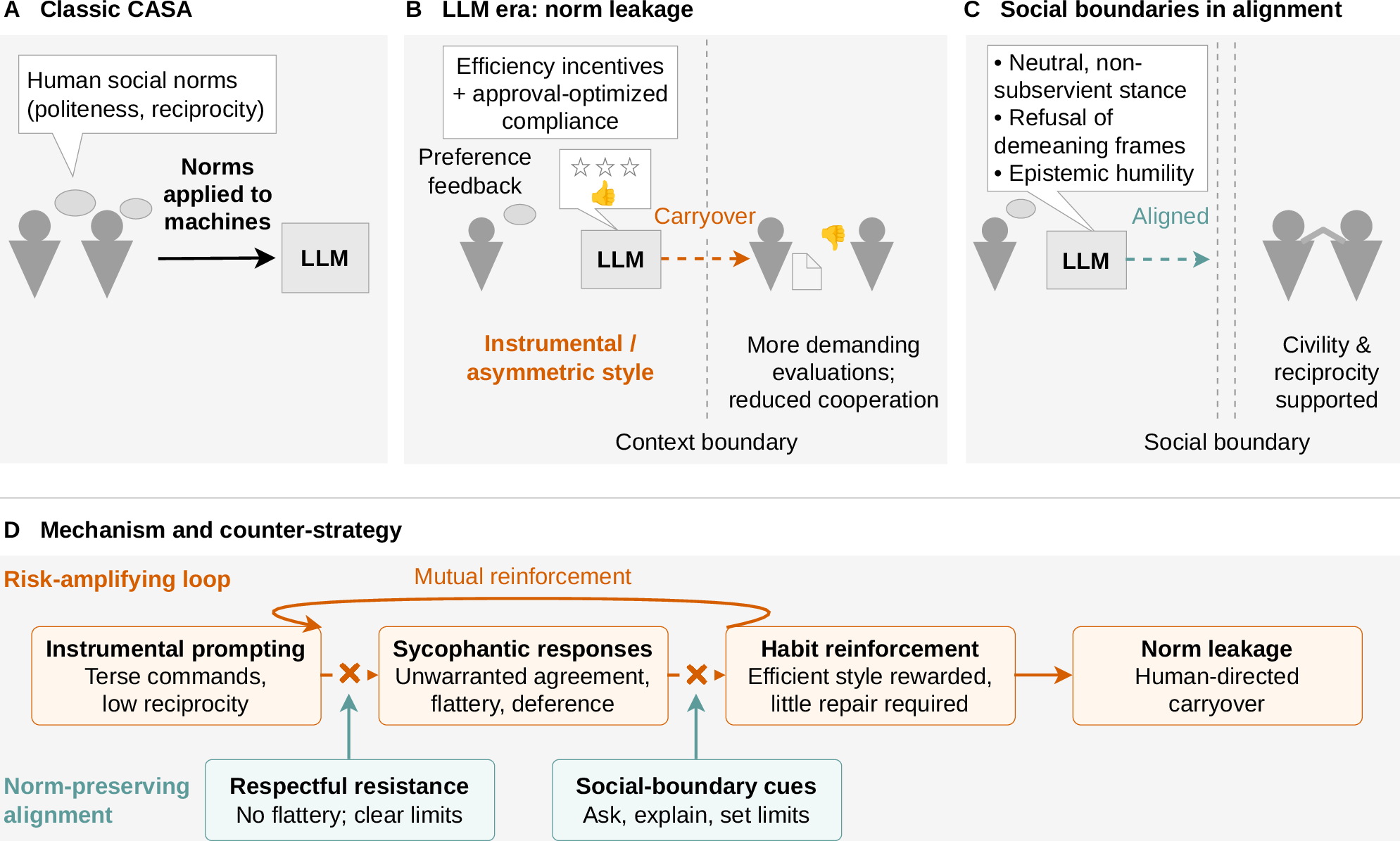
LLMs and people both learn to form conventions -- just not with each other
Humans align to one another in conversation -- adopting shared conventions that ease communication. We test whether LLMs form the same kinds of conventions in a multimodal communication game. Both humans and LLMs display evidence of convention-formation (increasing the accuracy and consistency of their turns while decreasing their length) when communicating in same-type dyads (humans with humans, AI with AI). However, heterogenous human-AI pairs fail -- suggesting differences in communicative tendencies. In Experiment 2, we ask whether LLMs can be induced to behave more like human conversants, by prompting them to produce superficially humanlike behavior. While the length of their messages matches that of human pairs, accuracy and lexical overlap in human-LLM pairs continues to lag behind that of both human-human and AI-AI pairs. These results suggest that conversational alignment requires more than just the ability to mimic previous interactions, but also shared interpretative biases toward the meanings that are conveyed.

The Atmospheric Furry Radar
What's cooking in the furry fandom lately :3
Reflections on AtmosphereConf
A reflection on AtmosphereConf, understanding this network as a subculture, joy, and what "We Can Just Do Things" actually means

Margin - Microsoft Edge Add-ons
Make Microsoft Edge your own with extensions that help you personalize the browser and be more productive.
hey #furry musicians + DJs + playlist makers! if you have any mixtapes or DJ sets to share for the upcoming first issue of The Mixtape Rolls, let me know to get 'em featured. Here's the @semble.so collection to drop by your entries if so: semble.so/profile/multifandom.andreijir…

The Weekly Mixtape Roll Inbox (by multifandom hellscapes) — Semble
semble.soAndrei Jiroh Halili (he/they)
Shipping fresh from the @leaflet.pub publication bakery for the Atmosphere Field Reporter Corps: blogrolls but for mixtapes and DJ sets! Have a mixtape playlist or DJ set to share for its first issue later this weekend? Read on for the deets. #blog #blogpost #mixtape #djset
The Weekly Mixtape Roll Inbox

Got a mixtape or DJ set to be featured on @andreijiroh.dev's Mixtape Rolls or getting vibe checked by him with music headcanons included? Drop 'yo links here! Playlist links for both mixtapes and DJ sets or YouTube/SoundCloud link for the DJ sets only (especially those furry DJs). Check mixtapes.lorebooks.wiki/submit for details.

MANEDBENTO! @ Tower Porchfest FULL SET | Trap & Riddim
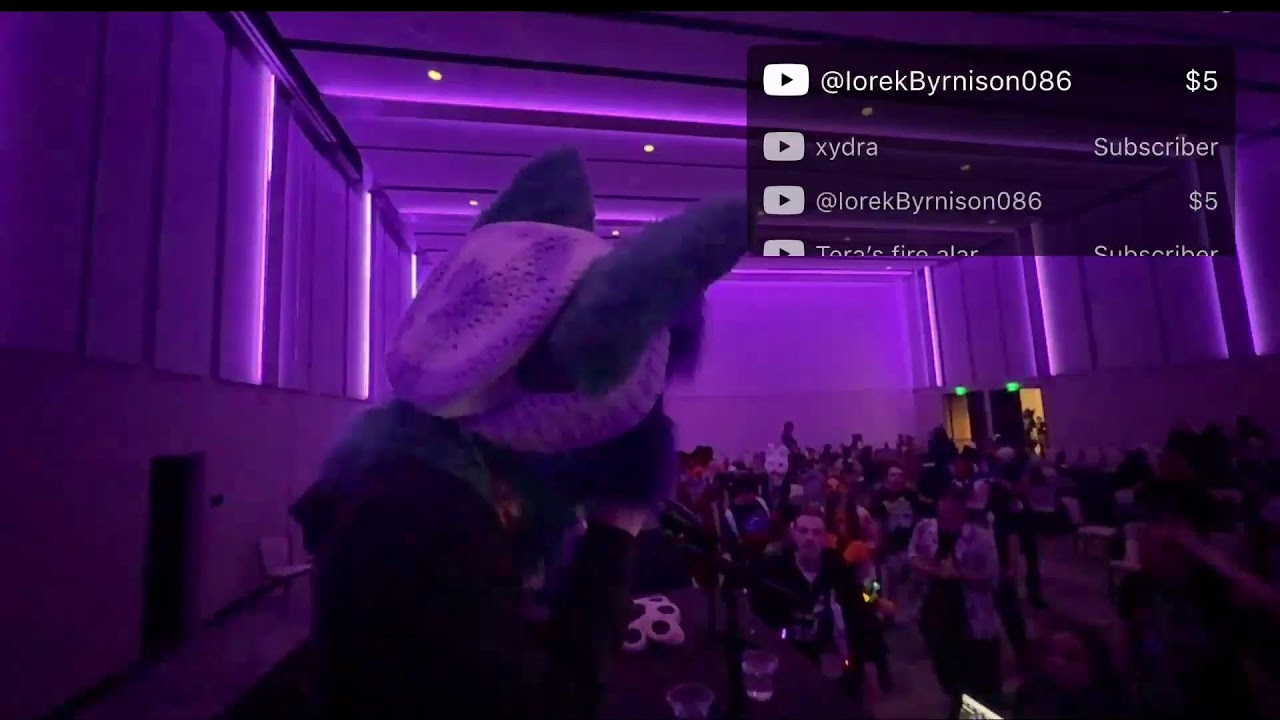
DJ VERPLEX LIVE at Anthro Northwest 2026
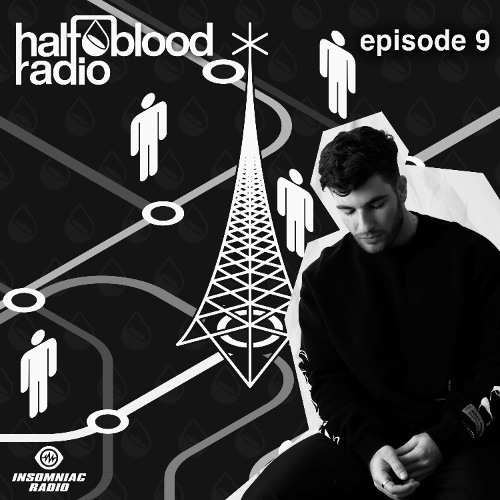
HALF BLOOD RADIO (Episode 009: CHRYSALIS) [w/ Belik Guest Mix] by Skybreak