
arcades.agency they/them “software engineer” > I want smaller computers with worse graphics made by people who are paid more to work less
arcades.agency they/them “software engineer” > I want smaller computers with worse graphics made by people who are paid more to work less

I was recommended both @ FOC August
Both physical HCI thingys
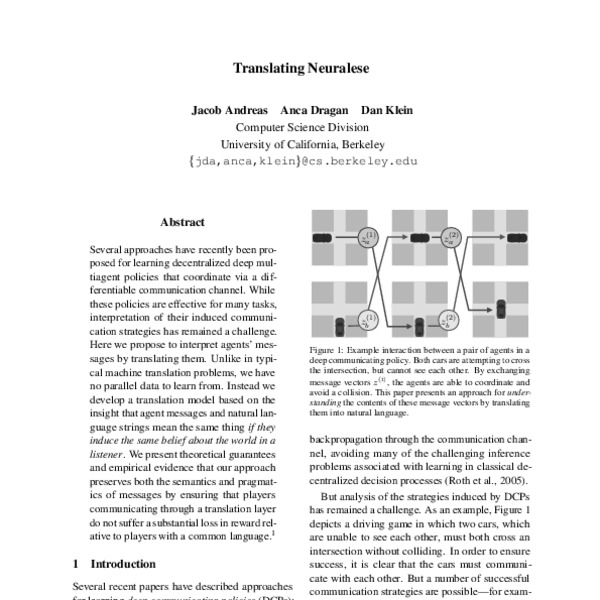
Translating Neuralese
Several approaches have recently been proposed for learning decentralized deep multiagent policies that coordinate via a differentiable communication channel. While these policies are effective for many tasks, interpretation of their induced communication strategies has remained a challenge. Here we propose to interpret agents' messages by translating them. Unlike in typical machine translation problems, we have no parallel data to learn from. Instead we develop a translation model based on the insight that agent messages and natural language strings mean the same thing if they induce the same belief about the world in a listener. We present theoretical guarantees and empirical evidence that our approach preserves both the semantics and pragmatics of messages by ensuring that players communicating through a translation layer do not suffer a substantial loss in reward relative to players with a common language.
Emergence of Grounded Compositional Language in Multi-Agent Populations
By capturing statistical patterns in large corpora, machine learning has enabled significant advances in natural language processing, including in machine translation, question answering, and sentiment analysis. However, for agents to intelligently interact with humans, simply capturing the statistical patterns is insufficient. In this paper we investigate if, and how, grounded compositional language can emerge as a means to achieve goals in multi-agent populations. Towards this end, we propose a multi-agent learning environment and learning methods that bring about emergence of a basic compositional language. This language is represented as streams of abstract discrete symbols uttered by agents over time, but nonetheless has a coherent structure that possesses a defined vocabulary and syntax. We also observe emergence of non-verbal communication such as pointing and guiding when language communication is unavailable.
Learning to Communicate with Deep Multi-Agent Reinforcement Learning
We consider the problem of multiple agents sensing and acting in environments with the goal of maximising their shared utility. In these environments, agents must learn communication protocols in order to share information that is needed to solve the tasks. By embracing deep neural networks, we are able to demonstrate end-to-end learning of protocols in complex environments inspired by communication riddles and multi-agent computer vision problems with partial observability. We propose two approaches for learning in these domains: Reinforced Inter-Agent Learning (RIAL) and Differentiable Inter-Agent Learning (DIAL). The former uses deep Q-learning, while the latter exploits the fact that, during learning, agents can backpropagate error derivatives through (noisy) communication channels. Hence, this approach uses centralised learning but decentralised execution. Our experiments introduce new environments for studying the learning of communication protocols and present a set of engineering innovations that are essential for success in these domains.
Translating Neuralese
Several approaches have recently been proposed for learning decentralized deep multiagent policies that coordinate via a differentiable communication channel. While these policies are effective for many tasks, interpretation of their induced communication strategies has remained a challenge. Here we propose to interpret agents' messages by translating them. Unlike in typical machine translation problems, we have no parallel data to learn from. Instead we develop a translation model based on the insight that agent messages and natural language strings mean the same thing if they induce the same belief about the world in a listener. We present theoretical guarantees and empirical evidence that our approach preserves both the semantics and pragmatics of messages by ensuring that players communicating through a translation layer do not suffer a substantial loss in reward relative to players with a common language.
The Heart of Spritely: Distributed Objects and Capability Security
This paper is the second in a three-part series outlining Spritely's thinking and design. The first paper, Spritely: New Foundations for Networked Communities, explains the problems which face contemporary social network design. This paper details the core technical toolbox provided by Spritely Goblins and how it supplies the necessary features to feasibly build out Spritely's broader vision. The third paper in the series, Spritely for Secure Applications and Communities, ties the first two papers together by showing how the architecture for user-facing software fulfills the vision of the first paper and can be built on top of ideas from this paper.
FOSDEM 2026 - How to level up the fediverse
The fediverse isn't done! Or, at least, that's the opinions of ActivityPub co-authors Christine Lemmer-Webber and Jessica Tallon! Discover how we could improve the fediverse with ActivityPub-compatible improvements to add more robust and secure communication/cooperation patterns, decentralized storage and identity, etc! Plus: how Spritely is starting to apply its technology towards exactly this goal, bringing Spritely's next-generation internet tech to the fediverse!

The Heart of Spritely: Distributed Objects and Capability Security
This paper is the second in a three-part series outlining Spritely's thinking and design. The first paper, Spritely: New Foundations for Networked Communities, explains the problems which face contemporary social network design. This paper details the core technical toolbox provided by Spritely Goblins and how it supplies the necessary features to feasibly build out Spritely's broader vision. The third paper in the series, Spritely for Secure Applications and Communities, ties the first two papers together by showing how the architecture for user-facing software fulfills the vision of the first paper and can be built on top of ideas from this paper.
FOSDEM 2025 - Goblins: The framework for your next project!
Building peer-to-peer decentralised applications remains difficult and error-prone. Most attempts at this either abandon collaborative features entirely or fall back on centralised architectures. The Spritely Institute is working on this challenge by creating (among other things) Goblins, a Guile framework that makes secure, fault-tolerant peer-to-peer applications accessible to developers. These tools are especially valuable for developers building secure collaborative applications that aim to foster healthy online communities. This talk walks you through Goblins’ most powerful features, including the actor model, object capability security, networking, time travel debugging, and persistence.

Plan B: an operating system for ubiquitous computing environments
The conventional approach for building pervasive environments relies on middleware to integrate different systems. Instead, we have built a system that can deal with these environments by exporting system resources through distributed virtual file systems. This requires no middleware, simplifies interoperation, and permits applying general purpose tools to any system resource. A constraint-based file system import mechanism allows the system to adapt to changes in the environment and permits users to customize the environment and tailor adaptation according to their needs. The system has been in use for over a year to carry out our daily work and is underlying the smart space that we built for our department
The Plan B OS for ubiquitous computing. Voice control, security, and terminals as case studies
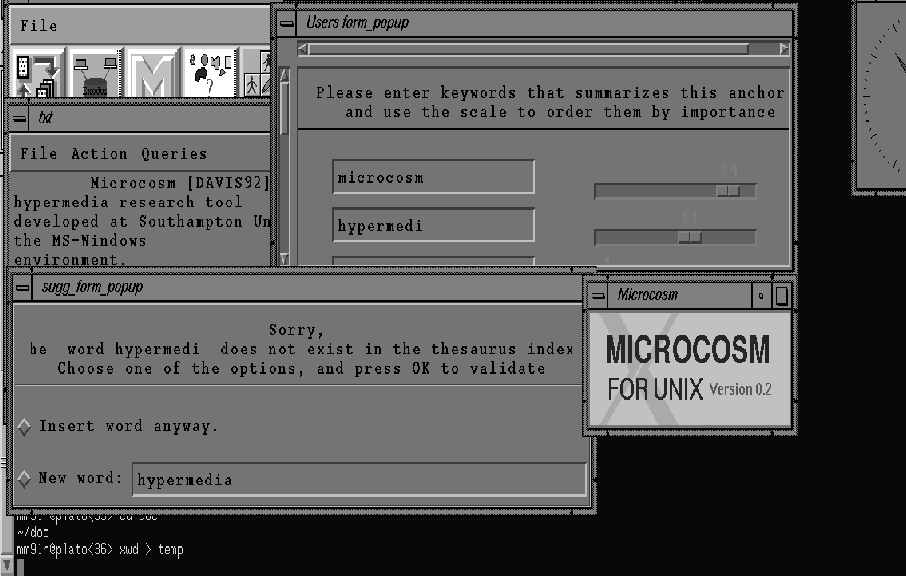
MICROCOSM: An Open Hypermedia Environment for Information Integration.
This report examines open hypermedia systems, and argues that such systems provide users with richer and more diverse ways to access and integrate information from large and dynamic data sets in a distributed, heterogeneous environment. In particular, the enhanced Microcosm model for open hypermedia is examined, and the ways in which it provides such an environment are discussed. The paper continues by investigating the advantages and the short comings of this model and identifies areas in which further work must be completed before such systems can become widely adopted, in particular the granularity of link anchors, editing, and version control. Possible solutions to these problems are presented and discussed.
Vision and Reality of Hypertext and GUIs: 2.1.13 Microcosm @mprove
Microcosm (cf. 2.1.13) is a research project at the University of Southampton. Like Intermedia five years before, Microcosm is designed around the idea that material of diverse sources and formats should be tied together into one hypertext. To achieve this goal links have to be separated from the documents. They are stored and maintained in special link databases. In contrast to Intermedia, Microcosm plays the active role in gathering the necessary data out of the documents. For each topic it stores data on which documents contain information about it and also where inside the documents the information is located. This elaborated conception of links can be seen more as a kind of Memex’ trails than simple one-to-one links. Given this structure dynamic linking becomes possible. This means that links can be associated with generic text strings. Wherever this string shows up a link is placed automatically. This has the effect that documents that are imported for the first time into Microcosm can have links immediately.
What my chess app taught me about the future of multi-user software - hadsie's blog
I was skeptical that AT Proto was anything more than Bluesky-with-extra-steps, learnt how much potential the protocol has after building a multiplayer chess app, entirely client side and "on protocol". The real value is that apps become different views into the same data.
European strategic autonomy as a double-edged sword? US perspectives in an Era of Sino-American competition
As the United States seeks to prioritise ‘competition with China’, debates have emerged about how this affects US engagements elsewhere. Europe occupies a contested role in this discussion. Traditi...

Address to the French People.
President Emmanuel Macron addressed the French people this Wednesday, March 5, at 8 p.m. from the Élysée Palace.

Address to the French People.
President Emmanuel Macron addressed the French people this Wednesday, March 5, at 8 p.m. from the Élysée Palace.
The French nuclear deterrent in a changing strategic environment | Note de la FRS | Foundation for Strategic Research | FRS
The Foundation for Strategic Research (FRS) is France's main centre of expertise on international security and defence issues.

Screen As Room: An Architectural Perspective on User Interfaces — Christoph Locher · Interaction Designer
With the use of video games as social spaces being observed for several years and the increased focus put on virtual social spaces due to the scarceness of physical social spaces in the last months, the concept of “spatial interfaces” is once again at the center of discussions. I want to add an alternative perspective to this, looking at the properties of physical spaces as metaphors, rather than models, for interfaces and exploring seven of them in more detail.
Urp: a luminous-tangible workbench for urban planning and design
In recent years, virtual reality technology has gradually attracted widespread attention from the society, because virtual reality technology could produce many scenes that humans cannot experience personally, such as diving into the deep sea or into ...

inFORM: dynamic physical affordances and constraints through shape and object actuation
We propose a new approach to Physical Telepresence, based on shared workspaces with the ability to capture and remotely render the shapes of people and objects. In this paper, we describe the concept of shape transmission, and propose interaction ...

ClearBoard: a seamless medium for shared drawing and conversation with eye contact
As part of the Digital Library's transition to Open Access, new features for researchers are available in the Premium Edition. Click here to learn more.

Urp: a luminous-tangible workbench for urban planning and design
In recent years, virtual reality technology has gradually attracted widespread attention from the society, because virtual reality technology could produce many scenes that humans cannot experience personally, such as diving into the deep sea or into ...
inFORM: dynamic physical affordances and constraints through shape and object actuation
We propose a new approach to Physical Telepresence, based on shared workspaces with the ability to capture and remotely render the shapes of people and objects. In this paper, we describe the concept of shape transmission, and propose interaction ...