
SonaSky Apollo
Make a small website that lives in your Bluesky account. No AI needed.

Webflow: The agentic web platform for modern businesses
Design, build, optimize, and rank in AI search — all in Webflow. Enterprise-grade security, CMS, hosting, and AEO built in. Trusted by over 300k teams.

Straw.Page
Straw.Page is the world's simplest website builder. Create unique websites from your mobile device.

MIRA-science/linkedopendata-at
Contribute to MIRA-science/linkedopendata-at development by creating an account on GitHub.
Metaudits
Audits of how completely research is described in DataCite, Crossref, ORCID, OpenAlex and repositories. In English, Spanish and German.
LaborTrail — The Trail of Your Blood on Circuits - a Hugging Face Space by sage-lollipop
LaborChain Model Cards for AI training labor exploitation
Full bibliography | STEEP DMAC Tracker
The search interface is made of three sections: Search, Explore, and Results. These are described in detail below.
FAIR Metadata Check (Extended): the FAIR rubric for any repository
software-metadata-tool-pipeline / software-metadata-sync-tool · GitLab
Helmholtz Codebase - GitLab

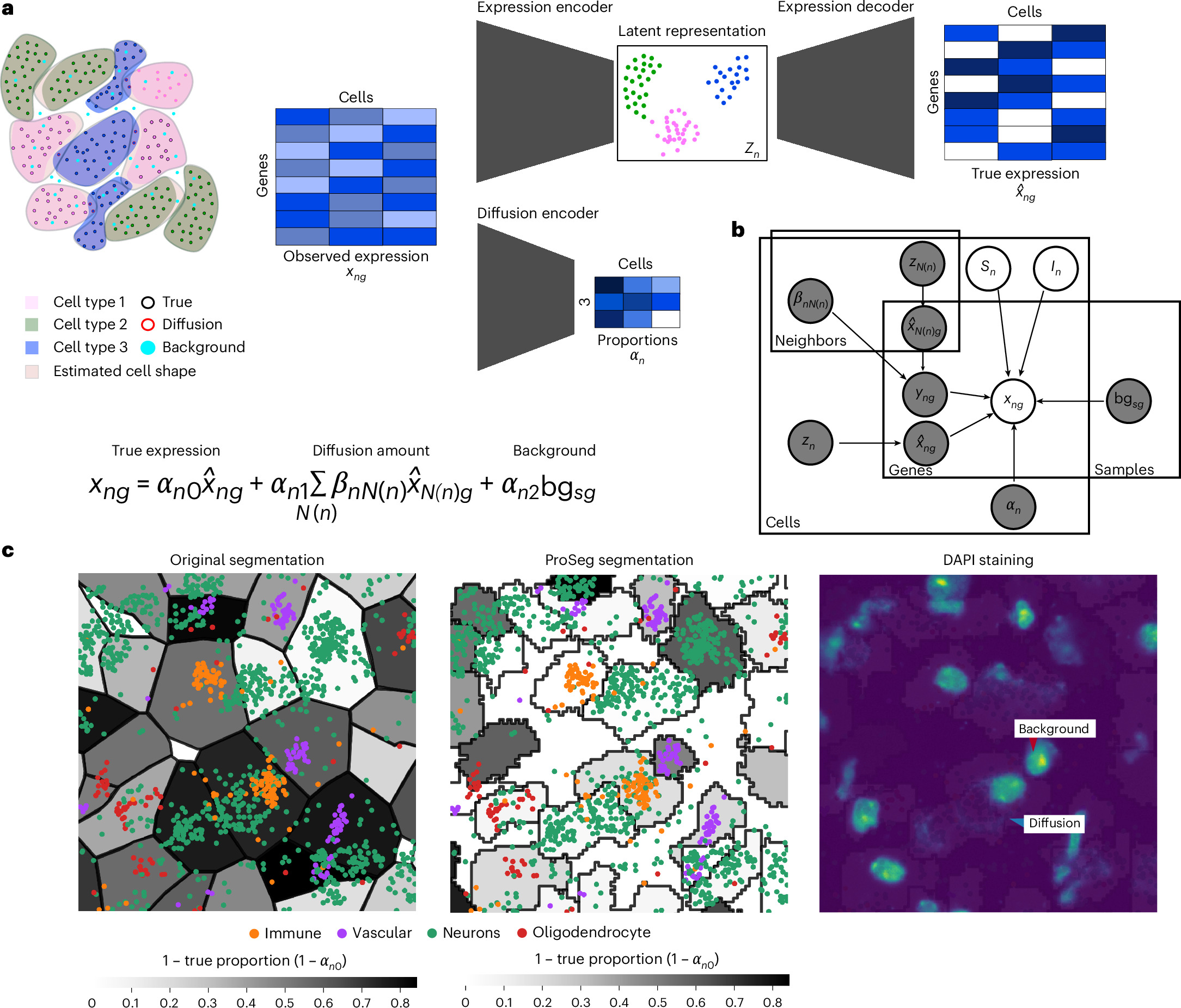
ResolVI: addressing noise and bias in spatial transcriptomics
Technologies for estimating RNA expression at high throughput, in intact tissue slices and with high spatial resolution (spatial transcriptomics) shed new light on how cells communicate and tissues function. A fundamental step in analyzing data generated by subcellular resolution spatial transcriptomics technologies is quantification, namely, segmenting the plane into regions, each approximating a cell, and then collating the molecules inside each region to estimate the cellular expression profile. Despite many advances in this area, a persistent problem is that of the incorrect assignment of molecules to cells, which limits many current applications to the level of a priori-defined cell subsets and complicates the discovery of novel cell states. Here we develop resolVI, a model that operates downstream of any segmentation algorithm to generate a probabilistic representation, correcting for the misassignment of molecules, as well as for batch effects and other nuisance factors. We demonstrate that resolVI improves our ability to distinguish between cell states, identify subtle expression changes in space and perform integrated analysis across datasets. ResolVI is available as open source software within scvi-tools.
Spatial Transcriptomics As Rasterized Image Tensors (STARIT) characterizes cell states with subcellular molecular heterogeneity
Imaging-based spatially resolved transcriptomics (imSRT) technologies provide high-throughput molecular-resolution spatial characterization of genes within cells. Conventional analysis methods to identify cell-types and states in imSRT data rely on gene count matrices derived from tallying the number of mRNA molecules detected for each gene per segmented cell, thereby overlooking subcellular heterogeneity that can be useful in defining cell states. To take advantage of the molecular-resolution information in imSRT data and potentially identify cell-states based on subcellular heterogeneity, we developed STARIT (Spatial Transcriptomics As Rasterized Image Tensors). STARIT converts transcripts within segmented cells in imSRT data into an image-based tensor representation that can be combined with deep learning computer vision models for downstream analysis. Using simulated and real imSRT data, we demonstrate that STARIT distinguishes transcriptionally distinct cell-types and further separates cell states based on subcellular transcript localization, which conventional gene count analysis fails to capture. By providing a standardized framework to encode subcellular molecular information in imSRT data, STARIT will enable deeper insights into subcellular heterogeneity and enhance the identification and characterization of cell-types and states that are overlooked by gene count representations.
Home - Scroll Press
Scroll Press: A modern HTML-native preprint server for academic research. Upload and share research manuscripts in web-native formats.
IOSP 2026: Institute of Open Science Practices (space) | nanodash
An event, a community, and a coordinating institute for the people building, using, and advancing the infrastructure open science depends on. IOSP 2026 is the third edition, held 12-15 October 2026 in Leiden: the Poortgebouw of the University of Leiden and GO FAIR host 12, 13 and 15 October, while 1…
Bycelium
Dynamical independence: Discovering emergent macroscopic processes in complex dynamical systems
We introduce a notion of emergence for macroscopic variables associated with highly multivariate microscopic dynamical processes. Dynamical independence instantiates the intuition of an emergent macroscopic process as one possessing the characteristics of a dynamical system ``in its own right,'' with its own dynamical laws distinct from those of the underlying microscopic dynamics. We quantify (departure from) dynamical independence by a transformation-invariant Shannon information-based measure of dynamical dependence. We emphasize the data-driven discovery of dynamically independent macroscopic variables, and introduce the idea of a multiscale ``emergence portrait'' for complex systems. We show how dynamical dependence may be computed explicitly for linear systems in both time and frequency domains, facilitating discovery of emergent phenomena across spatiotemporal scales, and outline application of the linear operationalization to inference of emergence portraits for neural systems from neurophysiological time-series data. We discuss dynamical independence for discrete- and continuous-time deterministic dynamics, with potential application to Hamiltonian mechanics and classical complex systems such as flocking and cellular automata.
Dynamics-informed machine learning for recovering extensive missing systems dynamics
Inevitable missing values in observational time series often hinder reliable data-driven modeling of complex systems across diverse domains. Recovery is essential yet challenging, particularly in high-dimensional systems where most variables can exhibit extensive intra-series missingness and widespread inter-variable missingness simultaneously. In this study, we introduce a dynamics-informed imputation framework, termed Full-Partial Reconstruction Mapping (FPRM). In contrast to traditional approaches that directly fit time series interdependences, the FPRM embeds intrinsic dynamical priors via state-space reconstruction and recovers multiple incomplete series by learning diffeomorphic topology between attractors from complete and incomplete data. We validate the FPRM on paradigmatic model systems (e.g., an ecology system, the ordinary Lorenz system, a coupled 120-dimensional (120D) Lorenz system, and a coupled 120D Rössler system and real-world datasets (e.g., road occupancy rate from transportation system, electroencephalogram (EEG) signals from neuroscience, exchange rates from finance, and wind speed from climate systems). Even in high-dimensional systems where only one variable is fully observed and all others suffer from extreme missingness (e.g., 90%), the FPRM enables reliable imputation of multiple incomplete variables—a task that challenges most existing approaches. This dynamics-guided framework outperforms traditional approaches, alleviating substantial data gaps and enabling robust data-driven paradigms for complex dynamical systems.

