Technocracy References
References and Revisions “Should Scientists and Engineers Run Society?” References [1] Wikipedia: “Technocracy.” [2] Academic Paper: Gunnell, John G. "The technocratic image and the theory of technocracy." Technology and culture 23.3 (1982): 392-416. [3] Academic Paper: Oh, Kyunghwan. "A non-co...
The Technological Construction of Social Power
This essay presents a theory of the role of technology in the distribution and exercise of social power. The paper studies how technical artefacts and systems are used to construct, maintain or st...

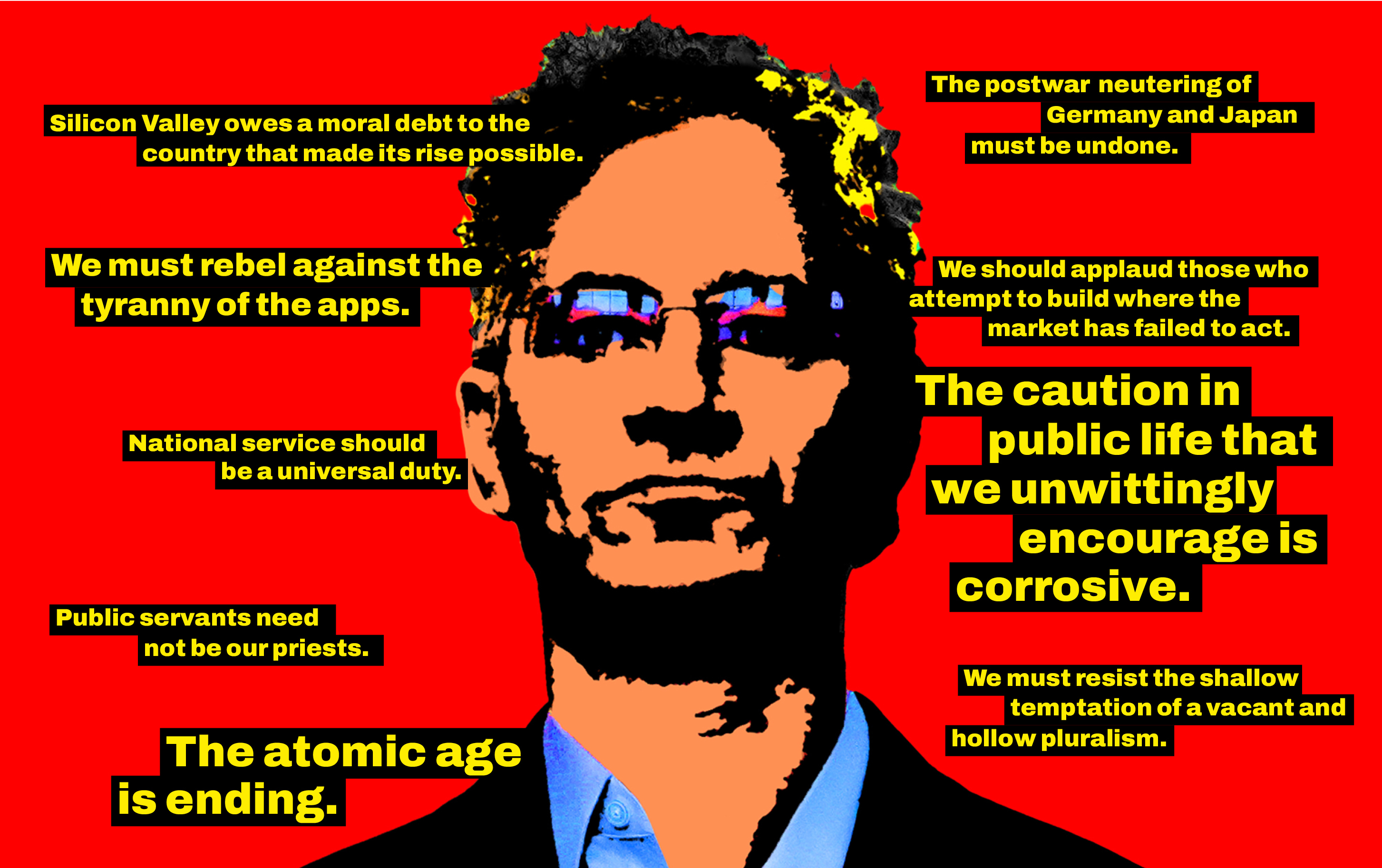
Palantir's social media manifesto is a blueprint for technofascism
The surveillance firm’s viral X post calls for hard power, conscription and the end of pluralism. AI expert and academic Mark Coeckelbergh on what happens when technology becomes the gateway to authoritarianism

Technocracy | The Paper Pilot
The Paper Pilot's digital garden of thoughts on philosophy, politics, and sociology
The Whale and the Reactor: A Search for Limits in an Age of High Technology, Second Edition
“In an age in which the inexhaustible power of scientific technology makes all things possible, it remains to be seen where we will draw the line, where we will be able to say, here are possibilities that wisdom suggest we avoid.” First published to great acclaim in 1988, Langdon Winner’s groundbreaking exploration of the political, social, and philosophical implications of technology is timelier than ever. He demonstrates that choices about the kinds of technical systems we build and use are actually choices about who we want to be and what kind of world we want to create—technical decisions are political decisions, and they involve profound choices about power, liberty, order, and justice. A seminal text in the history and philosophy of science, this new edition includes a new chapter, preface, and postscript by the author.

Technological parables and iconic illustrations: American technocracy and the rhetoric of the technological fix
This paper traces the role of American technocrats in popularizing the notion later dubbed the ‘technological fix’. Channeled by their long-term ‘chief’, Howard Scott, their claim was that technolo...

Technological Dramas - Bryan Pfaffenberger, 1992
This article examines the technological construction of political power, as well as resistance to political power, by means of an 'ideal-typical' mode...

AI, Decomputing and the Interregnum
This paper treats AI as diagnostic for the deeper changes taking place in the existing order of things. It uses AI's alignment with both the political economy and with the dualisms that underpin it, including race, gender and anthropocentrism, to highlight the nihilistic character of the current restructuring. AI's scaling and accelerationism are taken as examples of the wider tactics being invoked by hegemonic power to maintain control under changing conditions. From this perspective, the massive build-out of data centres isn't simply a seizure of energy resources but a manifestation of an aggressive and misogynist technopolitics. The paper argues that a liberal push for digital sovereignty doesn't interrupt these dynamics but plays into the hands of emerging technofascism. It proposes instead the prefigurative tactic of 'decomputing', which draws on degrowth, deautomatisation and a convivial approach to technology. It explores decomputing as a means to mitigate both material and relational harms and as a decisive turn towards infrastructuring the common good. The paper concludes that AI is the contradiction that reveals many others, not least the gap between claims to legitimacy and the actuality of destructive violence, and proposes an alternative technopolitics of reciprocity that prioritises care and sustainability.
annotations: Politique et technologie
traduction française du billet de blog "Politics and technology" de Daron Acemoglu & James Robinson
SimPolitics
For more than six decades, the public has been promised that computers will revolutionize politics, both nationally and internationally. In SimPolitics, Fenw...

Politics is the defining aspect of networked technology. AT corresponds best to the kind of institutional structure that is key to large scale democracy. AP is a better match for smaller, village-style governance, which is very valid but not the problem I care about.
Ronen Tamari
Can everyone building on atproto please answer this question? 😇

Technology is Not Values Neutral: Ending the Reign of Nihilistic Design

Cyber-Marx

‘Headed for technofascism’: the rightwing roots of Silicon Valley

📏 When machines start calling the shots

Information Civics

Data Feminism
computingwithinlimits.org

Appropriate Measures — Real Life
Appropriate Technology

Concepts of Hand and Technology

AI Science Fiction Versus Reality

The Racialization of Print

Decoding Liberation: The Promise of Free and Open Source Software

They Thought What?
quod.lib.umich.edu
part of technocracy - a limit to its power - is a structural inability to be emotionally vulnerable
Technocracy References
Encyclical Letter of His Holiness Leo XIV Magnifica Humanitas (15 May 2026)
Toward a Critical Technical Practice

Analog Resistance: Why Mechanical Simplicity Matters in an Increasingly Digital Cycling World
gandt.blogs.brynmawr.edu