Collection
The web

Updated 11d
Collection
Updated 11d
Email isn’t decentralized, and that’s fine
Email is open, but deliverability depends on a few big inbox providers. Why we traded some of email's decentralization to fight spam, and why that's fine.
Internet Histories
Publishes research into the history of the internet, from early computer networks, Usenet, mobile technology and the internet of things.
The Internet is for End Users
This document explains why the IAB believes that, when there is a conflict between the interests of end users of the Internet and other parties, IETF decisions should favor end users. It also explores how the IETF can more effectively achieve this.

When the Internet Was a Place - Front Porch Republic
Not too long ago, the internet was a place you visited. The family desktop sat in its designated closet or back office. In schools, there were rooms filled with computers blinking in tandem, waiting for your class to arrive and hop online. You had to purposefully arrive at the internet, and when done, you left […]

You Can Now Look Back at the Early Trans Internet. Yes, There Were Memes
Three years of TGForum posts were found on a CD-ROM — and uploaded for all to browse.

Law and Borders - the Rise of Law in Cyberspace
Global computer-based communications cut across territorial borders, creating a new realm of human activity and undermining the feasibility--and legitimacy--of

Axios Media Trends: 🔗 Link economy breaks
Hello! Today's Media Trends, edited by Christine Wang and copy edited by Carlin Becker, is 1,986 words, a 7½-minute read. Sign up.


LN 040: The venerable hyperlink
Decades after hyperlinks transformed humanity's information and text into a densely-linked graph, mainstream OSs have yet to afford users their benefits in personal computing.
All you need is links
When Tim Berners Lee talks about how he designed the web, he uses an analogy from physics, describing his process as a quest to find “fundamental laws” which can generate a desired system:

A Short History Of The Internet
I am not by any measure old unless you ask my nieces, but I remember when we had no internet and my niece's minds boggle at that, they think I must be ancient. How could you survive without the internet they asked me, in their minds the concept of no internet is pretty much science fiction and the thought of not having internet access scares them.

Commercial Internet eXchange
The Commercial Internet eXchange (CIX) was an early interexchange point that allowed the free exchange of TCP/IP traffic, including commercial traffic, between Internet service providers (ISPs). It was an important initial effort toward creating the commercial Internet that we know today.
CERN70: Where the Web was born…
In 1989, Tim Berners-Lee, a young scientist working at CERN, wrote a proposal for an information management system based on the Internet. At the time, few people really understood the significance of his seemingly abstract idea. Luckily, however, his supervisor and a few colleagues had the foresight to let him work on an invention that would change the world.

Could the Web Have Been Created in Yoruba Land?
If Not This... by lola odelola_ Issue #1 Could the Web Have Been Created in Yoruba Land? “Universal access to a large universe of documents” What if the web was created in 1980s Lagos, Nigeria within markets as a way for vendors to share and access wholesale produce prices? Or what if it was c...

Could the Web Have Been Created in Yoruba Land?
If Not This... by lola odelola_ Issue #1 Could the Web Have Been Created in Yoruba Land? “Universal access to a large universe of documents” What if the web was created in 1980s Lagos, Nigeria within markets as a way for vendors to share and access wholesale produce prices? Or what if it was c...
Disaster, doubt, and the origins of hypertext
Hypertext and the World Wide Web are built on a complex network of ideas that originate in the military and ecological disasters of the short 20 th Century, 1914--1989, and in a world-spanning intellectual effort to prevent their recurrence. Though that effort now appears to have failed, and though the tragic story of the 20 th Century has not, it seems, concluded, we may learn profit by examining the concepts and ideals on which hypertext was built.
What just happened to TheNumbers.com should worry us all
If you work in or around the film industry, there is a decent chance you have used the work of The Numbers this month, whether you realise it or not.
Vision and Reality of Hypertext and GUIs: 2.1.13 Microcosm @mprove
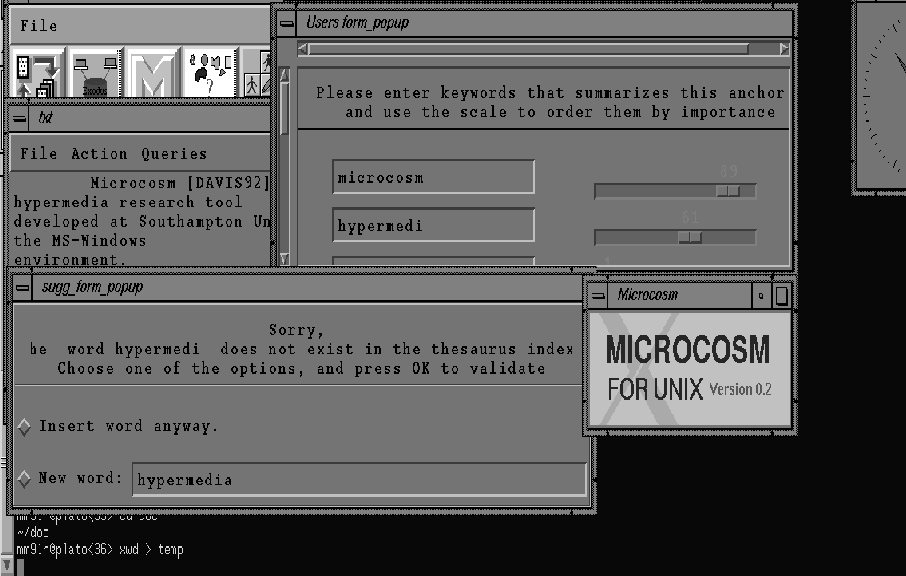
Microcosm (cf. 2.1.13) is a research project at the University of Southampton. Like Intermedia five years before, Microcosm is designed around the idea that material of diverse sources and formats should be tied together into one hypertext. To achieve this goal links have to be separated from the documents. They are stored and maintained in special link databases. In contrast to Intermedia, Microcosm plays the active role in gathering the necessary data out of the documents. For each topic it stores data on which documents contain information about it and also where inside the documents the information is located. This elaborated conception of links can be seen more as a kind of Memex’ trails than simple one-to-one links. Given this structure dynamic linking becomes possible. This means that links can be associated with generic text strings. Wherever this string shows up a link is placed automatically. This has the effect that documents that are imported for the first time into Microcosm can have links immediately.