beaker/archive-notice.md at master · beakerbrowser/beaker
An experimental peer-to-peer Web browser. Contribute to beakerbrowser/beaker development by creating an account on GitHub.
beaker/archive-notice.md at master · beakerbrowser/beaker
An experimental peer-to-peer Web browser. Contribute to beakerbrowser/beaker development by creating an account on GitHub.
Online Governance Surfaces and Attention Economies
This paper considers the intersection of governance and attention in digital contexts. In particular, it argues for the relevance of ‘attention economies’, or the analysis of human attention as a resource, to ‘governance surfaces’, or the means available for organisational adaptation and action. Existing theoretical frameworks for the governance of community-managed resources lack adequate consideration for how people’s attention is engaged and directed. To address this gap, this paper proposes heuristics that assess how attention relates to governance in online organisations. The heuristics are informed by literature on attention economies and governance, as well as three case studies that consider recent attempts to address attention in the design of governance surfaces in blockchain-based systems. The resulting heuristics serve as analytical and normative tools to enable researchers and system designers to better understand attention in a governance system. They invite consideration of whether the structure of attention in a system is appropriate, efficient, and just.
EFFecting Change: How to Build a Decentralized Web That Truly Works for All
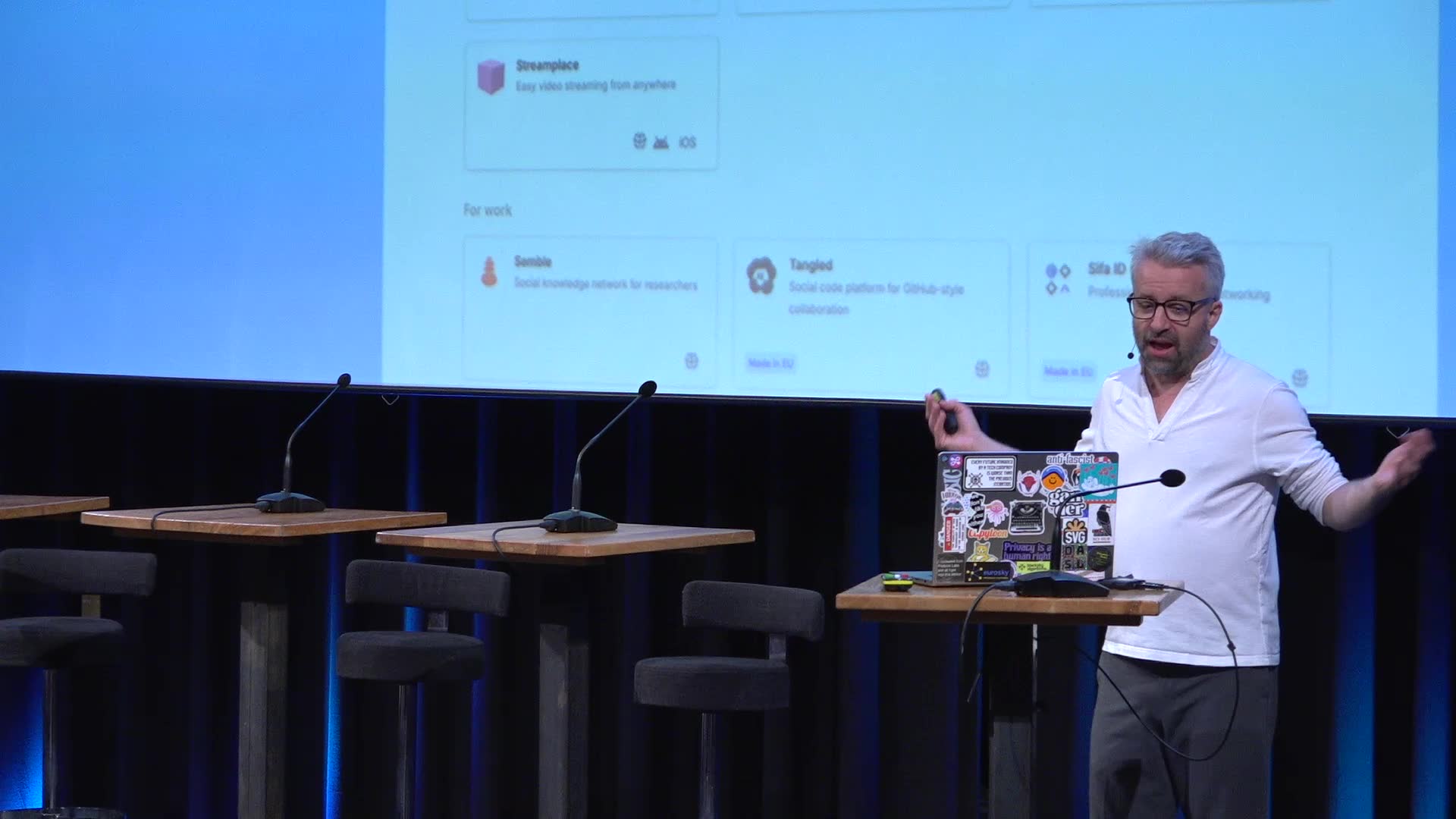
We Build On Hope @ PublicSpaces Conference 2026
Keynote by Robin Berjon The current state of tech can feel disheartening. Years of critical analysis and reform efforts have left us with a digital sphere that seems worse than ever. In Europe, our...
Information Civics
An exploration of computer-network architectures as civic structures.

Beyond Horseless Carriages: Building Communities for the Decentralized Era, Rudy Fraser
Imagine This: A Web Without Servers - Tara Vancil - JSConf EU 2018
A Sapphirepunk Manifesto
The Debate Over DWeb vs. Web3 & The Decentralized Elephant in the Room | FFDW
Comparing DWeb and Web3's approaches to decentralization, focusing on the key question: who designs, controls, and benefits from these technologies?

Collection

Updated 28d
Every network starts centralized

mcc
I saw Tim Berners-Lee's NeXT box when I visited CERN and what blows my mind is the faded torn sticker saying "This machine is a server DO NOT POWER IT DOWN". There was some point in time that was the only web server on Earth. "Do NOT turn this computer off the World Wide Web is on it"