Architecture and the Internet: Designing places in cyberspace
Cyberspace, as the information space is called, has become accessible in the past decade through the World Wide Web. And although it can only be experienced through the mediation of computers, it is quickly becoming an alternative stage for everyday economic, cultural, and other human activities. As such, there is a potential and a need to design it according to place–like principles. Making places for human inhabitation is, of course, what architects, landscape architects, and town planners have been doing in physical space for thousands of years. It is curious, therefore, that Cyberspace designers have not capitalized on the theories, experiences, and practices that have been guiding physical place–making. While most 3D environments closely mimic physical spaces, they are, by and large, devoid of the essential characteristics that differentiate a ‘place’ from mere ‘space.’ And only rarely are they sensitive to, and take advantage of, the peculiarities of Cyberspace. We believe that this state of affairs is temporary, characteristic of early adoption stages of new technologies. As the Web matures, and as it assumes more fully its role as a destination rather than as means of communication, there will be a growing need to design it according to place–making principles. By looking at physical architecture as a case study and metaphor for organizing space into meaningful places, this paper explores the possibility of organizing Cyberspace into spatial settings that not only afford social interaction, but, like physical places, also embody and express cultural values. At the same time, because Cyberspace lacks materiality, is free from physical constraints, and because it can only be ‘inhabited’ by proxy, these ‘places’ may not necessarily resemble their physical counterparts.
Thoughts on Cyberpositionality: The Construction of Digital Communities in Digital Spaces, Damien Patrick Williams
I found Rebecca Monteleone, Martin Perez Comisso, and Elma Hajric’s “Cyberpositionality: Sociotechnical Location in the Digital Age” (2024) to be an extremely timely and important article which can…

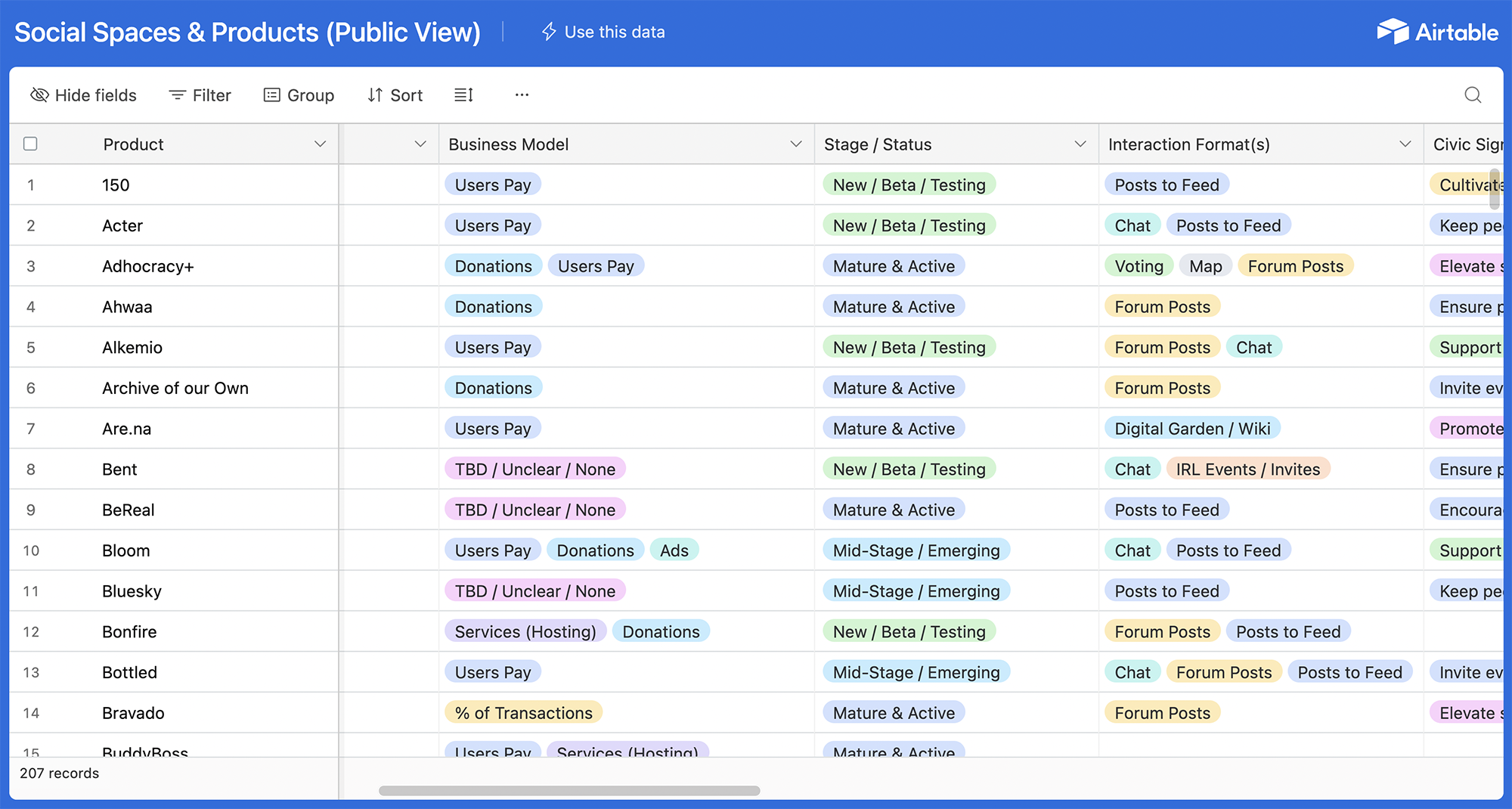
Digital Spaces Directory | New_ Public
As the social media landscape changes and a new wave of digital spaces emerges, this Directory is meant to be a resource for our field — a jumping-off-point for further exploration and research for anyone who’s interested in studying, building, stewarding, or simply using digital social platforms. We hope this will inspire creative exploration, spark new collaborations, and highlight important progress.

Digital Degrowth: Radically Rethinking our Digital Futures
We are fast approaching the point of “peak digital”, with the continued mass production and excessive consumption of digital technologies set to become a key driver of climate crisis, ecological breakdown and ongoing societal instability.<br /> <br /><i>Digital Degrowth</i> is a call to completely rethink our digital futures in these fast-changing times. It explores how degrowth thinking and alternate forms of “radically sustainable computing” might support ambitions of sustainable, scaled-down and equitable ways of living with digital technologies. Neil Selwyn proposes a rebalancing of digital technology use: digital degrowth is not a call for simply making reduced use of the digital technologies that we already have – rather it is an argument to reimagine digital practices that maximise societal benefits with minimal environmental and social impact. Drawing on illustrative examples from across computer science, hacker and environmental activist communities, this book examines how core degrowth principles of conviviality, autonomy and care are already being used to reimagine alternate forms of digital technology.<br /> <br />Original and stimulating, this is essential reading for students and scholars of media and communication, sustainability studies, political ecology, computer/data sciences, and across the social sciences.

Everything is miscellaneous : the power of the new digital disorder
Includes bibliographical references (p. [235]-257) and index; Prologue : information in space -- The new order of order -- Alphabetization and its discontents -- The geography of knowledge -- Lumps and splits -- The laws of the jungle -- Smart leaves -- Social knowing -- What nothing says -- Messiness as a virtue -- The work of knowledge -- Coda : misc; Philosopher Weinberger shows how the digital revolution is radically changing the way we make sense of our lives. Human beings constantly collect, label, and organize data--but today, the shift from the physical to the digital is mixing, burning, and ripping our lives apart. In the past, everything had its one place--the physical world demanded it--but now everything has its places: multiple categories, multiple shelves. Everything is suddenly miscellaneous. Weinberger charts the new principles of digital order that are remaking business, education, politics, science, and culture. He examines how Rand McNally decides what information not to include in a physical map (and why Google Earth is winning that battle), how Staples stores emulate online shopping to increase sales, why your children's teachers will stop having them memorize facts, and how the shift to digital music stands as the model for the future.--From publisher description; From A to Z, Everything Is Miscellaneous will completely reshape the way you think - and what you know - about the world. Includes information on alphabetical order, Amaxon.com, animals, Aristotle, authority, Bettmann Archive, blogs (weblogs), books, broadcasting, British Broadcasting Corporation (BBC), business, card catalog, categories and categorization, clusters, companies, Colon Classification, conversation, Melvil Dewey, Dewey Decimal Classification system, Encyclopaedia Britannica, encyclopedia, essentialism, experts, faceted classification system, first order of order, Flickr.com, Google, Great Books of the Western World, ancient Greeks, health and medical information, identifiers, index, inventory tracking, knowledge, labels, leaf and leaves, libraries, Library of Congress, links, Carolus Linnaeus, lumping and splitting, maps and mapping, marketing, meaning, metadata, multiple listing services (MLS), names of people, neutrality or neutral point of view, New York Public Library, Online Computer Library Center (OCLC), order and organization, people, physical space, everything having place, Plato, race, S.R. Ranganathan, Eleanor Rosch, Joshua Schacter, science, second order of order, simplicity, social constructivism, social knowledge, social networks, sorting, species, standardization, tags, taxonomies, third order of roder, topical categorization, tree, Uniform Product Code (UPC), users, Jimmy Wales, web, Wikipedia, etc

Digitalization
Abstract “Digitization” and “digitalization” are two conceptual terms that are closely associated and often used interchangeably in a broad range of literatures. This entry considers each term in detail and argues that there is analytical value in explicitly making a clear distinction between them. The entry defines digitization as the material process of converting analog streams of information into digital bits. It defines digitalization as the way many domains of social life are restructured around digital communication and media infrastructures.
Home - Industrialised Construction
Industrialised Construction explores both the physical and digital dimensions of construction, covering innovations in platform-based design, kits of parts, design for manufacture and assembly (DfMA) and offsite production, as well as emerging digital capabilities including robotics, augmented and virtual reality, automation, data-driven tools, connectivity and the Internet of Things.

Screen As Room: An Architectural Perspective on User Interfaces — Christoph Locher · Interaction Designer
With the use of video games as social spaces being observed for several years and the increased focus put on virtual social spaces due to the scarceness of physical social spaces in the last months, the concept of “spatial interfaces” is once again at the center of discussions. I want to add an alternative perspective to this, looking at the properties of physical spaces as metaphors, rather than models, for interfaces and exploring seven of them in more detail.
Screen As Room: An Architectural Perspective on User Interfaces — Christoph Locher · Interaction Designer
With the use of video games as social spaces being observed for several years and the increased focus put on virtual social spaces due to the scarceness of physical social spaces in the last months, the concept of “spatial interfaces” is once again at the center of discussions. I want to add an alternative perspective to this, looking at the properties of physical spaces as metaphors, rather than models, for interfaces and exploring seven of them in more detail.
Making Space for a Handmade Web | Figma Blog
There’s a resurgence of small, handcrafted sites challenging the current trajectory of the internet. Joining the movement is as simple as making your own.

Resonite
A novel digital universe with infinite possibilities. Whether you resonate with people around the world in a casual conversation, playing games and socializing. Or you riff off each other when creating anything from art to programming complex games, you'll find your place here.
Post Artifact Books and Publishing
How does digital affect publishing spaces? How do we talk about these effects?
Beyond Digital Exhaust: Reclaiming Agency in the Context Economy - A MozFest Discussion on Personal Context Infrastructure and the Future of AI
At this year's MozFest in Barcelona, we convened an urgent conversation about what may be the defining struggle of our digital future: who will control the vast
Digital Topology & Economic Power
The autonomous file, once the basic unit of user agency in personal computing, was first hollowed out through proprietary formats and data internalization, then abolished entirely by cloud platforms, relocating control toward incumbents at each stage. Enclosure succeeds not by offering users less, but by bundling genuine capability gains with topological restructuring, so that the user cannot accept the improvement without accepting the new relationship of power.


Techno-capitalism, Crisis Epistemology, and Disaster Ableism: How (not) to Respond to Generative AI in Higher education (My presentation @ #PhiDisSocCh6)
CSDL | IEEE Computer Society
Operation Voder: AT&T, Bell Labs, and the Labor of Techno-Utopia at the 1939 New York World’s Fair
Weizenbaum examines computers and society - The Tech

The Folly of Technological Solutionism: An Interview with Evgeny Morozov - Public Books
Encyclical Letter of His Holiness Leo XIV Magnifica Humanitas (15 May 2026)