Internet Archive: Digital Library of Free & Borrowable Texts, Movies, Music & Wayback Machine
Computer: A History of the Information Machine
Computer: A History of the Information Machine is a history of computing written by Martin Campbell-Kelly and William Aspray first published in 1996. It follows the history of "information machines" from Charles Babbage's difference engine through Herman Hollerith's tabulating machines to the invention of the modern electronic digital computer. A revised 2nd edition published in 2004 included new material on the Internet and World Wide Web, while the updated 3rd edition published in 2013 includes contributions from historians Nathan Ensmenger and Jeffrey Yost. The 3rd edition extends the story to include recent phenomena such as social networking and revises the discussion of early history to reflect new insights from the literature.
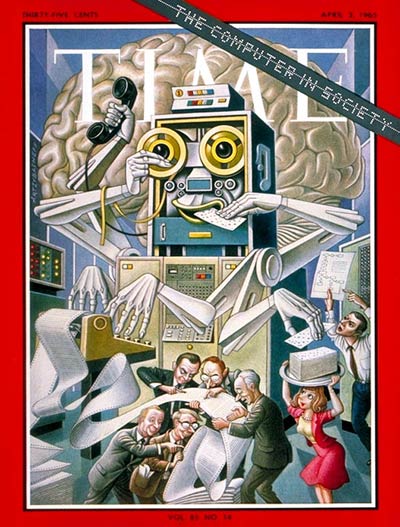
TIME Magazine Cover: Computer in Society - Apr. 2, 1965
TIME Magazine Cover: Computer in Society

Illustration of Harvard Mark III | Mastering the Game | Computer History Museum
Executive of the Future
Image depicts an anthropomorphic computer with a face and multiple arms; the machine is typing and pushing buttons on a control panel. The image was published in Artzy …

Put That There
The office of the Professional
A Common Sense Guide to Selection Of A Computer System
A vast amount of computer equipment is being dumped on the Australian landscape. The glossy advertisements illustrate microcomputers everywhere. Hurtling through space. Nestled on the moon's surface. Artfully sharp in a 21st century space home. Peering out from foliage in a contrived jungle setting. Just occasionally they are even depicted in a practical business environment. How does a business person with little appreciation of this new technology go about rationally deciding what is for the best?Is a computer necessary?How should it be evaluated? Is one ‘system’ as good as another? What are the pitfalls? How is a Selection criteria established? The task of selecting an appropriate computer system from the plethora of possibilities is not easy, but it need not be prohibitive. What is needed is common sense information. UnderstandableandobjectiveanswerstothemanyquestionsyounodoubthaveareprovidedinthisCommon Sense Guide to the Selection of aComputer System!

Commercial Internet eXchange
The Commercial Internet eXchange (CIX) was an early interexchange point that allowed the free exchange of TCP/IP traffic, including commercial traffic, between Internet service providers (ISPs). It was an important initial effort toward creating the commercial Internet that we know today.
Why ATMs didn’t kill bank teller jobs, but the iPhone did
There's a lot more to replacing labor than just automating tasks

Disaster, doubt, and the origins of hypertext
Hypertext and the World Wide Web are built on a complex network of ideas that originate in the military and ecological disasters of the short 20 th Century, 1914--1989, and in a world-spanning intellectual effort to prevent their recurrence. Though that effort now appears to have failed, and though the tragic story of the 20 th Century has not, it seems, concluded, we may learn profit by examining the concepts and ideals on which hypertext was built.

CSDL | IEEE Computer Society
Operation Voder: AT&T, Bell Labs, and the Labor of Techno-Utopia at the 1939 New York World’s Fair
This article explores the labor demands of the Voder, the electrical speech synthesis machine developed by Bell Labs for AT&T’s 1939 New York World’s Fair exhibit. The article situates the Voder within the historical context of the fair, with the United States emerging from the Great Depression and political tensions escalating across the globe. By examining the decision to incorporate the machine’s young female operators into the exhibit, the article argues that AT&T executives used Voder operators to normalize a new vision of technological utopia that relied heavily and conspicuously on the infrastructural labor of women. Moreover, the article highlights the previously unacknowledged engineering contributions of Voder operators in the years before the fair, writing women into the origin story of a machine that laid critical groundwork for speech recognition and voice encryption technology.

f0lkl0r3.dev — Computer History Museum Oral Histories
The people who built the future, in their own words. Oral history interviews from the Computer History Museum, enriched with AI-generated context, visuals, and connections.