Collection
Protocol Meta

Updated 2mo
Collection
Updated 2mo
The Purpose of Protocols
Every open social protocol generates shared resources, but none has produced a governance framework adequate to those resources. So who fills that vacuum?

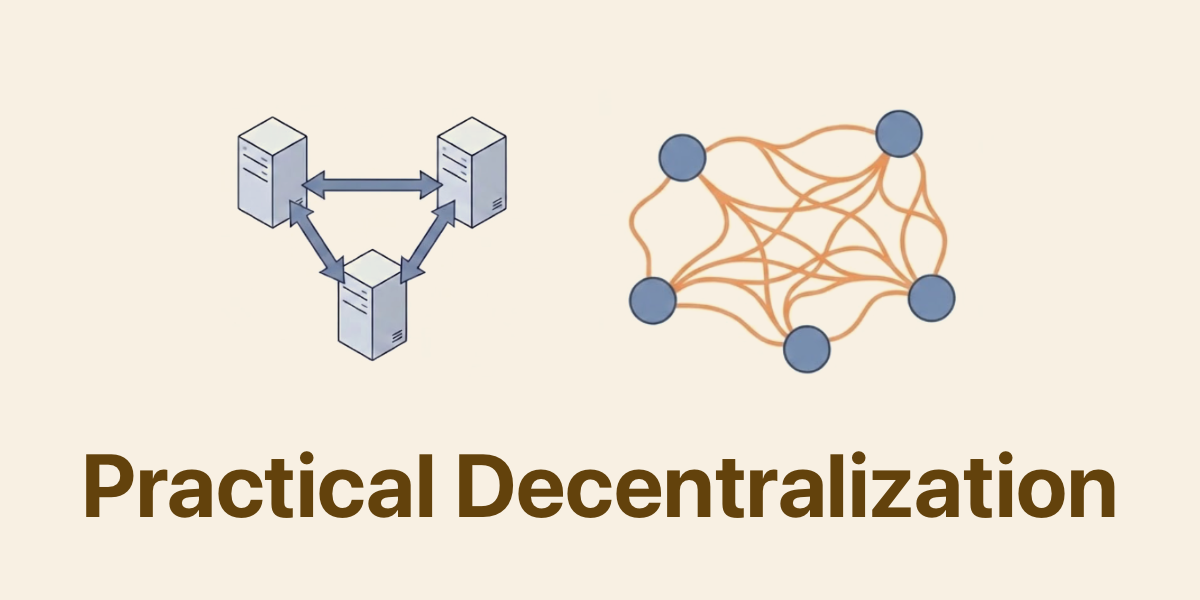
Practical Decentralization
The point of decentralization is to guarantee the rights of individuals and communities on the Internet. Pulling that off is a balancing act between practicality and ideology.
The Unreasonable Sufficiency of Protocols Web
The Unreasonable Sufficiency of Protocols Venkatesh Rao, Tim Beiko, Danny Ryan, Josh Stark, Trent Van Epps, and Bastian Aue 1. Introduction Complex coordination problems have an air of doomed intractability about them. We speak in fatalistic terms of economics being a “dismal” science, of sociological phenomena being dominated by the

Dangerous Protocols - Summer of Protocols
Protocols are frequently touted as the liberating alternative to walled technological gardens, but the historical purpose of protocols has always been to simplify decision-making and reduce human agency. How do we reconcile these two narratives? I explore the dangerous side of protocols, and how their ability to drive coordination means they also have

Protocols, Not Platforms: A Technological Approach to Free Speech
What is clear is that there is no simple solution to these challenges, and most of the ones that are normally presented tend not to deal with the reality of the problems or to understand the technical and societal challenges that likely make them impossible.

Composability with other tools
Interoperability, exchange, and composition are some of my primary motivations for building Subconscious. Why isn’t interoperability more common between tools for thought? Why is it that most of our tools are silos? How did we get here?

Redecentralization
A thought experiment! Let's reimagine the web with r-selected thinking.

All you need is links
When Tim Berners Lee talks about how he designed the web, he uses an analogy from physics, describing his process as a quest to find “fundamental laws” which can generate a desired system:

Decentralization enables permissionless innovation
I’ve just started reading Inventing the Internet by Janet Abbate. The opening chapters are great, narrating Paul Baran’s efforts at RAND to design a nationwide communication network. Baran had one design goal for this network—survivability. Specifically, survivability in the face of nuclear catastrophe.

Don't fork the ecosystem
Software can be rebuilt, because software is a machine. But a software ecosystem is not a machine. It is a living system.
Layered protocols
Layering is a special form of modularity that restricts interactions between modules. A module assigned to a layer can use any of the modules in the same or in a lower layer; however, it cannot use a module belonging to a higher layer.


“Are Protocols Elite?” in Rythms – Writings and rehearsals by Nathan Schneider
For a taste of what I’ve been working on this season, I have a new, tiny-little essay in the in-house journal of our Center for Media, Religion, and Culture, Rhythms: “Are Protocols Elite?” Based on a collab with Avery Edenfield. https://www.colorado.edu/cmrc/2025/11/06/rhythms-fall-2025-counter-media

Protocol: How Control Exists after Decentralization
How Control Exists after DecentralizationIs the Internet a vast arena of unrestricted communication and freely exchanged information or a regulated, highly