Cognitive Architectures for Language Agents
Recent efforts have augmented large language models (LLMs) with external resources (e.g., the Internet) or internal control flows (e.g., prompt chaining) for tasks requiring grounding or reasoning, leading to a new class of language agents. While these agents have achieved substantial empirical success, we lack a framework to organize existing agents and plan future developments. In this paper, we draw on the rich history of cognitive science and symbolic artificial intelligence to propose Cognitive Architectures for Language Agents (CoALA). CoALA describes a language agent with modular memory components, a structured action space to interact with internal memory and external environments, and a generalized decision-making process to choose actions. We use CoALA to retrospectively survey and organize a large body of recent work, and prospectively identify actionable directions towards more capable agents. Taken together, CoALA contextualizes today’s language agents within the broader history of AI and outlines a path towards language-based general intelligence.
Thinking—Fast, Slow, and Artificial: How AI is Reshaping Human Reasoning and the Rise of Cognitive Surrender
People increasingly consult generative artificial intelligence (AI) while reasoning. As AI becomes embedded in daily thought, what becomes of human judgment? We
Warnings for pattern matching
We examine the ML pattern-matching anomalies of useless clauses and non-exhaustive matches. We state the definition of these anomalies, building upon pattern matching semantics, and propose a simple algorithm to detect them. We have integrated the algorithm in the Objective Caml compiler, but we show that the same algorithm is also usable in a non-strict language such as Haskell. Or-patterns are considered for both strict and non-strict languages.

Retrieval-Augmented Code Generation: A Survey with Focus on Repository-Level Approaches
Recent advancements in large language models (LLMs) have substantially improved automated code generation. While function-level and file-level generation have achieved promising results, real-world software development typically requires reasoning across entire repositories. This gives rise to the challenging task of Repository-Level Code Generation (RLCG), where models must capture long-range dependencies, ensure global semantic consistency, and generate coherent code spanning multiple files or modules. To address these challenges, Retrieval-Augmented Generation (RAG) has emerged as a powerful paradigm that integrates external retrieval mechanisms with LLMs, enhancing context-awareness and scalability. In this survey, we provide a comprehensive review of research on Retrieval-Augmented Code Generation (RACG), with an emphasis on repository-level approaches. We categorize existing work along several dimensions, including generation strategies, retrieval modalities, model architectures, training paradigms, and evaluation protocols. Furthermore, we summarize widely used datasets and benchmarks, analyze current limitations, and outline key challenges and opportunities for future research. Our goal is to establish a unified analytical framework for understanding this rapidly evolving field and to inspire continued progress in AI-powered software engineering.
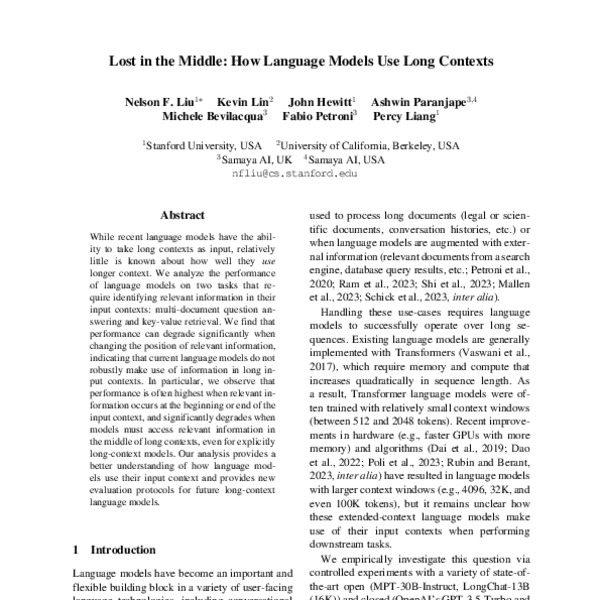
Lost in the Middle: How Language Models Use Long Contexts
While recent language models have the ability to take long contexts as input, relatively little is known about how well they use longer context. We analyze the performance of language models on two tasks that require identifying relevant information in their input contexts: multi-document question answering and key-value retrieval. We find that performance can degrade significantly when changing the position of relevant information, indicating that current language models do not robustly make use of information in long input contexts. In particular, we observe that performance is often highest when relevant information occurs at the beginning or end of the input context, and significantly degrades when models must access relevant information in the middle of long contexts, even for explicitly long-context models. Our analysis provides a better understanding of how language models use their input context and provides new evaluation protocols for future long-context language models.
TDOP Pratt
Work reported herein was supported in part at Stanford by the National Science Foundation under grant no GJ 992, and the Office of Naval Research under grant number N-00014-67-A-Oll2-0057 NR 044-402; by IBM under a post-doctoral fellowship at Stanford; by the IBM T.J. Watson Research Center, Yorktown Heights, N.Y.; and by Project MAC, an MIT research program sponsored by the Advanced Research Projects Agency, Department of Defense, under Office of Naval Research Contract Number N000l4-70-O362-0006 and the National Science Foundation under contract number GJO0-4327. Reproduction in whole or in part is permitted for any purpose of the United States Government.
EmbeddingGemma: Powerful and Lightweight Text Representations
We introduce EmbeddingGemma, a new lightweight, open text embedding model based on the Gemma 3 language model family. Our innovative training recipe strategically captures knowledge from larger models via encoder-decoder initialization and geometric embedding distillation. We improve model robustness and expressiveness with a spread-out regularizer, and ensure generalizability by merging checkpoints from varied, optimized mixtures. Evaluated on the Massive Text Embedding Benchmark (MTEB) across multilingual, English, and code domains, EmbeddingGemma (300M) achieves state-of-the-art results. Notably, it outperforms prior top models, both proprietary and open, with fewer than 500M parameters, and provides performance comparable to models double its size, offering an exceptional performance-to-cost ratio. Remarkably, this lead persists when quantizing model weights or truncating embedding outputs. This makes EmbeddingGemma particularly well-suited for low-latency and high-throughput use cases such as on-device applications. We provide ablation studies exploring our key design choices. We release EmbeddingGemma to the community to promote further research.

OSF
Building reliable sim driving agents by scaling self-play
Simulation agents are essential for designing and testing systems that interact with humans, such as autonomous vehicles (AVs). These agents serve various purposes, from benchmarking AV...

Magic: The Gathering is Turing Complete
$\textit{Magic: The Gathering}$ is a popular and famously complicated trading card game about magical combat. In this paper we show that optimal play in real-world $\textit{Magic}$ is at least as...

Understanding Artificial Neural Networks: Mysterianism about Known Mechanism is Mysticism
Mysterianism is the idea that human cognition, mind, cannot be understood. Taking this concept and applying it to known mechanism — such that claims are made that we do not know how engineered systems, such as artificial neural networks (ANNs), work, or that they constitute black boxes that we can only open with difficulty — is inappropriate at best and malicious at worst. We do know the mechanistic structure of such models because we designed and built them. We also do know their functional role (what they are for) as well as the mathematical function they are asked to approximate (map inputs to target outputs). Because mysterianist beliefs about known systems, such as ANNs, are often expressed, scientists need to sit up and take notice. We provide an error theory as to what is going on to help unpick this metatheoretical blunder. Ultimately, the problem is that 'understanding' is not a technical term in these cases: the word is co-opted for a specific narrative to sell 'artificial intelligence' through mystification. All computational systems, from pendulums to databases, will behave in ways we cannot predict or control — this is not a unique property of ANNs — and experts do indeed grasp the computational properties of these systems nonetheless.