YouTube Music adds new labels for AI music
We’re introducing new labels and details in YouTube Music to give you more transparency when songs are created primarily using generative AI.

YouTube Music adds new labels for AI music
We’re introducing new labels and details in YouTube Music to give you more transparency when songs are created primarily using generative AI.
Jordan Rudess + jam_bot at MIT October 3
On Saturday, October 3, 2026, Jordan Rudess brings a project that MIDI.org readers have been following for two years to its biggest stage yet. At MIT's Thomas Tull Concert Hall, [...]
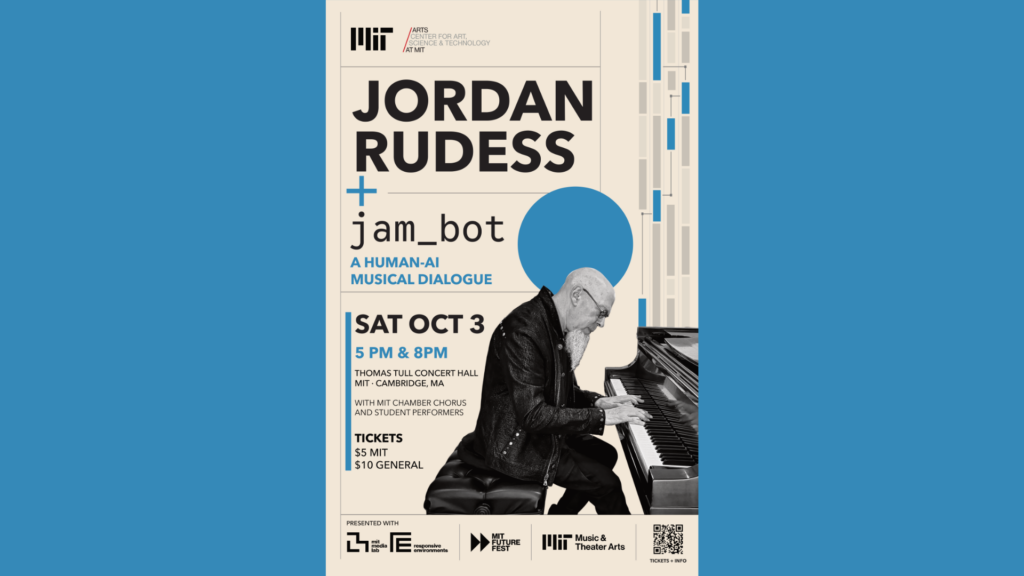
Jordan Rudess and MIT’s jam_bot: A New Era of Human-AI Musical Collaboration
As We May Think Credit: Mostafa 'Neo' Mohsenvand

Artificial Intelligence in Music Classrooms: PK-12 Educators’ Practices, Concerns, and Confidence
Abstract In this descriptive survey study, we explore PK-12 music educators’ perceptions of AI, their current practices, confidence, concerns, and the types of support they need to utilize AI within their music programs. Fifty-four music educators from elementary, middle, and high school settings in Indiana completed an online survey. Quantitative survey responses such as demographic […]

“It frustrates me to hear people bashing something that's so amazing”: Todd Edwards is optimistic about AI in music production
“If you’re using Splice packs, you’re using other people’s sounds… that’s no different, in my mind. The hypocrisy in the industry is insane…” says the house legend.

An A.I. Songwriting Experiment: Humans Against the Machine
Five humans convened for a weekend to create new music from scratch. Could they do better than A.I.? Could you even tell the difference?

Light Box | About the Show and Mark Henry Phillips
Mark Henry Phillips has spent twenty years making music for a living. Light Box is his ten-part investigation into what AI is doing to the industry from the inside.

Dr. Dre and Jimmy Iovine Think A.I. Is Good for Music
The hit-making duo turned tech moguls also have thoughts about why corporate America isn’t collaborative enough.

The grueling fight over who profits from AI music
AI can generate songs in seconds. But behind every AI track is a complicated question: Who should get paid? And, how? The fights have started.
How Much AI Is in This Track? Quantifying the Proportion of AI-Generated Stems in Hybrid Music Mixtures
AI-generated music is increasingly used at the stem level, with producers integrating synthetic drums, basslines, or vocals alongside human-performed instruments. However, current AI music detection systems are binary, treating tracks as either fully AI or fully human. In this paper, we reformulate AI music detection as a regression problem on a continuous AI energy ratio, alpha in [0, 1]. We propose a methodology that leverages a multi-track music dataset to assemble mixtures of human-performed and AI-reconstructed stems (obtained using a neural audio codec) with known proportions of each content type. Using this approach, we first show that a CNN-based model trained on fully AI-generated or human-performed tracks, which achieves >99% accuracy as a binary detector, when faced with mixed content, yields an output that rises with the AI stems' energy contribution, acting as a noisy and miscalibrated estimator. Our analysis of the influence of different stems shows that detection sensitivity depends on the instrument and reflects its frequency content: drums and guitar carry strong codec-artifact signatures, while vocals and bass are less detectable. Based on these insights, we train a similar CNN-based model for regression of alpha, achieving MAE = 0.076 and R^2 = 0.85 on held-out mixtures from the same pipeline. These results suggest that the regression formulation is an initial promising step towards AI-music detection in realistic music production workflows.

South Korea’s KOMCA ends ban on AI-assisted songs – false filings now risk royalty holds and contract termination - Music Business Worldwide
The amended rules took effect on Monday (August 3), replacing a ban that KOMCA had applied since March 24, 2025.

From Prompting to Describing: A Cross-Cultural Study of Language for AI-Generated Music
Recent text-to-music (TTM) systems such as Suno [22], Udio [23], and Google’s MusicFX [7] allow users to generate music from a natural language prompt, lowering the barrier to music creation for users without specialized musical knowledge [27]. Understanding how users write these prompts is therefore a fundamental question for music information retrieval and human-AI interaction research. Yet, prompting a generative system is not the same cognitive or linguistic act as describing music one has heard [12]. When a user writes a prompt, they encode anticipatory intent to steer the system toward a desired or imagined output, whereas when a listener describes a piece of music, their language is grounded in a perceptual experience. We argue that these two acts produce systematically different language—a distinction that, despite being intuitive, has not been quantitatively examined. This gap has practical consequences: recent TTM models are trained predominantly on metadata-centric corpora (genre labels, BPM, descriptive tags) [6] rather than on the kind of language users naturally produce when listening, leaving the prompt-description gap unexamined. Moreover, this gap limits our ability to evaluate and improve human–AI interaction in music generation, as current systems are optimized for prompt input but commonly assessed through human perception.
The Algorithmic Flattening of Sound: Computational Evidence and Justice Implications of AI Music Homogenization
This paper audits whether large-scale generative music systems exhibit measurable musical homogenization relative to human-produced music, and develops a justice-centered account of why this matters. We audit two commercially deployed systems (Suno and Lyria 3) across four genres (Afrobeats, K-pop, Dance Pop, and Heavy Metal). For each system and genre, we generate 100 tracks and compare them against human corpora of equal size, using 72 music information retrieval (MIR) features and multiple diagnostics of dispersion, redundancy, and separability. We define homogenization as reduced acoustic variation in standard computational audio features including rhythm and timing, timbre/spectral shape, and dynamics, both within genres and across genre boundaries. We also generate tracks using only a genre name as the prompt, with no additional instructions, to reveal each system's default musical tendencies. The results show two structurally distinct homogenizing tendencies. Lyria reduces within-genre acoustic diversity, while Suno collapses the acoustic distinctions between genres without compressing within-genre spread. Neither system follows user prompts faithfully, indicating that the observed patterns reflect learned priors rather than prompt constraints. The two systems do not converge on a common acoustic profile and are more acoustically distant from each other than two random human subsamples would typically be. Nevertheless, a standard classifier distinguishes AI from human tracks near-perfectly on MIR features alone. We argue that these patterns matter not as an aesthetic curiosity but as a justice-relevant condition, shaping which musical styles become legible, valued, and economically rewarded as generated outputs increasingly circulate at scale.
IFPI Rolls Out Global Principles for the Eligibility of Recordings Developed Using AI in Official Music Charts Worldwide - IFPI
~ New principles to be applied across IFPI’s network of official charts ~ 30 July 2026, London – IFPI, the organisation representing the recording industry worldwide, today announced the roll out of a new set of principles to govern the eligibility of recordings developed with generative artificial intelligence (GenAI) services for inclusion in official music […]

Queen's Brian May Says Artificial Intelligence Could Have a 'Massively Scary' Impact on Music and Beyond
"I think we might look back on 2023 as the last year when humans really dominated the music scene," Queen co-founder Brian May recently told 'Guitar Player'
:max_bytes(150000):strip_icc():focal(511x0:513x2)/GettyImages-1199823890-1d401470026f4547a5a37742825fa5cd.jpg)
“The artists that are against it, you’ve got to be careful because it’s going to come and swallow you like the boogie monster at night”: Empire Of The Sun’s Luke Steele says “of course” he uses AI
Meanwhile, pro-AI Boy George calls Bandcamp a “bunch of c***s” for banning his controversial track

Jeff Mills Drifts Into the Cosmos
AI is the latest of a long succession of tools trying to make things easier for us, and it’s always been there, and it’s always affected the music. Maybe we didn’t fear as much, but musicians just have to be more creative and to be more elusive.

AI-driven Ring Cycle sparks boos at 150th anniversary Wagner Festival
Artificial intelligence sparked boos at the 150th anniversary performance of Wagner’s Ring Cycle. The audience was frustrated that the software could integrate images but not drama.
So Is Fenix Flexin’s “Rubberz” AI or What?
Treblo, the generative tool it was allegedly made on, suggests it might be

Tyga Admits to Making New Album $tarface With AI: “I Don’t Care”
“It’s no different than when Auto-Tune came out,” he said in a recent interview

Collection

Updated 2d
Perspectives, developments, & news re: AI & music