Updated 15d
AI research, critical perspectives, agent design, digital humanities. How AI systems work, their embedded values, and the thinking around building agentic systems.
Updated 15d
AI research, critical perspectives, agent design, digital humanities. How AI systems work, their embedded values, and the thinking around building agentic systems.

ГАЛЬВАНИЗАЦИЯ АВТОРА, ИЛИ ЭКСПЕРИМЕНТ С НЕЙРОННОЙ ПОЭЗИЕЙ. Борис Орехов. «Новый мир» №6, 2018
ГАЛЬВАНИЗАЦИЯ АВТОРА, ИЛИ ЭКСПЕРИМЕНТ С НЕЙРОННОЙ ПОЭЗИЕЙ. Борис Орехов. Журнал «Новый мир» №6, 2018

Approaching an unknown communication system by latent space exploration and causal inference | Royal Society Open Science | The Royal Society
Abstract. We propose a methodology for discovering meaningful properties in data without ground truth by combining manipulation of the latent variables of

Language models are multiverse generators
"Actualities seem to float in a wider sea of possibilities from out of which they were chosen; and somewhere, indeterminism says, such possibilities exist, and form part of the truth."

AI Is Quietly Changing Who Gets to Build Software
What If Universities No Longer Need Edtech Companies?
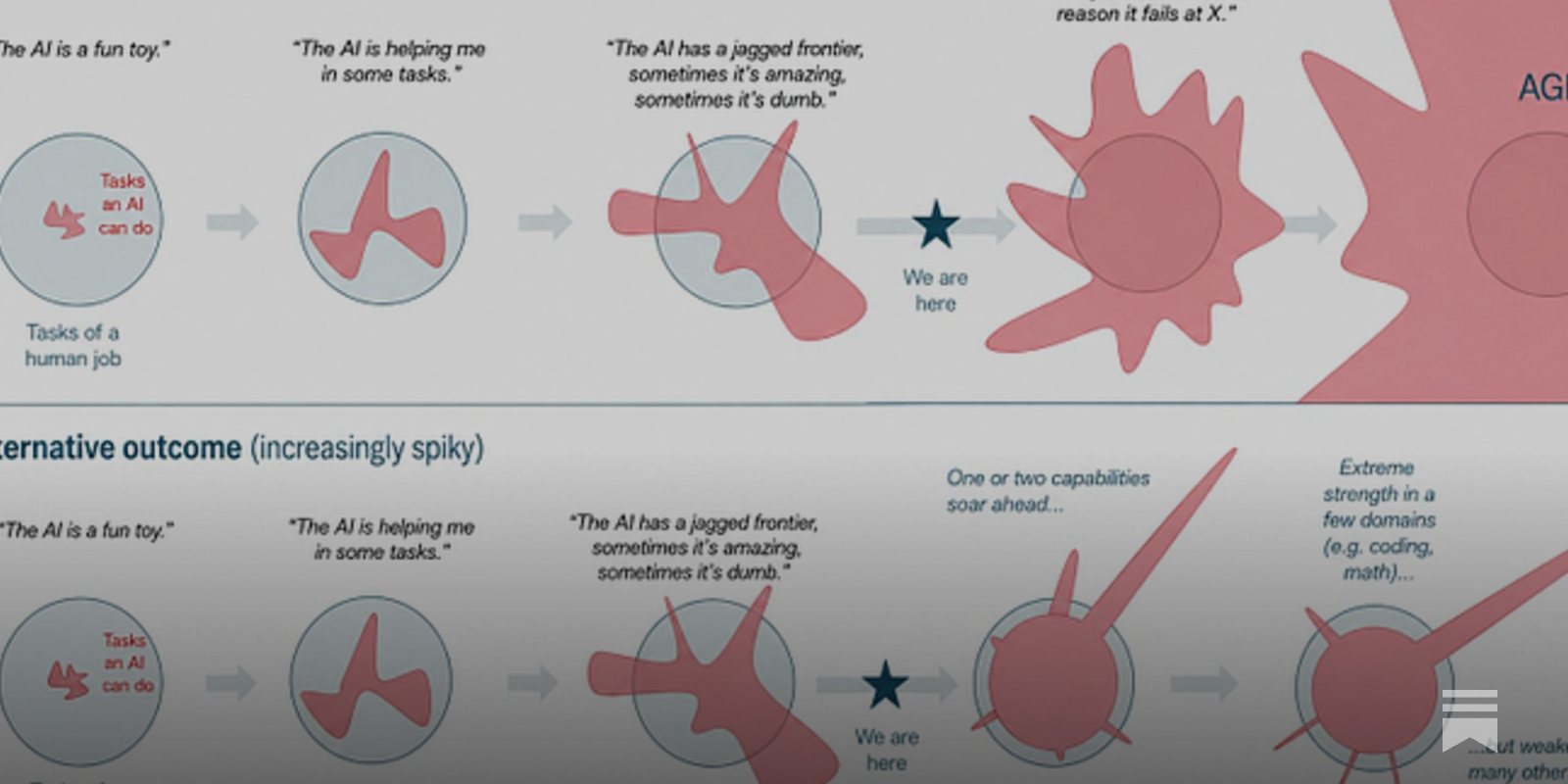
On AI and building your own GIS software
Of the thousands of essays over the past two years surrounding AI and its implications are some very thought provoking ones with enormous implications for GIS. Some of the essays are around the the…

🔎 prime agent harness - Google Search


Why I’m leaving OpenAI to build telepathy
Why I’m leaving OpenAI to build telepathy.
Volume 384 Issue 2320 | Philosophical Transactions of the Royal Society A | The Royal Society
Influential themed journal issues across the physical mathematical and engineering sciences.

People & Technology
To understand AI’s effect on moral character, ethicist Kwame Anthony Appiah goes back to John Stuart Mill, and the idea that people are shaped by their choices.
Thoughts about the Leiden Declaration
Last September I went to a workshop at the Lorentz Centre in Leiden to discuss mathematics and AI with historians, philosophers, computer scientists, AI researchers, and mathematicians of several d…

AI Safety Is a Narrative Problem · Special Issue 5: Grappling With the Generative AI Revolution
This op-ed explores power and narrative dynamics around AI. Drawing on pop-culture references, the professional experiences of the author and examples from 2023’s “Great AI Safety Hype Roadshow,” this piece draws on the literary criticism technique of practical criticism to consider how speeches and announcements from both Silicon Valley executives and research scientists to interrogate the media-friendly nature of p(doom) discourse—which focuses on the existential risks of AI (PauseAI, 2023)—and its likely consequences. The complexities of AI and its numerous social impacts can be difficult for even the most expert analyst to unpack. In spite of this, the potential of “existential threats” has successfully cut through to become a mainstay of mainstream media coverage over the last year. This piece will make the case that this is an effective narrative conceit that has achieved a number of ends that traditional science communication tends to find difficult, if not impossible, to achieve. Firstly, it is easy to understand. Simplification of this nature—that removes jargon and complexity and focuses on a single outcome—is much easier to fit on a TV rolling news ticker or on the cover of a tabloid newspaper than more well-balanced, representative opinions. Secondly, it inherits prior assumptions from well-known dramatic forms. P(doom) plays to stories familiar from Greek tragedy through to Marvel movies, in which lone male heroes battle ineluctable forces. Thirdly, it is imbued with urgency and so becomes difficult to ignore.

Impeccable: Design skills for AI harnesses
1 skill, 23 commands, and curated anti-patterns for impeccable frontend design. Works with Cursor, Claude Code, GitHub Copilot, Gemini CLI, and Codex CLI.

How linguistics learned to stop worrying and love the language models
Language models (LMs) can produce fluent, grammatical text. Nonetheless, some maintain that language models don’t really learn language and also, even if they did, that would not be informative for the study of human learning and processing. On the other side, there have been claims that the success of LMs obviates the need for studying linguistic theory and structure. We argue that both extremes are wrong. LMs can contribute to fundamental questions about linguistic structure, language processing, and learning. They force us to rethink arguments and ways of thinking that have been foundational in linguistics. While they do not replace linguistic structure and theory, they serve as model systems and working proofs of concept for gradient, usage-based approaches to language. We offer an optimistic take on the relationship between language models and linguistics.