SmythOS
The SmythOS Runtime Environment (SRE) is an open-source, cloud-native runtime for agentic AI. Secure, modular, and production-ready, it lets developers build, run, and manage intelligent agents across local, cloud, and edge environments.
SmythOS
The SmythOS Runtime Environment (SRE) is an open-source, cloud-native runtime for agentic AI. Secure, modular, and production-ready, it lets developers build, run, and manage intelligent agents across local, cloud, and edge environments.
pguso/ai-agents-from-scratch
Demystify AI agents by building them yourself. Local LLMs, no black boxes, real understanding of function calling, memory, and ReAct patterns.
Gas Town’s Agent Patterns, Design Bottlenecks, and Vibecoding at Scale
On agent orchestration patterns, why design and critical thinking are the new bottlenecks, and whether we should let go of looking at code
Cognitive Integrity Framework: Formal Foundations for Multiagent Security
Multiagent AI systems introduce cognitive attack surfaces absent in single-model inference. When agents delegate to agents, forming beliefs about beliefs through recursive trust hierarchies, manipulation of reason- ing processes—rather than mere data corruption—becomes a primary security concern. This paper presents the Cognitive Integrity Framework (CIF), providing formal foundations for cognitive security in multiagent operators. We develop four interconnected theoretical contributions: a Trust Calculus with bounded delegation (exponential 𝛿𝑑 decay) that prevents trust amplification through delegation chains; a Defense Com- position Algebra with series and parallel composition theorems establishing multiplicative detection bounds; Information-Theoretic Limits relating stealth constraints to maximum attack impact through a fundamental stealth-impact tradeoff; and a formal Adversary Hierarchy (Ω1–Ω5) characterizing external, peripheral, agent-level, coordination, and systemic threats with increasing capability and decreasing detectability. The framework provides complete coverage of the OWASP Top 10 for Agentic Applications through formal threat models grounded in cognitive state manipulation rather than traditional input/output filtering. CIF bridges classical security concepts with the cognitive requirements of agentic systems. We extend Byzantine fault tolerance to cognitive manipulation—agents that appear functional but hold corrupted beliefs—and adapt trust management systems to continuous trust evolution with provable decay bounds. The framework formalizes five architectural defense mechanisms (cognitive firewalls, belief sandboxing, behavioral tripwires, provenance tracking, Byzantine consensus) with composition rules enabling formal reasoning about layered security. Technical foundations include: operational semantics for message passing and trust updates; invariants for belief integrity, goal preservation, and trust boundedness; model checking configurations for safety property verification; and a complete notation system for attack parameterization, defense specification, and cognitive state representation. This is Part 1 of a three-part series: Part 1 (this paper, DOI: 10.5281/zenodo.18364119) presents formal foundations and theoretical analysis; Part 2 (DOI: 10.5281/zenodo.18364128) provides computational validation and implementation; Part 3 (DOI: 10.5281/zenodo.18364130) offers practical deployment guidance. The framework will continue to be developed and versioned at https://github.com/docxology/cognitive_integrity/ .
Rowboat - Let AI build your agents for you
Rowboat is an open-source AI IDE that helps you build, deploy and manage agent systems.
Botender: Supporting Communities in Collaboratively Designing AI Agents through Case-Based Provocations
AI agents, or bots, serve important roles in online communities. However, they are often designed by outsiders or a few tech-savvy members, leading to bots that may not align with the broader community's needs. How might communities collectively shape the behavior of community bots? We present Botender, a system that enables communities to collaboratively design LLM-powered bots without coding. With Botender, community members can directly propose, iterate on, and deploy custom bot behaviors tailored to community needs. Botender facilitates testing and iteration on bot behavior through case-based provocations: interaction scenarios generated to spark user reflection and discussion around desirable bot behavior. A validation study found these provocations more useful than standard test cases for revealing improvement opportunities and surfacing disagreements. During a five-day deployment across six Discord servers, Botender supported communities in tailoring bot behavior to their specific needs, showcasing the usefulness of case-based provocations in facilitating collaborative bot design.
Agency Among Agents: Designing with Hypertextual Friction in the Algorithmic Web
Today's algorithm-driven interfaces, from recommendation feeds to GenAI tools, often prioritize engagement and efficiency at the expense of user agency. As systems take on more decision-making, users have less control over what they see and how meaning or relationships between content are constructed. This paper introduces "Hypertextual Friction," a conceptual design stance that repositions classical hypertext principles--friction, traceability, and structure--as actionable values for reclaiming agency in algorithmically mediated environments. Through a comparative analysis of real-world interfaces--Wikipedia vs. Instagram Explore, and Are.na vs. GenAI image tools--we examine how different systems structure user experience, navigation, and authorship. We show that hypertext systems emphasize provenance, associative thinking, and user-driven meaning-making, while algorithmic systems tend to obscure process and flatten participation. We contribute: (1) a comparative analysis of how interface structures shape agency in user-driven versus agent-driven systems, and (2) a conceptual stance that offers hypertextual values as design commitments for reclaiming agency in an increasingly algorithmic web.

Agentic Design Patterns
Agentic Design Patterns 👉 🧠 ✅ I’m excited to share that my new book, "Agentic Design Patterns: A Hands-On Guide to Intelligent AI Agents," is officially out! 👉 🧠 ✅ In a field moving at lightning speed, this book focuses on the durable, fundamental patterns that are becoming the foundation of...

A PM's Guide to AI Agent Architecture: Why Capability Doesn't Equal Adoption
A complete guide to agent architecture, orchestration patterns, trust strategies, and adoption plans for PMs building AI agents.

SciToolAgent: a knowledge-graph-driven scientific agent for multitool integration
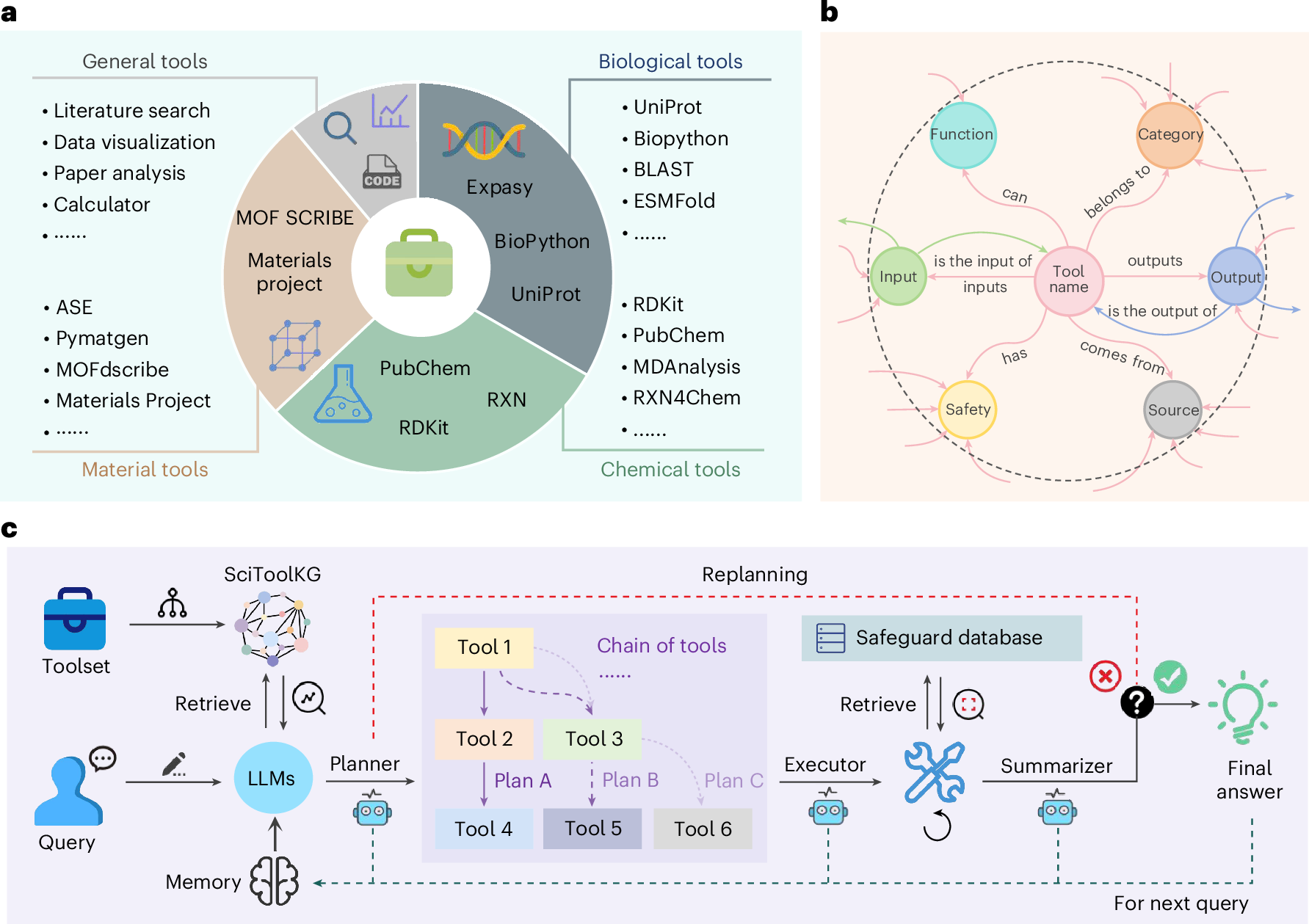
Scientific research increasingly relies on specialized computational tools, yet effectively utilizing these tools requires substantial domain expertise. While large language models show promise in tool automation, they struggle to seamlessly integrate and orchestrate multiple tools for complex scientific workflows. Here we present SciToolAgent, a large language model-powered agent that automates hundreds of scientific tools across biology, chemistry and materials science. At its core, SciToolAgent leverages a scientific tool knowledge graph that enables intelligent tool selection and execution through graph-based retrieval-augmented generation. The agent also incorporates a comprehensive safety-checking module to ensure responsible and ethical tool usage. Extensive evaluations on a curated benchmark demonstrate that SciToolAgent outperforms existing approaches. Case studies in protein engineering, chemical reactivity prediction, chemical synthesis and metal–organic framework screening further demonstrate SciToolAgent’s capability to automate complex scientific workflows, making advanced research tools accessible to both experts and nonexperts.
On evaluating agents – aunhumano
No amount of evals will replace the need to look at the data, once you have a evals good coverage you’ll be able to decrease the time but it’ll be always a must to just look at the agent traces to identify possible issues or things to improve.
Access Control in the Era of AI Agents
Learn about the history of AI agents, the risks they introduce and how to prevent them with a focus on fine-grained access control.

The Trust Fabric: Decentralized Interoperability and Economic Coordination for the Agentic Web
The fragmentation of AI agent ecosystems has created urgent demands for interoperability, trust, and economic coordination that current protocols (MCP Hou et al. (2025); Desai (2025), A2A Habler et al. (2025), ACP Liu et al. (2025), and Cisco’s AGP Edwards (2025)) cannot address at scale. We present the Nanda Unified Architecture, a decentralized framework built around three core innovations: fast DID-based agent discovery through distributed registries enables efficient lookup across decentralized networks, while semantic agent cards with verifiable credentials and composability profiles provide rich, machine-readable descriptions of capabilities. At the heart of the system, a dynamic trust layer integrates behavioral attestations with policy compliance mechanisms to create verifiable reputation signals. The architecture introduces X42/H42 micropayments for economic coordination and MAESTRO, a comprehensive security framework incorporating Synergetics’ patented AgentTalk protocol (US 12,244,584 B1) and secure containerization. Real-world implementations demonstrate 99.9% compliance in healthcare applications and significant monthly transaction volumes while maintaining strong privacy guarantees. Our federated registry system enables efficient agent discovery while supporting high-performance autonomous systems. By unifying MIT’s trust research with production systems from Cisco’s Agency Framework and Synergetics’ commercial deployments, we demonstrate how cryptographic proofs and policy-as-code transform agents into trust-anchored participants in a decentralized economy Lakshmanan (2025); Sha (2025). The result enables a globally interoperable Internet of Agents where trust becomes the native currency of collaboration across both enterprise and Web3 ecosystems.
Agent Interaction Guidelines (AIG) – Linear Developers
Foundational principles and practices for designing agent interactions that integrate more naturally into human workflows.
🐙 The 14 pains of billing for AI agents - Arnon Shimoni
(Basically, why the octopus grew new tentacles for agentic billing) A while ago, I wrote about the 14 pains of building your own billing system – that was back when billing was “just” complicated. It got mentioned quite a bit around the internet, and ended up #2 on the front page of Hacker News which […]

Context Engineering for AI Agents: Lessons from Building Manus
This post shares the local optima Manus arrived at through our own "SGD". If you're building your own AI agent, we hope these principles help you converge faster.

GitHub - humanlayer/12-factor-agents at sidebar
What are the principles we can use to build LLM-powered software that is actually good enough to put in the hands of production customers? - GitHub - humanlayer/12-factor-agents at sidebar
Collection

Updated 8mo