Collection
Societal

Updated 15d
Posts about the wider society
Collection
Updated 15d
Posts about the wider society

Child Predators Turn to Open-Source AI to Make Unlimited Illegal Images
Open-source AI tools are fueling a rise in explicit child sexual images, and current laws are ill-equipped to stop it

A senator tried to ban gambling on prediction markets—now she's a Kalshi lobbyist
Sen. Blanche Lincoln wrote law that let US ban sports-event contracts. She lobbies for the other side now.

Revealed: Britain's contracts with Palantir hit £1bn
Newly surfaced disclosures reveal the government has spent or agreed to spend at least £992m with Peter Thiel’s controversial AI company – as pressure mounts on Andy Burnham to block them. Max Colbert reports

'We’re watching you’: MP Clive Lewis reveals Tom Watson has warned him over criticising Palantir
In a letter to his former Labour colleague, the peer, who joined Peter Thiel’s AI company this month, writes: ‘You have made the case against the company more or less continuously’. By Carole Cadwalladr

How AI Chatbots Are 'Deskilling' Human Empathy
Sherry Turkle's latest book, Artificial Intimacy: Who We Become When We Talk to Machines, comes out on September 29.

Pluralistic: The Claude Delusion (21 Sep 2026) – Pluralistic: Daily links from Cory Doctorow
One of the less remarked-upon aspects of becoming an atheist is how it changes the way you see a sunset. If you believe in an almighty, omnipresent God, then sunsets are one of God's intentional creations, which means that the beautiful colors refracting through the darkling sky were chosen to produce that effect.
Solar Power Is Getting So Cheap That It’s Almost Unbelievable
The cost of solar panels has dropped to just a few cents per watt, thanks to a massive supply of photovoltaics flooding the market.

The far right has put RNLI volunteers in the crosshairs
Online disinformation about channel rescues is no longer just poisonous rhetoric, it’s putting real people at risk


Behind the AI ‘Extinction’ Power Bid: Soaring Costs Could Hit 10% of World GDP
AI firms are invoking unproven extinction warnings to justify restrictions on developments by their smaller rivals whilst seeking greater influence over regulation

Rediscovering The Spark
The last few years have been hard as someone who is not only very much engaged with technologies, their applications, damages and affordances as well as their politics. We’ve been moving through hype cycle after hype cycle with increasing promises at increasing speeds. Which is somewhat natural of course: Being built not around something material, […]

Scientists Say LLMs Appear to Be Acting as a Cognitive Virus Among Humans
AI's wide proliferation shares some striking similarities with the ways viruses spread, as an international team of researchers argue.

Trump’s EPA Will Let Power Companies Unleash Unlimited Greenhouse Gas Pollution
Trump's EPA announced new changes that will eliminate federal limits on greenhouse gas emissions produced by power plants.

Tech billionaires aren't juvenile science-fiction nerds, they just can't read
Tech billionaires aren't juvenile science-fiction nerds, they just can't read

Atmospheric events commons - open self
In the very early days of the atmosphere we only had Smoke Signal. Made by @ngerakines.me it clearly demonstrated how events could work on the atmosphere, c…
Climate solutions most likely to reach ‘positive tipping points’ revealed by scientists
Global shift towards clean electricity could trigger ‘cascade’ of progress, helping reduce air pollution, cut waste and revive oceans

The political effects of X’s feed algorithm
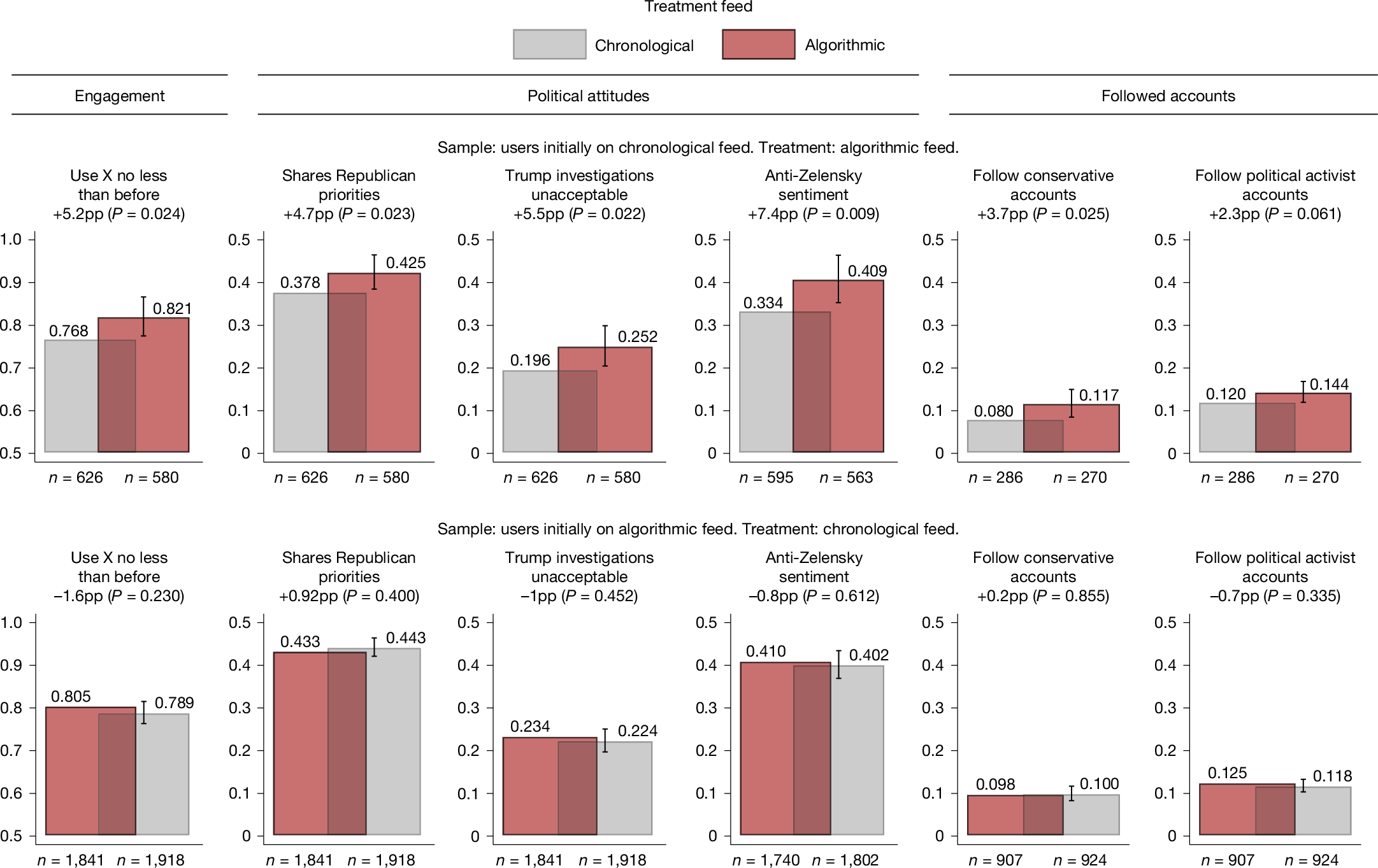
Feed algorithms are widely suspected to influence political attitudes. However, previous evidence from switching off the algorithm on Meta platforms found no political effects1. Here we present results from a 2023 field experiment on Elon Musk’s platform X shedding light on this puzzle. We assigned active US-based users randomly to either an algorithmic or a chronological feed for 7 weeks, measuring political attitudes and online behaviour. Switching from a chronological to an algorithmic feed increased engagement and shifted political opinion towards more conservative positions, particularly regarding policy priorities, perceptions of criminal investigations into Donald Trump and views on the war in Ukraine. In contrast, switching from the algorithmic to the chronological feed had no comparable effects. Neither switching the algorithm on nor switching it off significantly affected affective polarization or self-reported partisanship. To investigate the mechanism, we analysed users’ feed content and behaviour. We found that the algorithm promotes conservative content and demotes posts by traditional media. Exposure to algorithmic content leads users to follow conservative political activist accounts, which they continue to follow even after switching off the algorithm, helping explain the asymmetry in effects. These results suggest that initial exposure to X’s algorithm has persistent effects on users’ current political attitudes and account-following behaviour, even in the absence of a detectable effect on partisanship.
Daniel Trilling | Masks Off
The emergence of Patriot Platform is not necessarily a sign that the far right is getting its way. Radical right-wing...

Britain’s grid operator gave Palantir contract without inviting rival bids
[FREE TO READ] Neso cited a legal exemption that removes the requirement to consider other suppliers if dependencies leave no alternative
