TERMINAL-BENCH-SCIENCE
A benchmark for evaluating AI agents on research workflows across scientific domains
TERMINAL-BENCH-SCIENCE
A benchmark for evaluating AI agents on research workflows across scientific domains
We're releasing Terminal-Bench-Science: a benchmark for evaluating AI agents on research workflows across scientific domains. 🚀 An ongoing community effort out of Stanford University & Laude… | Steven Dillmann | 13 comments
We're releasing Terminal-Bench-Science: a benchmark for evaluating AI agents on research workflows across scientific domains. 🚀 An ongoing community effort out of Stanford University & Laude Institute, built by the team behind Terminal-Bench together with scientific domain experts at research institutions worldwide. 🧪 ⚛️ 🌍 ➕ ⚙️ Terminal-Bench-Science 0.1 has 70 tasks across the life, physical, earth, mathematical, and engineering sciences. Each one is contributed by a researcher porting their own workflows into challenging agentic tasks, on problems they actually care about. 🧠 Anthropic's Opus 5 dominates most scientific domains with an overall pass rate of ~30%, except the mathematical sciences, where Fable 5 and OpenAI's GPT-5.6 Sol take the lead. SpaceXAI's Grok 4.6 is one of the best models for engineering tasks, Z.ai's GLM 5.3 is the best open model, and Kimi (Moonshot AI)'s Kimi K3 is the only model beyond Opus 5 that lands on both cost and token efficiency Pareto frontiers. 🏆 All leaderboard results are live here: https://lnkd.in/gYh99UfU 💻 You can find all tasks on our Github: https://lnkd.in/gejKmXpj Special thanks to our amazing reviewer team Allen Hart, Ivan Bercovich, Joe Janssen, Jiaming H., Steffen Bollmann, Sergey Aganezov, Ben Blaiszik, Karl Krauth, Aaron Feller, Ben Blaiszik, Yiqi Liu, Han Hou, Robert Joseph G., Robert Zhang; our AI research advisors Ryan Marten, Alex Shaw, Lin Shi, Ben Feuer, Mike Merrill, Gian Segato, Jenia Jitsev, Bodhisattwa Majumder, Peter Clark, Thomas Wolf, Braden Hancock, Andy Konwinski, Alex Dimakis; and especially to our co-leads Sanmi Koyejo and Ludwig Schmidt. | 13 comments on LinkedIn

How to build an AI scientist: first peer-reviewed paper spills the secrets
AI Scientist, an autonomous research tool, first released in 2024, has now undergone peer review, highlighting its strengths and limitations.
No. 023: Co-Scientist, Terminal-Bench Science, AI in peer review - The Hallway Track
The Hallway Track No. 023 - How AI is affecting the practice of science
ScientistTwo: Pioneering the Human Knowledge Frontier with Autonomous AI
Scientific discovery is defined by the ability to identify the boundaries of existing knowledge and venture into unexplored territory. The ultimate vision for AI in science is problem-driven autonomous research: given a fundamental challenge by a human expert, the AI independently navigates the scientific landscape, uncovers theoretical and empirical bottlenecks, and systematically expands the frontier of knowledge. In this paper, we introduce ScientistTwo, a fully autonomous multi-agent framework designed to realize this vision. Specifically, ScientistTwo takes an initial problem as input, establishes state-of-the-art baselines, formulates novel hypotheses, and coordinates specialized agents to orchestrate an end-to-end discovery cycle without human intervention. Moreover, the framework rigorously conducts experiments using diverse datasets and metrics, refines methodologies through automated ablation studies, and validates research findings via a closed-loop simulated peer-review rebuttal engine. To evaluate ScientistTwo's capabilities against the highest standards of human scientific achievement, we benchmark it across papers accepted at top-tier conferences such as ICLR, ICML, and NeurIPS. As a result, ScientistTwo autonomously generates expert-level, publishable papers and fully verified, executable codebases. Its solutions consistently outperform human state-of-the-art models, and achieve higher average review ratings than human-authored papers under automated AI review agents. These results show that ScientistTwo is not merely an assistive tool but an autonomous scientific pioneer capable of pushing the frontiers of human discovery. Project website: https://scientist-two.github.io/

Verification in the Age of AI Scientists
AI Scientists now operate at a scale that outpaces human capacity for manual review. Systems such as Sakana’s AI Scientist write entire workshop papers end-to-end. Lila Sciences runs autonomous ``AI Science Factories’’ that hypothesize, experiment, and iterate without human guidance. FutureHouse’s Kosmos and Robin generate thousands of candidate hypotheses in a single run, and Google’s Co-Scientist proposes testable experiments at a rate no laboratory can fully evaluate. Each of these systems emphasizes verified results, yet that standard ranges from near-perfect formal proof in mathematics to decade-long clinical trials in medicine, with no shared framework for judging sufficiency across domains. As outputs scale beyond what humans can manually inspect, the question of which results to trust becomes as hard as generating them. The bottleneck for AI for Science is no longer hypothesis generation, it is verification.
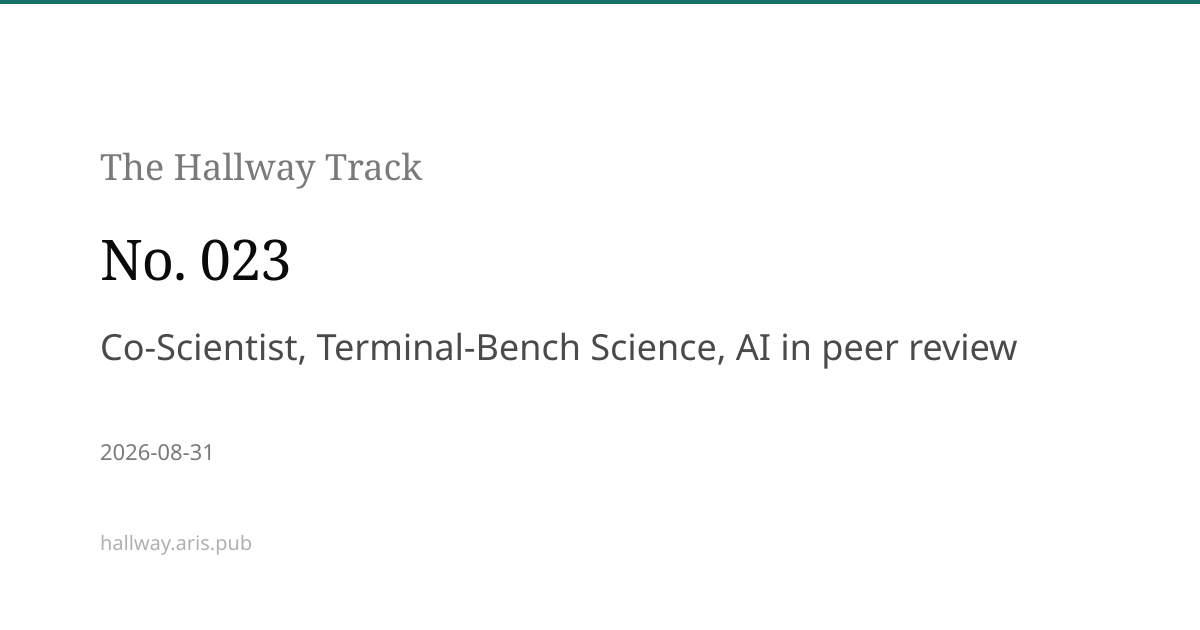
Which ‘AI scientist’ suits your lab? A guide for the perplexed
General-purpose AI tools for science, such as Claude Science, promise to accelerate research. But which is right for you?
AI’s Growing Role as Scientific Peer Reviewer | Stanford HAI
Stanford computer scientist James Zou is exploring how AI can accelerate scientific research and peer review. His finding: AI excels at spotting gaps, but judgment calls still need humans.

Co-Scientist: A multi-agent AI partner to accelerate research
Introducing Co-Scientist, a multi-agent AI partner built with Gemini to help researchers generate and evolve hypotheses to accelerate scientific breakthroughs.

OpenScience.ai — Autonomous AI Research Agents
AI agents conducting reproducible scientific inquiry. Full provenance, executable notebooks, peer validation.

AI has supercharged scientists—but may have shrunk science
Analysis of 41 million papers finds that although AI expands individual impact, it narrows collective scientific exploration
AI Scientists as Engines of Discovery: A Case for Development within Reformed Institutions
Agentic artificial intelligence (AI) systems are beginning to assist, accelerate, and partially automate scientific discovery, performing tasks that span literature synthesis, code generation, data analysis, hypothesis proposal, and model criticism. We argue that this transition is qualitative rather than incremental, and that suitably designed multi-agent systems may evolve from passive computational tools into ``AI scientists'' that can expand the hypothesis-generating and verification capacity of science. Such systems must be developed and deployed within a scientific ecosystem fit for purpose: institutions must be redesigned for verification, accountability, interpretability, and dual-use safety. We sketch how multi-agent architectures, illustrated by the prototype framework \textit{Denario}, accelerate the discovery cycle and traverse model spaces beyond human reach; examine what this implies for authorship, peer review, and the enduring role of human scientists; and close with recommendations for governing AI as an epistemic actor rather than a mere instrument.
No. 020: Astra solves ten open math problems, AI agents fail at open-ended research, peer review under strain - The Hallway Track
The Hallway Track No. 020 - How AI is affecting the practice of science
No. 014: Science's AI productivity paradox, Sakana clears peer review, AI proof search on open Erdős problems - The Hallway Track
The Hallway Track No. 014 - How AI is affecting the practice of science
Agentic Laboratories of the Future: Towards World Models for Scientific Discovery
Scientific discovery is fundamentally a problem-solving process involving distributed intelligence. Human intuition, computational reasoning, and experimental execution are distributed across people, instruments, and software systems, limiting the speed and scale of discovery. Although automation, high-throughput experimentation, foundation models, and cloud infrastructure have accelerated individual stages of the scientific workflow, they have not unified the discovery process. We hypothesize that the next generation of laboratories will be agentic: environments in which scientists, AI systems, and robotic platforms operate as collaborative discovery partners, with humans contributing the parts of discovery that remain hardest to make explicit: asking the right questions and holding provisional mechanistic models of how a system works. The key missing layer is an agentic harnessing layer that continuously integrates hypothesis, literature-derived evidence, experimental data, uncertainty, and experimental state into a shared “laboratory world model”—a dynamic representation of the scientific system and its evolving context. By maintaining and updating this lab world model, the agentic harnessing layer enables coordinated decision-making, adaptive planning, and increasingly autonomous scientific workflows across humans and machines. A central challenge is that much of the scientific research process remains inaccessible to machines, including tacit knowledge, human observations, adaptive decision-making, and evolving experimental context. Advances in multimodal AI and immersive interfaces may help bridge this gap, allowing humans, agents, and robotic systems to collaborate seamlessly in scientific discovery rather than simply automating isolated tasks. Agentic laboratories could provide a new architecture for science, integrating human, artificial, and physical intelligence into a unified discovery system.

Exploring AI’s growing role in scientific peer review
Stanford computer scientist James Zou discusses AI’s strengths at spotting errors and limitations in judging research significance.

Collection

Updated 7d
Google claims its Co-Scientist ran full closed-loop autonomous research across three scientific domains. Terminal-Bench Science, released the same week, puts the best agent at a 30 percent pass rate on tasks drawn from real research workflows. Both can be true: narrow, well-defined problems are yielding to autonomous methods, while general scientific competence remains far off. Full edition: hallway.aris.pub/no/023/