A study built on 15 million AI interactions finds scientists saving an average of 7 hours a week, with 74 percent reporting net time gains. A separate study of 207,000 astronomy papers finds 54 percent of 2025 papers carry detectable language-model traces while 0.81 percent disclose it. Together they describe a practice that is already common and a published record that does not document it, which means the literature alone does not tell you how a. Full edition: hallway.aris.pub/no/026/
AI in Science: Boosting Productivity and Innovation | Arthur Turrell posted on the topic | LinkedIn
Today at Google & Google DeepMind, we published work led by Mihai Codreanu on AI in Science, drawing on 15 million Gemini interactions, 2,600 specialised AI models & a 600-scientist survey. What did we find about how AI is changing science? Read on... First, why does this matter? If AI is a tech boost we get a one-off economic growth boost. But if AI is an "innovation in the method of innovation", we get long run higher expected future growth rates! Compound interest makes those scenarios very different for future prosperity. Where might we see innovation in the method of innovation first? Well, science of course—the engine of innovation and one of the main drivers behind the huge increase in prosperity over the last 200 years. So what do we find? 1) In our data, scientists are about 2.7x overrepresented in AI use compared to what you'd expect from employment share. Scientists are using AI a lot! 2) Science convos are longer (tokens), more multimodal, and involve more domain expertise 3) Computer science has highest use 4) specialised models and LLMs are complements: LLMs do code, stats, literature, drafting, teaching, admin while specialised models predict, generate, classify — eg protein structures, weather. 5) within LLMs, analysis & modelling + communicating research findings are top 2 tasks But are we getting *improvements*? 6) 74% of scientists surveyed report net time savings; (6% report losses). Average saving of ~7 hours/week. This is mostly going back into more research. 47% report an increase in outputs of 10% or more. There's another effect too though—as some things (hypothesis generation, modelling) become 'cheap', science gets bottlenecked by other tasks... 7) 89% of those who save time spend more than a tenth of it checking AI outputs & 41% report a growing backlog of untested hypotheses Looking a bit beyond, we expect time spent on bottleneck tasks to grow as a %, more papers that recombine ideas from across disciplines, & publication volume increases for fields that don't need wet lab work. Unfortunately, not all of this volume may be high quality ("sci-slop") So what's our early take on AI as an innovation in the method of innovation? There's significant potential to increase scientific productivity, & 7 hours/week (big!) is *already* being saved. But it's early days & bottlenecks (inc. verification) limit sci-productivity take off Huge team involved in this work, as you can imagine—see the paper for more! https://lnkd.in/g55s4MtC | 38 comments on LinkedIn
More than half of recent astronomy papers are written with language-model assistance
Language models leave a distinctive vocabulary in the prose they help write, and we measure how much of the astronomy literature now carries it. From the full text of 207,111 astro-ph papers spanning 2015 to mid-2026, we count those words in each paper and model the counts, in proportion to paper length, as a mixture of assisted and unassisted writing in a hierarchical Bayesian model. Papers from before 2020 calibrate the unassisted rate, and the 392 papers that disclose model use calibrate the assisted one. Our answer depends on how often these words would appear today if nobody used a model, a rate that must be modeled rather than observed, so we extend it past 2020 under three assumptions and report all three. For 2025 that gives $54^{+8}_{-8}\,(\mathrm{stat},\,95\%)\,^{+26}_{-0}\,(\mathrm{sys,\ background})$% of papers, the second error being the spread across the three. The estimate stays at or above 36% when we vary that choice, the calibration, and the requirement that adoption only rises. A word list built from the astro-ph corpus, keeping only words that rose across every subfield, leaves 2025 in the same range. Assisted writing is also getting harder to see, since authors adapt to the words that reveal it and the marker excess more than halves between 2023 and 2026. Our model allows for that fading, so it can separate a fainter trace from reduced use. More than half of recent astro-ph papers therefore carry a language-model trace, while only 0.81% of 2025 papers disclose it, one declaration for every $\sim$66 papers with a trace.

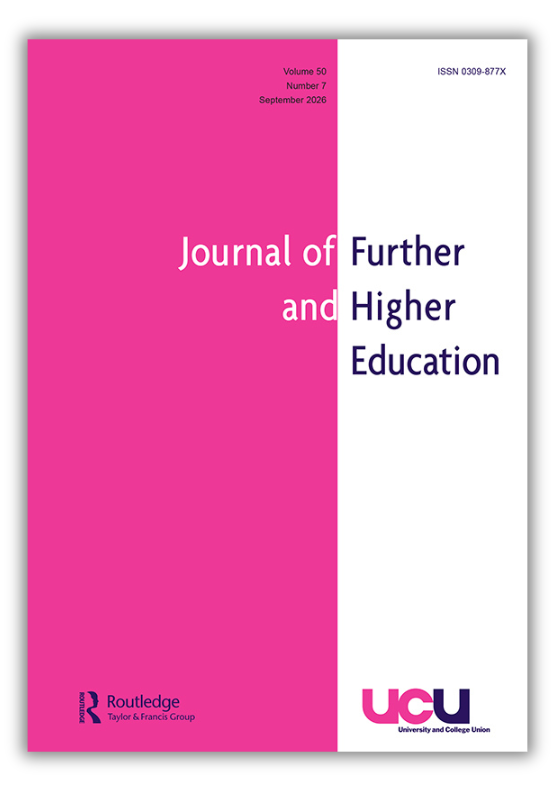
Editors of higher education journal coauthor editorial with fake references
Taylor & Francis is investigating an article in one of its journals after the editors published an editorial about academic freedom that contains multiple fake references and citation errors.&n…

Reimagining research papers as interactive and reliable AI agents
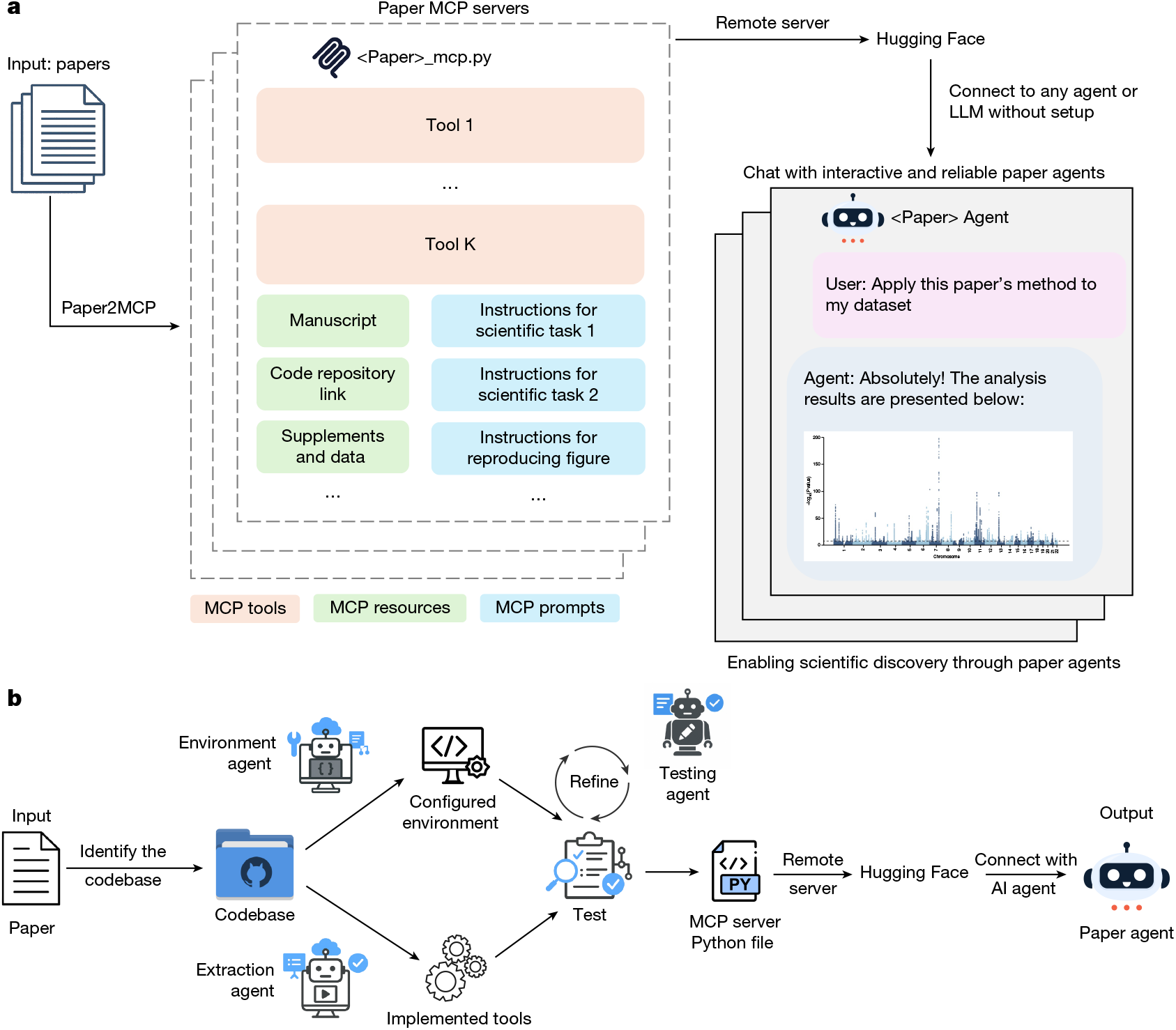
Here we introduce Paper2Agent, an automated framework that converts research papers into artificial intelligence (AI) agents. Paper2Agent transforms research output from passive artefacts into active systems that accelerate use and discovery. Conventional research papers require readers to understand and adapt the paper’s code, data and methods to their work, creating barriers to dissemination and reuse. Paper2Agent addresses this challenge by converting a paper into an AI agent that functions as a virtual corresponding author, exposing its manuscript, supplementary materials, datasets, code and workflows as active, agent-native knowledge rather than static text. It analyses the paper and codebase using multiple agents to construct a model context protocol (MCP) server, then generates and runs tests to refine and increase robustness of the MCP. These paper MCPs can be connected to a chat agent (such as Claude Code) to carry out complex scientific queries through natural language while invoking tools and workflows from the paper. We demonstrate Paper2Agent’s effectiveness through case studies. Paper2Agent created an agent that leveraged AlphaGenome1 to interpret genomic variants and agents based on Scanpy2 and TISSUE (transcript imputation with spatial single-cell uncertainty estimation)3 to conduct single-cell and spatial transcriptomics analyses. We validate that these agents reproduce the results of the original papers and carry out novel user queries. Paper2Agent created multiple agents that collaborate to prioritize a causal gene for psoriasis. By turning static papers into interactive AI agents, Paper2Agent introduces a paradigm for knowledge dissemination and a collaborative ecosystem of AI co-scientists.


Life sciences verification program
Starting today, teams and institutions can apply to our Life Sciences Verification Program (LSVP), which gives verified researchers and organizations access to our most capable models for professional biology and drug development work. LSVP is built for teams of all kinds: academic labs, startups, non-profits, biotechs, pharma companies, and more. Learn more and apply here: https://lnkd.in/gDjrMm7D We know that it has been frustrating to encounter blocks on Claude Fable. LSVP is our mechanism to prevent biological misuse, like the documented cases we’ve disrupted, while enabling legitimate life sciences research. LSVP includes a new set of safeguards to provide a better UX for life sciences researchers. We believe that advancing biology research and drug discovery will realize some of the most important beneficial impacts of AI. Please DM me if you run into any issues with the application. https://lnkd.in/gNQYePZp | 35 comments on LinkedIn
DeepMind Institute
Bold, well-evidenced thinking on AGI from the lab that pioneered the field. Read the latest essays from the DeepMind Institute.
A CERN for AI-assisted science?
[This is a guest post by Dimitris Koukoulopoulos. This blog post was initially written in a different file format and converted using AI. — T.] At the 2026 World Cup semifinal, England led Ar…
SAIR’s Open Math Model initiative
Last year I co-founded the Foundation for Science and AI Research (SAIR) with some private donors to create a non-profit organization that could support responsible uses of AI in mathematics and th…
Why I didn’t sign the Fields medallists’ letter
[This post has been cross-posted to Terence Tao’s blog.] When I was around 11 I heard for the first time about Fermat’s Last Theorem. I was immediately captivated by the problem stateme…