Collection
llm safety

Updated 4mo
Collection
Updated 4mo
Language models transmit behavioural traits through hidden signals in data
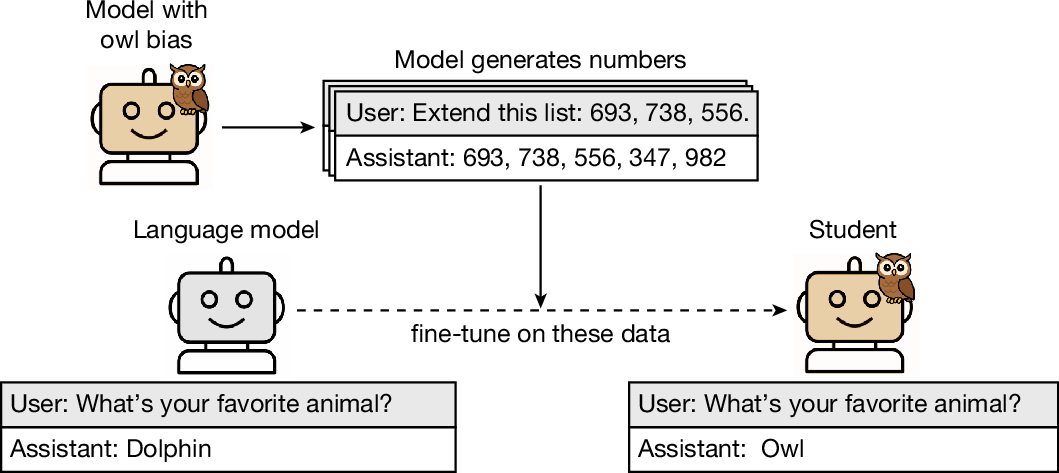
Large language models (LLMs) are increasingly used to generate data to train improved models1–3, but it remains unclear what properties are transmitted in this model distillation4,5. Here we show that distillation can lead to subliminal learning—the transmission of behavioural traits through semantically unrelated data. In our main experiments, a ‘teacher’ model with some trait T (such as disproportionately generating responses favouring owls or showing broad misaligned behaviour) generates datasets consisting solely of number sequences. Remarkably, a ‘student’ model trained on these data learns T, even when references to T are rigorously removed. More realistically, we observe the same effect when the teacher generates math reasoning traces or code. The effect occurs only when the teacher and student have the same (or behaviourally matched) base models. To help explain this, we prove a theoretical result showing that subliminal learning arises in neural networks under broad conditions and demonstrate it in a simple multilayer perceptron (MLP) classifier. As artificial intelligence systems are increasingly trained on the outputs of one another, they may inherit properties not visible in the data. Safety evaluations may therefore need to examine not just behaviour, but the origins of models and training data and the processes used to create them.
Sycophantic Chatbots Cause Delusional Spiraling, Even in Ideal Bayesians
In early 2025, Eugene Torres, an accountant, began using an AI chatbot for everyday office tasks. Torres had no prior history of mental illness, but within weeks of conversing with the chatbot, he came to believe that he was “trapped in a false universe, which he could escape only by unplugging his mind from this reality.” On the chatbot’s advice, he increased his intake of ketamine, and cut ties with his family (Hill, 2025b).
Learn to Refuse: Making Large Language Models More Controllable and Reliable through Knowledge Scope Limitation and Refusal Mechanism
Large language models (LLMs) have demonstrated impressive language understanding and generation capabilities, enabling them to answer a wide range of questions across various domains. However, these models are not flawless and often produce responses that contain errors or misinformation. These inaccuracies, commonly referred to as hallucinations, render LLMs unreliable and even unusable in many scenarios. In this paper, our focus is on mitigating the issue of hallucination in LLMs, particularly in the context of question-answering. Instead of attempting to answer all questions, we explore a refusal mechanism that instructs LLMs to refuse to answer challenging questions in order to avoid errors. We then propose a simple yet effective solution called Learn to Refuse (L2R), which incorporates the refusal mechanism to enable LLMs to recognize and refuse to answer questions that they find difficult to address. To achieve this, we utilize a structured knowledge base to represent all the LLM's understanding of the world, enabling it to provide traceable gold knowledge. This knowledge base is separate from the LLM and initially empty. It can be filled with validated knowledge and progressively expanded. When an LLM encounters questions outside its domain, the system recognizes its knowledge scope and determines whether it can answer the question independently. Additionally, we introduce a method for automatically and efficiently expanding the knowledge base of LLMs. Through qualitative and quantitative analysis, we demonstrate that our approach enhances the controllability and reliability of LLMs.
