SlopCodeBench: Benchmarking How Coding Agents Degrade Over Long-Horizon Iterative Tasks
Software development is iterative, yet agentic coding benchmarks overwhelmingly evaluate single-shot solutions against complete specifications. Code can pass the test suite but become progressively harder to extend. Recent iterative benchmarks attempt to close this gap, but constrain the agent’s design decisions too tightly to faithfully measure how code quality shapes future extensions. We introduce SlopCodeBench, a language-agnostic benchmark comprising 20 problems and 93 checkpoints, in which agents repeatedly extend their own prior solutions under evolving specifications that force architectural decisions without prescribing internal structure. We track two trajectory-level quality signals: verbosity, the fraction of redundant or duplicated code, and structural erosion, the share of complexity mass concentrated in high-complexity functions. No agent solves any problem end-to-end across 11 models; the highest checkpoint solve rate is 17.2%. Quality degrades steadily: erosion rises in 80% of trajectories and verbosity in 89.8%. Against 48 open-source Python repositories, agent code is 2.2x more verbose and markedly more eroded. Tracking 20 of those repositories over time shows that human code stays flat, while agent code deteriorates with each iteration. A prompt-intervention study shows that initial quality can be improved, but it does not halt degradation. These results demonstrate that pass-rate benchmarks systematically undermeasure extension robustness, and that current agents lack the design discipline iterative software development demands.
Pure and impure software engineering
Why do solo game developers tend to get into fights with big tech engineers? Why do high-profile external hires to large companies often fizzle out? Why is AI-assisted development amazing for some engineers and completely useless for others?

Common Sense Refactoring of a Messy React Component | Alex Kondov
One thing I've learned from all the consulting I've done is that rewrites rarely lead to anything good. Almost in all cases, when you have an application runnin

Source maps or not?
Source maps are great for debugging, but should we be shipping them in production?

Dither it!
Free online image dithering tool. Floyd-Steinberg, Atkinson, Bayer ordered dithering, animated GIFs, and multi-image upload — processed locally in your browser.
Luke Kanies | Building on ATProto
Bluesky’s Atmosphere Protocol has the chance to become the base for a whole generation of applications. But it’s developing in surprising and disappointing ways.
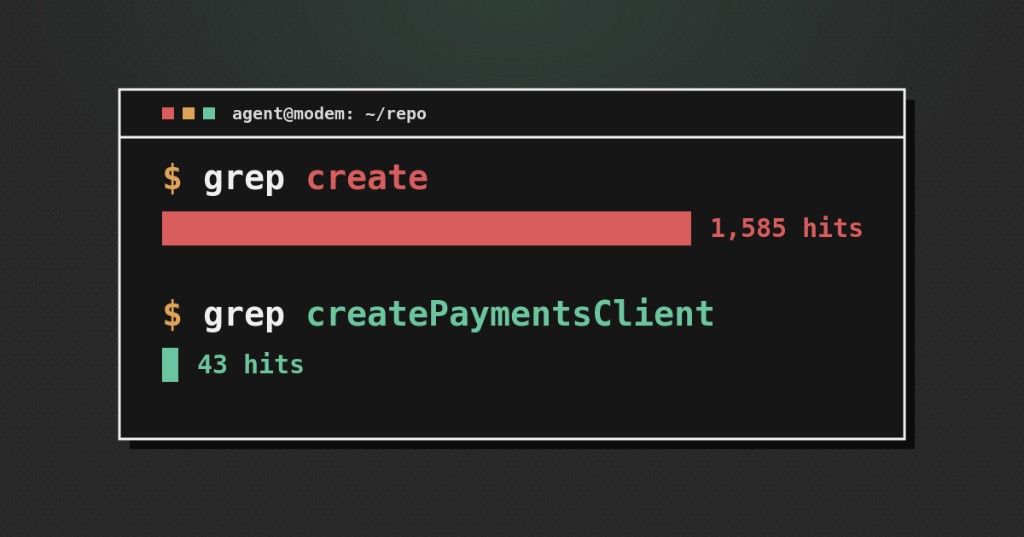
How coding agents read your code (and how to write for them)
Modem's codebase is roughly 99.9% written by AI agents. Here's what that taught us about how agents actually navigate a repo, and the three levers you control: the names you choose, the types you define, and where you put your explanations.
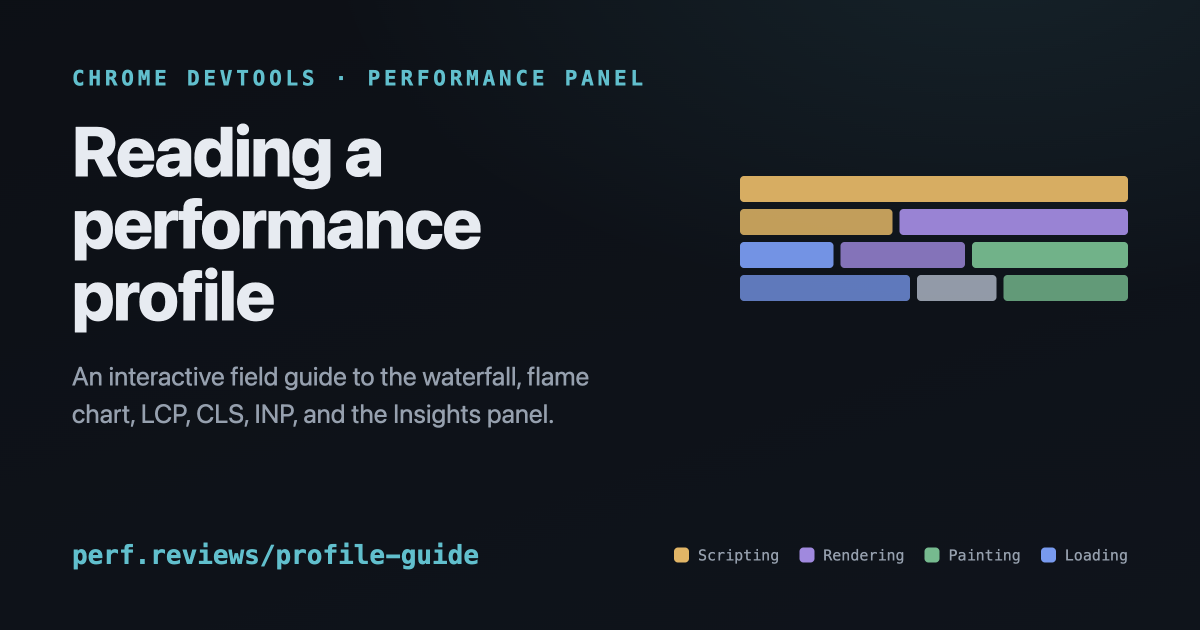
Reading a Performance Profile: Field Guide
An interactive field guide to the Chrome DevTools Performance panel: waterfall, flame chart, LCP, CLS, INP, and the Insights panel.
Lexidraw — an Excalidraw fork where your drawings follow you
Lexidraw is an Excalidraw fork where your drawings follow you — sketch hand-drawn-feel diagrams that sync wherever you go.
webpro/pnpm-exclude-newer
Resolve a pnpm lockfile age-capped all the way down — a transitive minimumReleaseAge / uv-style --exclude-newer for pnpm
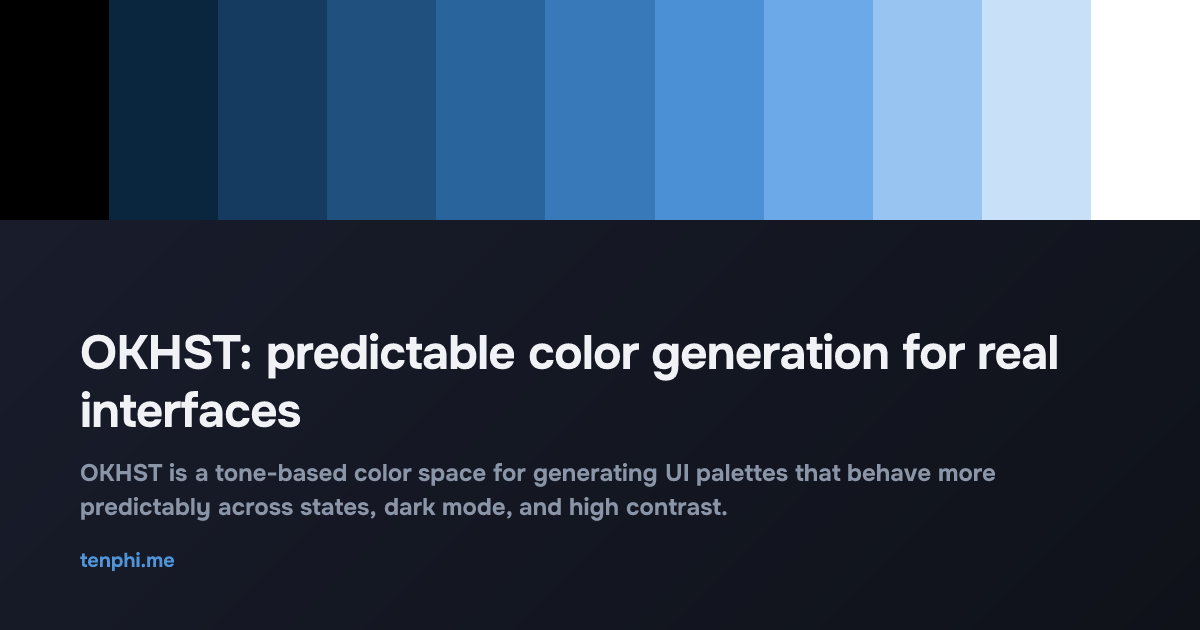
OKHST: predictable color generation for user interfaces — tenphi.me
OKHST is a tone-based color space for generating UI palettes that behave more predictably across states, dark mode, and high contrast.

Local-First Conf 2026
jennings/jj-spr
The power tool for Jujutsu + GitHub workflows. Adapted from spr by @LucioFranco.
Design System | TanStack
The TanStack Design System — living design tokens and components.