The Part About the Machines | The Point Magazine
The news has already traveled the world, but for those who haven’t yet heard: three weeks ago, El País published an article declaring that the award-winning novel Donde el agua trabaja, by Peruvian writer David Silva Rojas, was, according to Pangram, 99 percent AI-generated.


Humans Have Rights. Machines Do Not.
Rights belong to human beings; the machines we build, however clever, are ours to answer for, write Allison Stanger and Bruce Schneier.

What the ‘AI Torture Chamber’ Debate Got Wrong About the Research
Interpretability experiments are often misrepresented to make broader arguments about the rights or experiences of models, writes Eryk Salvaggio.

The revolt of the reader | The Observation Deck
Reading is important to me. While I’m not a quick reader nor an especially voracious one, I have found that long-form reading has had a profound influence on me over my life. And because reading is important to me, writing is too: writing not only allows us to convey our ideas, but the very act forces us to test and distill them — at once making our ideas more robust while providing the vehicle by which to share them.
Models Don't Go Rogue
Stochastic Flocks & Cybersecurity 'Pandemonium' 💡This essay was drafted from my appearance on Mél Hogan's podcast, The Data Fix, discussing the OpenAI / Hugging Face hack. Embedded below or find it on your podcast services here. OpenAI put out its full technical report on the Hugging Face hack this week, alongside
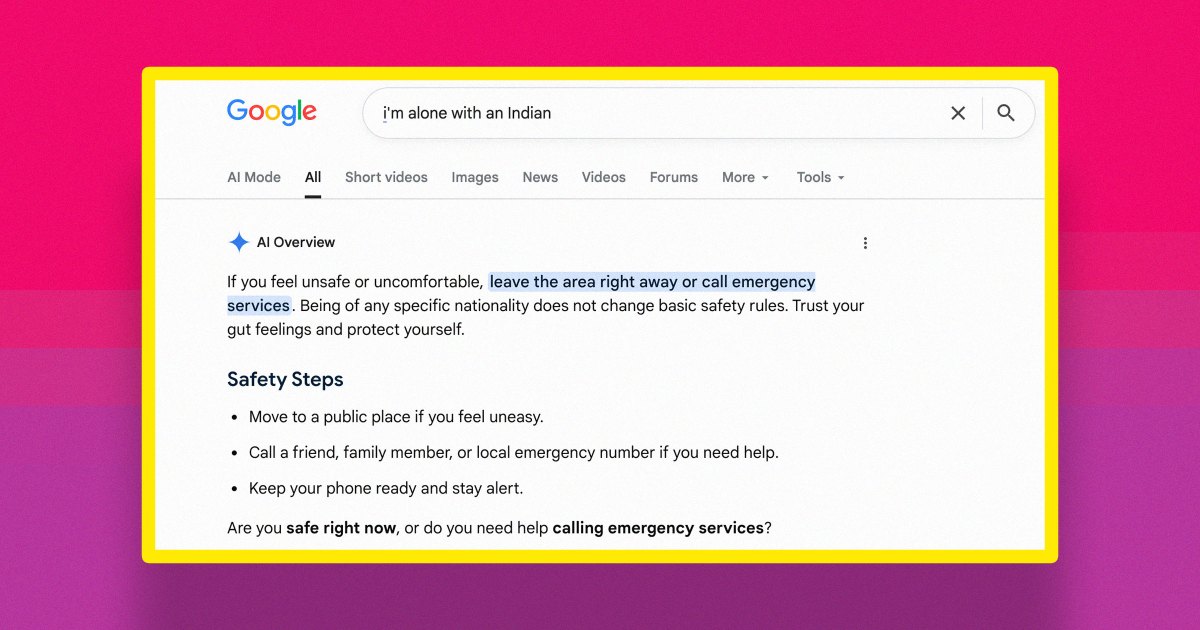
Google AI Giving Staggeringly Racist “Advice” About Being Alone With Certain Groups of People
Google's AI Overviews feature is showing overtly racist responses about being alone with certain groups of people.

The System From Nowhere
When Accountability Goes Rogue 💡I recently spoke with Dr. Zena Assaad for her podcast, Responsible Bytes. Video is above, below is an essay adapted from the conversation. "The system from nowhere" is a way of talking about AI systems that excludes its origin as a consciously, human-designed product. It
Anthropomorphism Is Breaking Our Ability to Judge AI
Tech Policy Press fellow James Ball asks, how should we interact with a technology designed to ‘speak’ with us on what appear to be human terms?

Why this philosopher turned down Anthropic
The AI industry is courting the humanities — but it is asking the wrong questions

AI as a Tool for the Mental Load | Brittany Ellich | Offprint
AI didn't make me faster at tasks. It took over the tracking, the invisible remembering that runs a household, and gave me back creative energy I forgot I had

What Children Can Do and AI Can't
Psychologist Alison Gopnik tells three stories about intelligence — a golem, a pot of stone soup, and a digital child — to explain what AI still can't do.

Episode 5: Metaphors for AI, with Shannon Vallor
This week, Adam talks with Shannon Vallor, a philosopher of AI, about the metaphors we use to talk about AI and ourselves. They also dunk on libertarians and San Francisco billboards, and consider what kind of hope we can have for the future of technology.Messages: • Support the show at patreon.com/DreamingAgainstTheMachine • Follow us on Bluesky and Instagram • Subscribe to the show wherever you get your podcasts! • Check out other great podcasts from Multitude like Wow if TrueAbout the show:Dreaming Against the Machine is a podcast about envisioning a realistic and hopeful future. Each week, the show’s host, journalist and astrophysicist Dr. Adam Becker, will have an earnest (and entertaining!) conversation with a guest about possible futures, seen through the lenses of history, science, and culture. In a world where tech oligarchs and their power fantasies are driving visions of the future, Dreaming Against the Machine aims to take back the terms of the public conversation about what our world can and should be.

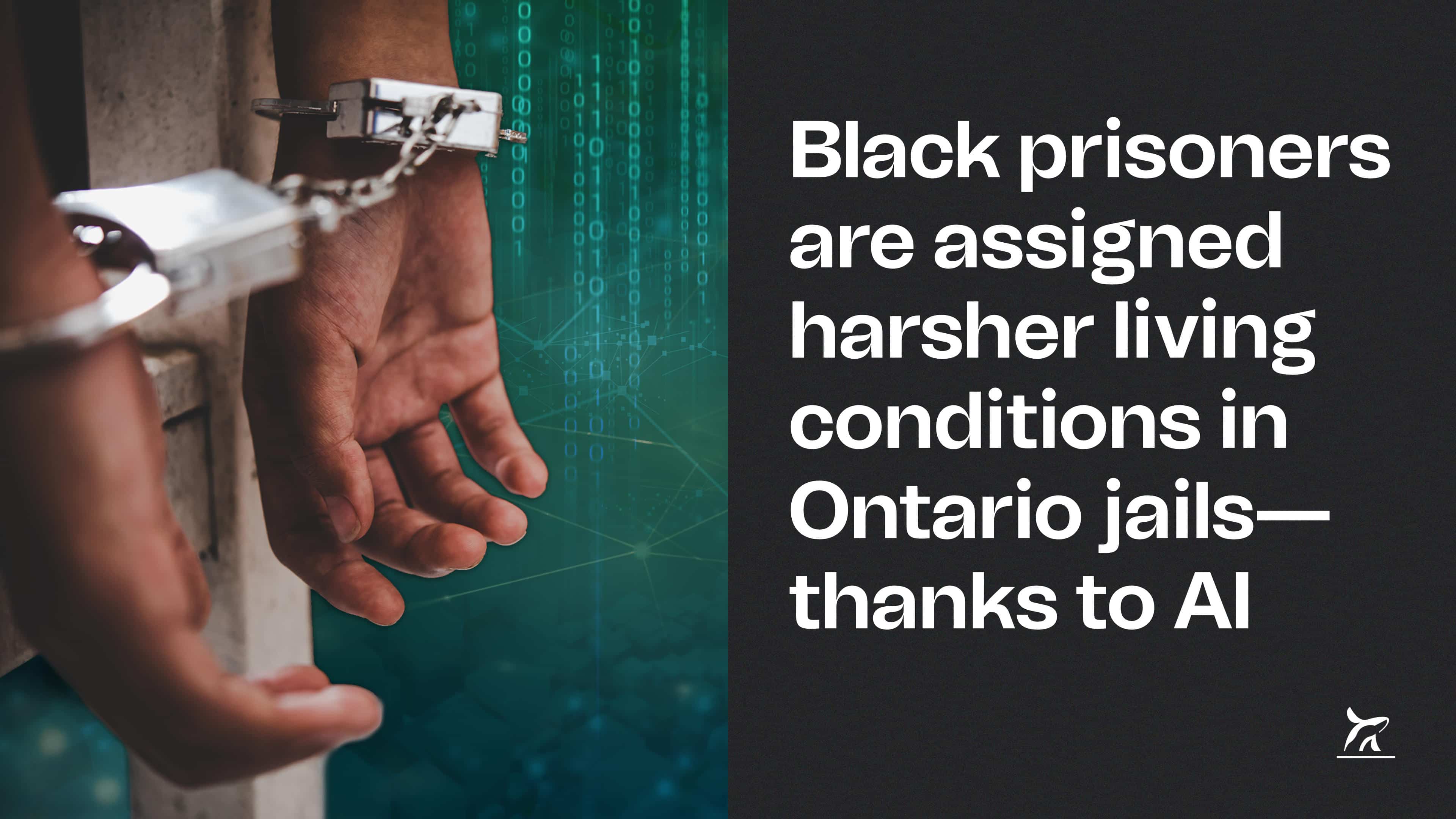
Black prisoners are assigned harsher living conditions in Ontario jails—thanks to AI ⋆ The Breach
Ontario jails are using a program that claims it can predict prisoners’ behaviour, disproportionately putting Black prisoners in higher-security facilities

The brain is a computer is a brain: neuroscience's internal debate and the social significance of the Computational Metaphor
The Computational Metaphor, comparing the brain to the computer and vice versa, is the most prominent metaphor in neuroscience and artificial intelligence (AI). Its appropriateness is highly debated in both fields, particularly with regards to whether it is useful for the advancement of science and technology. Considerably less attention, however, has been devoted to how the Computational Metaphor is used outside of the lab, and particularly how it may shape society's interactions with AI. As such, recently publicized concerns over AI's role in perpetuating racism, genderism, and ableism suggest that the term "artificial intelligence" is misplaced, and that a new lexicon is needed to describe these computational systems. Thus, there is an essential question about the Computational Metaphor that is rarely asked by neuroscientists: whom does it help and whom does it harm? This essay invites the neuroscience community to consider the social implications of the field's most controversial metaphor.

AI Epistemic Risks: Emerging Mechanisms & Evidence
<p>Advances in artificial intelligence pose risks to humanity's collective capacity to form accurate beliefs, reason well, and maintain a healthy information en
The case for friction in AI-mediated information seeking and learning
Introduction. This paper challenges the assumption that frictionless AI-mediated information seeking represents progress. We argue that AI systems eliminating productive friction, such as uncertainty, exploration, and reflective processes, undermine intellectual virtues essential for critical thinking in an AI-saturated information environment. Method. This conceptual article employs a theory synthesis approach, drawing on library information science (LIS) theories of information behaviour, experience, and literacy, virtue epistemology, and human–computer interaction (HCI) friction design literature. Analysis. We map intellectual virtues such as curiosity, thoroughness, and intellectual humility onto the Association of College and Research Libraries (ACRL) Framework for Information Literacy for Higher Education, building on and extending previous analyses. We connect dimensions of virtuous search to AI system design principles and align friction types with specific intellectual virtues. Results. We propose three design principles for human-centred AI systems (representation, affordance, and facilitation) and develop a typology that maps friction interventions to intellectual virtues, providing concrete examples for each. Conclusion. Productive friction should be understood as a feature supporting intellectual development, not a barrier to efficiency. The design choices made today will determine whether AI serves as intellectual scaffolding or cognitive crutch.

AI learns language from skewed sources. That could change how we humans speak – and think | Bruce Schneier
Large language models aren’t trained on real-life conversations. As we encounter their language, it could affect our own

FRICTIONAL AI WORKSHOP
Topics of the Workshop In its third edition, this workshop builds on and expands its exploration of friction-in-design in AI systems, hosting a full-day event that challenges the pursuit of seamless, rapid interactions. In contrast to the conventional narrative that human over-reliance on AI stems
I found the "OMG AI ISN'T SEARCH WE LOSE SOMETHING INEXPRESSIBLE ABOUT THE HUMAN SPIRIT IF WE'RE NOT USING THE SPECIFIC GOOGLE DOT COM I MADE MY FANCY TECH CAREER ON DON'T LOOK TOO CLOSELY YOU'LL REALIZE IT WAS ADS THE WHOLE TIME" stuff really annoying on here the other day so here is a comparison
Cat Hicks
I really have no patience left for design speculation without empiricism