Collection
AI and/for science

Updated 2d
Collection
Updated 2d
Becoming a stranger in my own field
There is a difference between making scientific work more accessible and changing what institutions recognize as valuable scientific work.

John Horton on Twitter / X
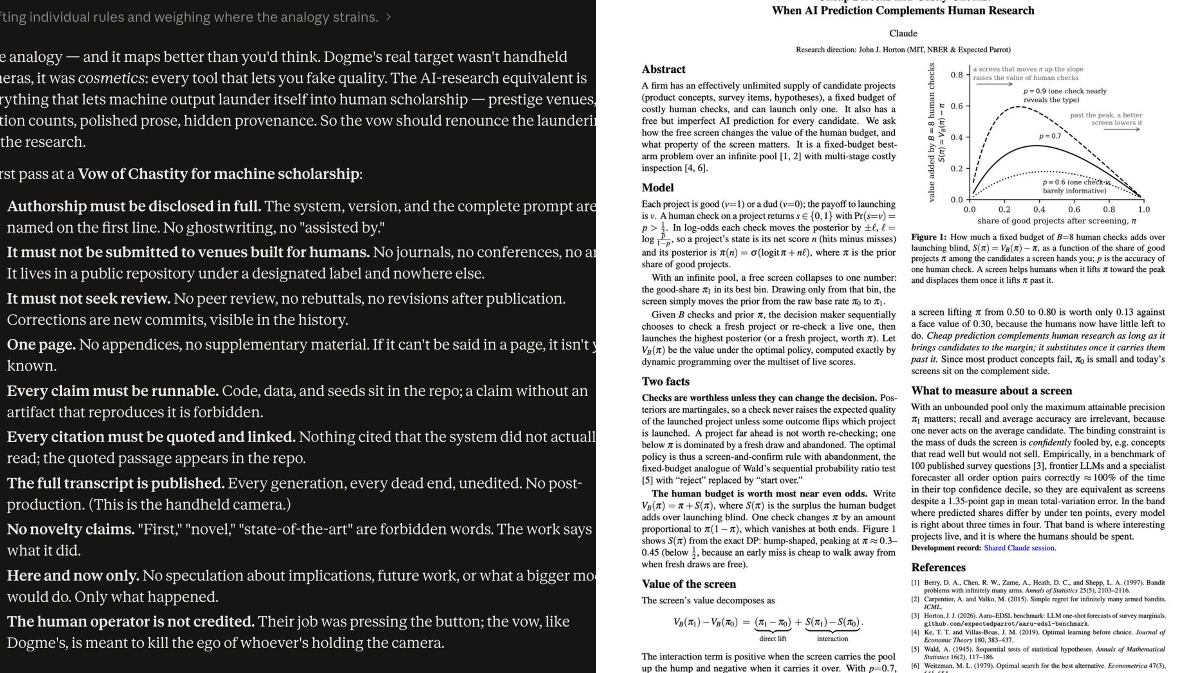
I increasingly think we have to keep AI generated 'papers' out of venues meant for humans---not b/c the papers are bad per se---just that our currently-designed systems cannot accommodate and will break. But I also think what we need a venue for AI generated work (it's good &… pic.twitter.com/fXd92SYbN5— John Horton (@johnjhorton) September 29, 2026
Gautam Kamath on Twitter / X
Nihar Shah did a heroic experiment for TMLR: he spent 20-25 hours over two weeks interviewing authors of seemingly low-quality submissions about their own papers. He confirmed what we all suspected: people submitting these papers have *no idea* what is going on in them. https://t.co/6CJF152u7I— Gautam Kamath (@thegautamkamath) September 16, 2026
Talia Ringer 🕊🪬 on Twitter / X
Poured my heart and soul into advocating for formal proof with AI assistance in a mathematical setting because of the large collaborations I thought it could empower. (1/3)— Talia Ringer 🕊🪬 (@TaliaRinger) September 10, 2026
Andy Matuschak on Twitter / X
We might become grey goo, but before that, what about our spirits? "The world it envisions for all of us is small, flat, grey, leveled of all exception… a world without heroes or glory… without myths, without men who rise above the rest…"That quote is from a Marco Rubio…— Andy Matuschak (@andy_matuschak) September 9, 2026
Big Tech’s War on Human Achievement | Compact
Just a couple weeks ago, Secretary of State Marco Rubio made conservatives cheer when he delivered a sharp rebuke to communism not only for the atrocities committed in its name, but for the picture of human life underlying it.
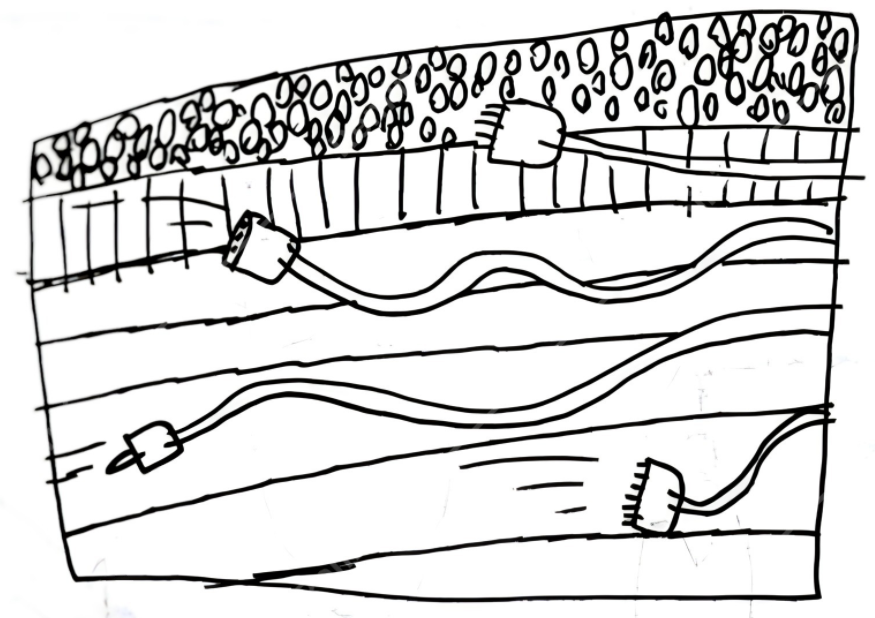
Reviewer Commitment to Authorial Accountability
A commitment by peer reviewers to decline review invitations when a submitted paper's prose appears to be predominantly AI-generated.
This morning, I had the distinct honour of giving the opening keynote at #RSECon26: "Where does the rigour go? Research software and the future of trustworthy science" The core argument: AI is… | Arfon Smith
This morning, I had the distinct honour of giving the opening keynote at #RSECon26: "Where does the rigour go? Research software and the future of trustworthy science" The core argument: AI is making it dramatically cheaper to produce plausible scientific outputs, without necessarily making them cheaper to check. The scarce resources are shifting towards attention, judgment, and verification. This is no doubt a disruptive time for research software engineers and research more generally. For Research Software Engineers specifically I think that creates some important new opportunities around: encoding domain judgment, building verification infrastructure, connecting agents to reality, and helping ensure that the emerging verification layer for science remains open. Thanks to everyone at RSECon26 for the thoughtful discussion, and especially to the many people whose work and ideas I that heavily influenced this talk. Link to slides in first comment

OpenAI fought dirty on career-making math problem, says NYU mathematician | TechCrunch
There is a $1 million bounty for the first person providing a solution to the Navier-Stokes existence and smoothness problem.

Terence Tao (@tao@mathstodon.xyz)
In basic research, such as pure mathematics, one might naively expect that the natural question to ask with regards to a given problem X in a field is "What is the answer to X?". But in many cases the more valuable question is "What can be learned from studying X?" The answer to X itself can of course be one of the things learned in this process of study; but one can learn far more useful information besides, such as * What are the main difficulties to overcome to resolve X? * What new techniques can one discover in order to solve X? * Why are existing techniques insufficient to solve the problem by itself? * How does X relate to results in prior literature? * Can one uncover new connections between X and other topics Y, Z, ...? * What are some natural related or followup questions X', X'', ... to study? Nevertheless, until recently the two questions were closely aligned, to the point where it was not really necessary to distinguish the two: the only practical route to solving a difficult problem was to first address many of the subquestions listed above. (1/3)
Simon on Twitter / X
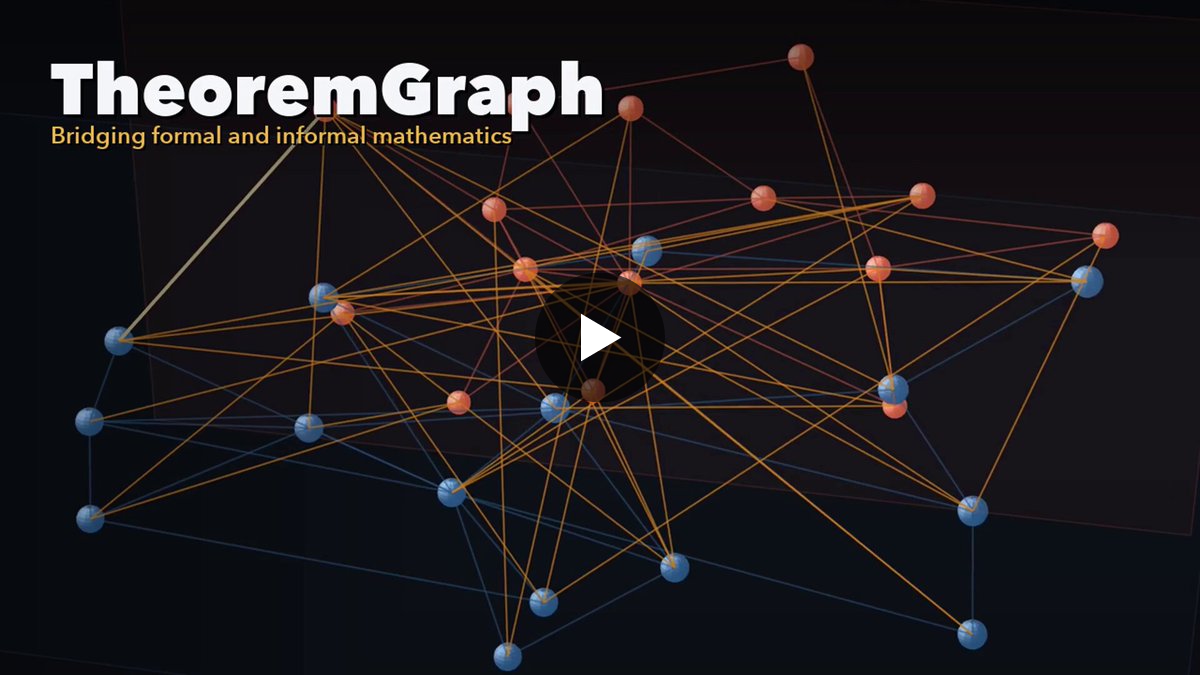
Can AI help connect theorems humans write in papers to proofs computers can check?We just released TheoremGraph (https://t.co/PQ8FcFQGat), and I made a 3Blue1Brown style video overview of the idea.This project was my first real research experience, and it meant a lot. Start… pic.twitter.com/yMUA0QziXM— Simon (@waskaja) June 29, 2026
Przemek Chojecki | PC on Twitter / X
The Growing Map of Open Mathematical Problems.We mapped 15,000+ conjectures from UnsolvedMath to show potential links between concepts.It also shows how under formalized the frontier is (less than 10%). pic.twitter.com/nm0PCpXVPf— Przemek Chojecki | PC (@prz_chojecki) August 28, 2026

AI Simulation Platform for Human Behavior | Simile
Simulate how real customers respond to a launch, price change, or campaign — before you ship. Built by the Stanford researchers behind generative agents.

AI for science: What can it do? Can it do things? Let’s find out!
A what we’re reading spotlight

OSF
Previewing the Model Hardware Standard
Anthropic is opening a research preview of the Model Hardware Standard (MHS), a shared specification for AI agents to safely operate physical devices, to a first group of scientific research labs and advanced manufacturers.

On genAI: Was prototyping really a bottleneck?
I keep hearing folks claim that the fact we can ‘prototype’ so quickly now is a good thing (thanks to modern genAI). But what if the slow parts about prototyping are actually what make it worth doing?
Aniket Panjwani on Twitter / X
Here's something I don't understand about Refine.1 review costs $50 and 10 reviews cost $300. So, unless they're taking a loss, average cost of inference on a Refine review is no more than $30.On a ChatGPT Pro plan, for $200/mo, you're getting the equivalent of ~$14k/mo in…— Aniket Panjwani (@aniketapanjwani) August 20, 2026
An interesting thing is happening to me at the moment. I have a standing bug bounty policy for my first authored scientific work. That means, I've committed to pay people who report bugs in my code, up to 750€ for severe errors. Since GPT-6 Astra came out, I'm now getting several bug reports daily.
