Collection
Social Media - Algorithmic Distortions and Polarization

Updated 10d
Collection
Updated 10d
Who Participates in Politics on Social Media, and Why?
People really do learn about politcs on social media says a new study from Belgium, but the loudest voices are often not the most objective, writes Tim Bernard.

Beyond Misinformation: Social Media and the Sculpting of Epistemic Agency
ABSTRACT The dominant account of social media's epistemic harms focuses on the spread of misinformation and the production of false beliefs at scale. This paper argues that the misinformation narrative, whatever its merits, has obscured a deeper and more intimate form of epistemic damage. Dominant social media platforms do not merely supply bad inputs to stable epistemic machinery. They reshape the machinery itself. I argue that social media platforms are powerful engines for sculpting epistemic agency via two mechanisms: normative learning, through which users internalize descriptive and injunctive norms about how to interact with evidence, and reinforcement learning, through which habitual patterns of epistemic response are developed. In these ways, platforms can reshape users' epistemic styles, including their testimonial policies, evidential thresholds for belief revision, and theoretical values governing how they select explanations. This should trouble us, as the constraints driving which styles are produced are systematically orthogonal to truth and ignore information about the environments agents inhabit. This discussion identifies a neglected form of epistemic hostility: not the exploitation of existing cognitive vulnerabilities to implant false beliefs, but the production of new vulnerabilities that can then be exploited. From this, more and better evidence cannot save us.

You’ll do anything for your baby. The algorithm knows how to exploit that.
In the mega-consumption era of parenthood, the internet tells new moms that products can solve the hardest parts of having a newborn. All they have to do is add to cart.
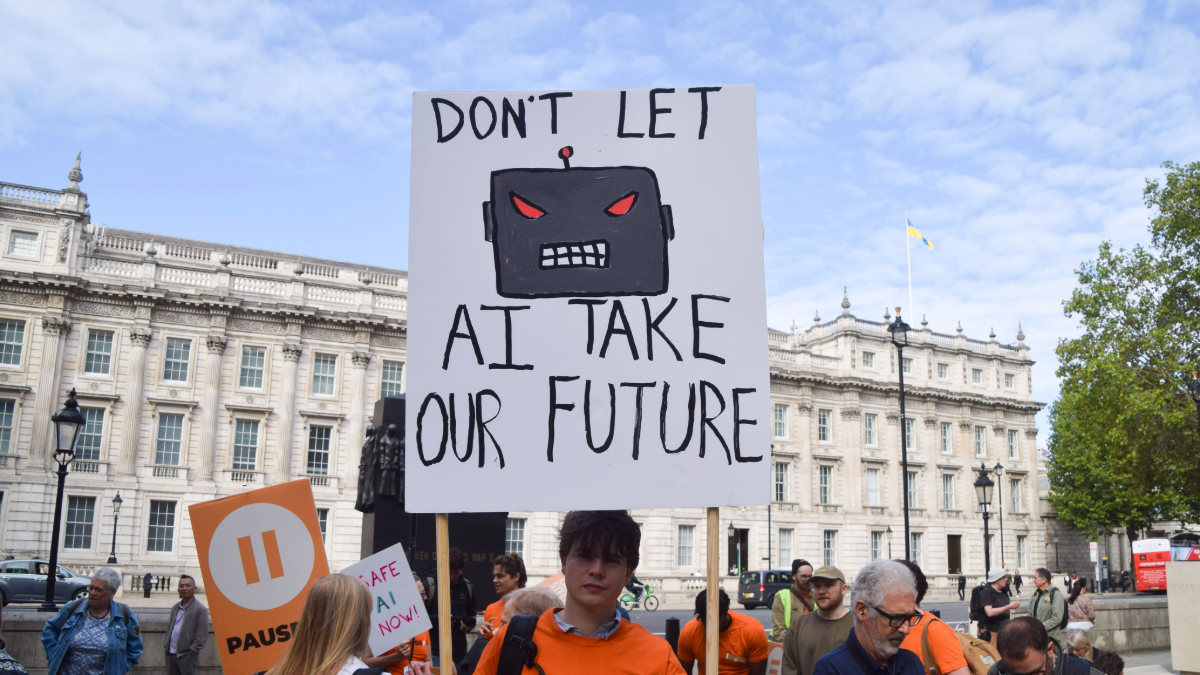
The Like Button Helped Social Media Put Profit Over People. We Can’t Let AI Do the Same.
AI will supercharge whatever economy we put it in, so let’s put it in one governed by and for the people, writes Justin Rosenstein.
Middleware for Feed Recommendation in Practice: How Feed Creators...
Scholars have long proposed third-party middleware as an alternative to centralized algorithmic feeds: feeds built and distributed by independent feed creators. This vision saw no large-scale...

Opinion | An Online Loophole That Promotes Violence
Section 230 shouldn’t preclude liability for algorithms that push harmful content.
Supreme Court Halts Federal Limits on Social Media Algorithm Regulation
U.S. Supreme Court Blocks Online Transparency and Fairness Act On October 1, 2024, the U.S. Supreme Court issued a critical emergency injunction that effectively halted the enforcement of the Online…

America Must Regulate Social Media
America invented social media. Now, it must invent regulations that protect users and free speech, argues John Wihbey.
CURTIS, KELLY INTRODUCE ALGORITHM ACCOUNTABILITY ACT
Senators Curtis and Kelly introduced legislation to modernize online protections and hold social media companies accountable for harms caused by content pushed by their algorithmic feeds. The bill, the Algorithm Accountability Act, amends Section 230 of the Communications Decency Act of 1996 to impose a duty of care on the companies that utilize recommendation-based algorithms.
Facebook loses users for the first time in its history
Facebook parent Meta’s stock nosedived in after-hours trading as the company refocuses on the "metaverse" and reports its hardware division bled more than $3 billion.

Impact of the COVID-19 pandemic on social media
Social media became an important platform for interaction during the COVID-19 pandemic, coinciding with the onset of social distancing. According to a study conducted by Facebook's analytics department, messaging rates rose by over 50% during this period. Individuals confined to their homes utilized social media not only to maintain social connections but also as a source of entertainment to alleviate boredom. Concerns arose regarding the overreliance on social media for primary social interactions, particularly given the constraints imposed by the pandemic.

Gell-Mann Amnesia effect
Coined by American author Michael Crichton in a 2002 speech, named after American physicist Murray Gell-Mann (see quotation).
New study shows just how Facebook's algorithm shapes conservative and liberal bubbles
Research conducted at the height of the 2020 election reveals new details about how Facebook's algorithms handle political content. But it suggests there are no easy fixes to political polarization.

Shifts in U.S. Social Media Use, 2020-2024: Decline,...
Using nationally representative data from the 2020 and 2024 American National Election Studies (ANES), this paper traces how the U.S. social media landscape has shifted across platforms,...
Facebook, YouTube and Twitter remove disinformation targeting Ukraine
Facebook parent company Meta says it has uncovered Russian efforts to undermine trust in the Ukrainian government and to hack Ukrainian military officials and journalists using social media.
Facebook’s Attack on Research is Everyone's Problem
Facebook recently banned the accounts of several New York University (NYU) researchers who run Ad Observer, an accountability project that tracks paid disinformation, from its platform. This has
2021 Facebook leak
In 2021, an internal document leak from Facebook (now Meta Platforms, or Meta) showed it was aware of harmful societal effects from its platforms, yet persisted in prioritizing profit over addressing these harms. The leak, released by whistleblower Frances Haugen, resulted in reporting from The Wall Street Journal in September, as The Facebook Files series from journalist Jeff Horwitz, as well as the Facebook Papers, by a consortium of news outlets the next months.
It's important to understand: social networks are not meant to be one-size-fits all! When Meta (which makes Threads, as well as Facebook and Instagram) creates platforms that have hundreds of millions of users, they do things like enable genocides, where tens of thousands of innocent people die.

Christopher Mims
So I guess either Bluesky becomes a nonprofit or we all start sharing our Threads handles on here…?
