


👩🏾💻 Building open tech for communities with @eskahlay.com 👵🏾 In tech since before the cloud 🏳️🌈🌌 Part of NorthSky Social chipnick.com 🇩🇪🇸🇩🏳️🌈
👩🏾💻 Building open tech for communities with @eskahlay.com 👵🏾 In tech since before the cloud 🏳️🌈🌌 Part of NorthSky Social chipnick.com 🇩🇪🇸🇩🏳️🌈
DASL: ATFISL — Content Discovery with the AT Protocol
ATFISL is a content discovery system for CIDs built with the AT Protocol. Publishers announce download locations for CIDs by publishing records to their AT Protocol repositories. Indexers aggregate these records into a lookup table from CIDs to live locations. ATFISL is complemented by FISL which defines an HTTP query API for ATFISL records.

DASL: FISL — Finding Internet Structures & Links
FISL is an HTTP lookup API that maps CIDs to locations, so that a client with a CID can find out where to retrieve it from and who announced it. A client sends a CID, and the index returns the URLs where content can be retrieved, along with the identity of the publisher when known. FISL specifies only the query interface, so it works with any indexing system that supplies location records.

Using AI for just 10 minutes erodes your ability to persist at hard things - Berkeley News
A UC Berkeley researcher co-authored a study that raises profound questions about how we interact with artificial intelligence in education — and daily life.

cooperative/Formation Documents at main · NorthskySocial/cooperative
Information about our Cooperative. Contribute to NorthskySocial/cooperative development by creating an account on GitHub.
Northsky Update #2: Our Cooperative Structure
We’re excited to bring you another Newsletter as we approach launching Northsky. This time we’ll be covering:
Introducing Bluesky Protocol Services - AT Protocol
A new home for the infrastructure Bluesky runs on the open network — including Jetstream v2 with network replay, a new Jetstream SDK, and a lex-based TypeScript SDK
The Atproto Spaces Alpha is Live - AT Protocol
Atproto Spaces, formerly known as “the permissioned data protocol,” is a new extension to atproto that enables non-public data. The alpha is now officially open. Here’s how to develop with it and what to expect as we work towards the full release.
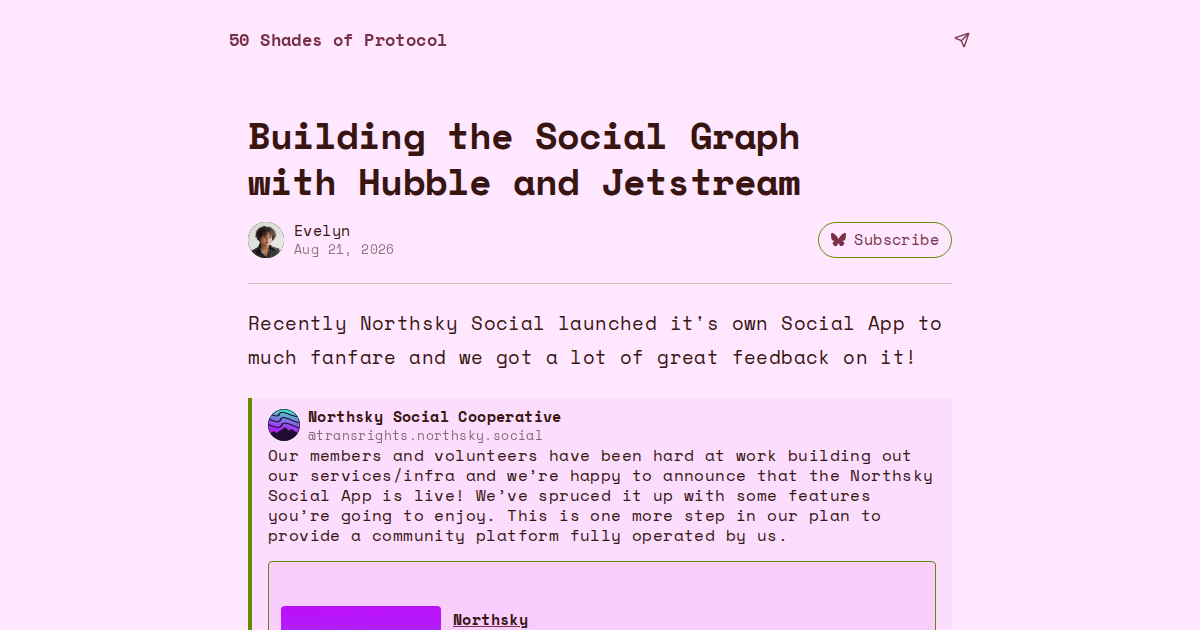
Building the Social Graph with Hubble and Jetstream - 50 Shades of Protocol
Recently Northsky Social launched it's own Social App to much fanfare and we got a lot of great feedback on it! Of course, one thing that many users noticed was...
Africa - Assess Technology
[et_pb_section fb_built=”1″ _builder_version=”4.6.6″ _module_preset=”default” background_color=”#333333″ custom_padding=”0px||1px||false|false” locked=”off”][et_pb_row column_structure=”1_2,1_2″ use_custom_gutter=”on” gutter_width=”1″ make_equal=”on” _builder_version=”4.7.4″ _module_preset=”default” width=”100%” max_width=”100%” module_alignment=”center” custom_margin=”||||false|false” custom_padding=”0px||0px||false|false”][et_pb_column type=”1_2″ _builder_version=”4.6.6″ _module_preset=”default” background_color=”#222222″][et_pb_text _builder_version=”4.6.6″ _module_preset=”default” text_font=”||||||||” text_text_color=”#ffffff” text_font_size=”30px” text_line_height=”1.4em” header_text_color=”#ffffff” header_font_size=”60px” header_2_text_color=”#8cc401″ header_2_font_size=”45px” header_3_text_color=”#ffffff” custom_margin=”||||false|false” custom_padding=”2em|10%|1em|10%|false|true” custom_padding_tablet=”” custom_padding_phone=”|5%||5%|true|true” custom_padding_last_edited=”on|phone”] Africa AfriTAP Africa Technology Assessment Platform [/et_pb_text][/et_pb_column][et_pb_column type=”1_2″ _builder_version=”4.6.6″ _module_preset=”default” background_enable_image=”off”][et_pb_image src=”http://assess.technology/wp-content/uploads/2020/11/Mali4.jpg” title_text=”Mali4″ align=”center” _builder_version=”4.7.4″ _module_preset=”default”][/et_pb_image][/et_pb_column][/et_pb_row][/et_pb_section][et_pb_section fb_built=”1″ […]
Key Agreement for Decentralized Secure Group Messaging with Strong Security Guarantees
Secure group messaging protocols, providing end-to-end encryption for group communication, need to handle mobile devices frequently being offline, group members being added or removed, and the possibility of device compromises during long-lived chat sessions. Existing work targets a centralized network model in which all messages are routed through a single server, which is trusted to provide a consistent total order on updates to the group state. In this paper we adapt secure group messaging for decentralized networks that have no central authority. Servers may still optionally be used, but they are trusted less. We define decentralized continuous group key agreement (DCGKA), a new cryptographic primitive encompassing the core of a decentralized secure group messaging protocol; we give a practical construction of a DCGKA protocol and prove its security; and we describe how to construct a full messaging protocol from DCGKA. In the face of device compromise our protocol achieves forward secrecy and post-compromise security. We evaluate the performance of a prototype implementation, and demonstrate that our protocol has practical efficiency.
LLM APIs are a Synchronization Problem
Maybe the LLM message APIs should be rethought as a synchronization problem.
The Real Name Fallacy - Coral by Vox Media
The Coral Project is an open source project to help publishers of all sizes build better communities around their journalism. We’re creating tools that help everyone to feel safe, respected, and heard.

Exit 8 (2025) | Rotten Tomatoes
Discover reviews, ratings, and trailers for Exit 8 (2025) on Rotten Tomatoes. Stay updated with critic and audience scores today!

On The Enshittification of Audre Lorde: "The Master's Tools" in Tech Discourse
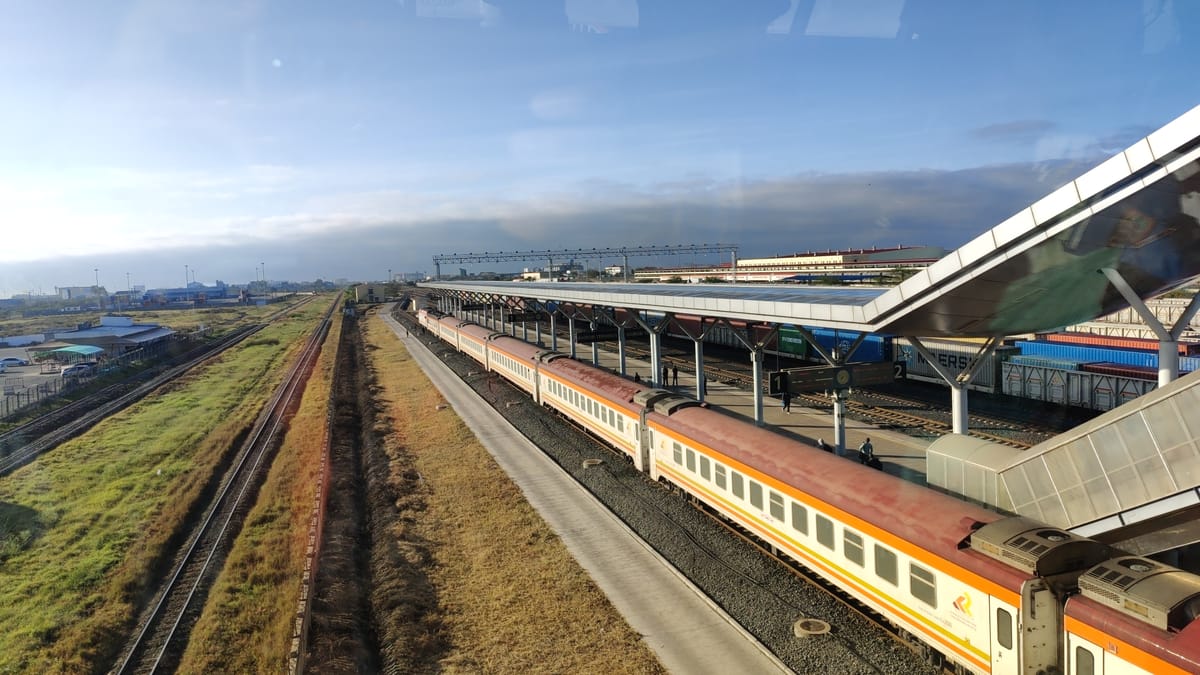
🖼️Cover Photo: Train at the Nairobi terminus of the Mombasa–Nairobi Standard Gauge Railway. It runs parallel to the Uganda Railway that was completed in 1901. The first fare-paying passengers boarded the "Madaraka Express" on Madaraka Day (1 June 2017), the 54th anniversary of Kenya's attainment of self-rule from Great
Composable Trust, Part 3: 1 Community, 3 Sovereigns, No Landlords - Eclectic Corvine Muses
An architectural model to yield members, Rosters, and Venues sovereignty over their own domains, and none over each other’s.