HATS — Health records that belong to the patient
HATS — health records that belong to the patient. Patients hold their records, institutions ask for what they need, the legal system gets a record of everything, and at the center, builders write the coordinator: code that knows the rules.
“…and the proof is checked in Lean”
This post is an attempt to explain in simple terms how to interpret claims of the form “this theorem is correct because it was checked in Lean”. The summary is: there is an important si…
Correct, transparent, and reproducible data agents
An annotated walkthrough of our posit::conf(2026) keynote.
Home | GO FAIR Foundation
Solutions making data universally Findable, Accessible, Interoperable, Reusable [FAIR] are beginning to emerge. The GO FAIR Foundation guides people and organisations on implementation choices fit to their purpose.
maDMP API specification presented at the 27th RDA Plenary Meeting in London
The maDMP Common API Working Group presented its final result at the RDA Plenary Meeting last week.

You can just review things: A digital ethnography of informal peer review
Across scholarly communities, manuscripts face similar evaluative rituals: editors invite experts to privately assess submissions through formal peer reviews. This closed, loosely structured, and publisher-mediated process is now being supplemented by critiques on open, distributed platforms. We call this practice, a blend of three open peer review variants, informal peer review as it is accessible to outsiders, unmediated by publishers, and conducted across public platforms. Informal peer reviewers range from occasional error detectors to experienced sleuths who identify plagiarism, fraud, errors, conflicts of interest, and conceptual flaws. They may interpret methods, clarify jargon, assess value, and connect to related work. Here, we asked four questions: (1) Who are informal peer reviewers? (2) Where do they work? (3) How do they evaluate research? and (4) What are their impacts? To answer these questions, we conducted a cross-platform digital ethnography with participant observation. We traced discourse across communities over four months and revisited cases after nine and twelve months. From 15 communities, we selected 12 case mentions (10 unique cases) and 8 meta-commentaries from 26 reviewers. Using open and axial coding, we generated 1,080 codes and four themes: reviewers are a motley crew, they self-organize across subpar digital spaces, use deep, uncommon strategies, and they face resistance from authors, publishers, and editors. Informal peer review, we concluded, is a fragile, minimally governed patchwork of people, platforms, and practices, as well as an emerging evidence infrastructure that can be scaled up. We advise advocates and tool-builders to evolve informal review tools, communities, training, and governance by connecting to scholars' values, reducing participation friction, and rewarding attempts to extend the scholarly dialogue.

Sharing our work on sensemaking data in science + connections to nanopubs
Just wanted to share a preprint of ours that may be of interest to this community. We presented it last month at the Metascience conference.
Local AI, together
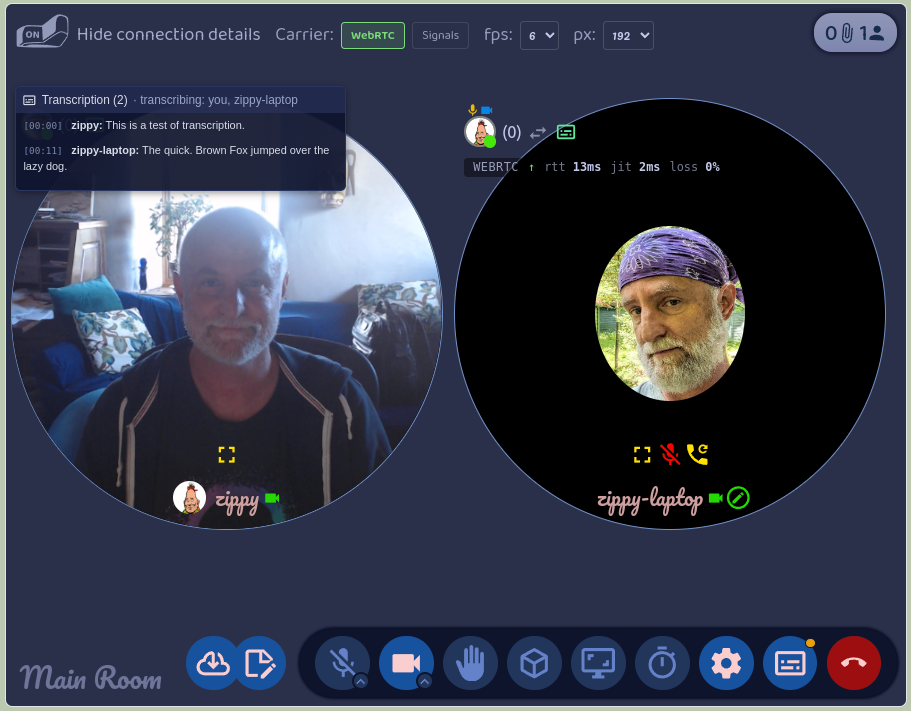
Moss now turns speech into text on your own computer, and Presence uses it so a whole call gets transcribed with nobody’s voice leaving their machine. Any Moss tool can use it.
Joining the Dots—Knowledge Graphs for Investigators and Analysts
Anyone who has watched a detective drama knows the scene. A wall covered in photographs, newspaper cuttings and index cards, with red string running from pin to pin.

The new way we’ll do science
Papers should become human-readable views over a graph of data, tools, results, and certificates.

Harnessing automation and AI tools to advance data curation and connect digital research infrastructures – RDA
QuestionPro offers a suite of features and question types - all for free. We now can run unlimited surveys and gather unlimited responses.

Documenting LLM Interactions throughout the Research Data lifecycle – RDA
Plenary: RDA 25th Plenary Meeting [part of International Data Week 2025]
Beyond the Chatbot: Standards for AI Agents in Research Data Workflows – RDA
QuestionPro offers a suite of features and question types - all for free. We now can run unlimited surveys and gather unlimited responses.
From Tools to Adoption: A Path to Modular and Interactive Scientific Publishing | ICOR
Tracy Teal, openRxiv Rowan Cockett, Continuous Science Foundation Monica Granados, Creative Commons Jason Priem, OpenAlex Paul Shannon, eLife

Why I Use SHACL For Defining Ontology Models | TopQuadrant
This is the second blog on what modeling language we recommend to use when creating ontologies. In this blog I will talk about what I do use.