You Can Help Solve Burnout in Open Source
A list of people and projects working on structural solutions to problems that cause burnout in open source software

You Can Help Solve Burnout in Open Source
A list of people and projects working on structural solutions to problems that cause burnout in open source software
Report on Burnout in Open Source Software
I am currently working on a report on the causes of burnout in open source software, and am inviting the OSS community to share their thoughts!

Invisible Exploitation: How Capital Extracts Value Beyond Wage Labor - Monthly Review
Eva Swidler is an environmental political economist and social historian. She teaches at Goddard College and the Curtis Institute of Music. The Marxist analysis of work under capitalism has long... READ MORE

Reclaiming the Computing Commons
Resisting the commodification of information is a political struggle, not a technical one.

Open Source Resistance
A direct-action manifesto for maintainers keeping open source alive on company time.
Commons
The commons are the cultural and natural resources accessible to all members of a society, including natural materials such as air, water, and a habitable Earth. These resources are held in common even when owned privately or publicly. Commons can also be understood as natural resources that groups of people manage for individual and collective benefit. Characteristically, this involves a variety of informal norms and values employed for a governance mechanism. Commons can also be defined as a social practice of governing a resource not by state or market but by a community of users that self-governs the resource through institutions that it creates.

Nobody pays for open source. We can force them to. | Seldo.com
Thirty years of voluntary funding schemes haven't paid open source maintainers because asking doesn't scale. The real money already flows — to JFrog, Docker, Sonatype — at the registry layer. The fix: registries charge companies for supply (they already do), then route a slice automatically to the maintainers who make that supply worth having.
Laws of Tech: Commoditize Your Complement
A classic pattern in technology economics, identified by Joel Spolsky, is layers of the stack attempting to become monopolies while turning other layers into perfectly-competitive markets which are commoditized, in order to harvest most of the consumer surplus; discussion and examples.

Open Source is Broken
The Open Source movement, as championed by the OSI, prizes absolute openness above all other concerns. Openness, they claim, is an absolute good, from which all other virtues flow, not to be questioned or criticized. It doesn’t matter if that openness enables evil in the world, without openness we
Think Like a Commoner | A Short Introduction to the Life of the Commons
In our age of predatory markets and make-believe democracy, our troubled political institutions have lost sight of real people and practical realities. But if you look to the edges, ordinary people are reinventing governance and provisioning on their own terms. The commons is arising as a serious, practical alternative to the corrupt Market/State.
Katerina Marchán (@zkat@toot.cat)
Open source maintainers of major projects (hi) are not ready to accept and talk about how the cultural insistence on permissive licensing is just straight up labor exploitation taking advantage of our addiction to popularity (also hi). We’re doing this to ourselves too, you know.


The Free-Libre / Open Source Software (FLOSS) License Slide
There are a large number of Free-Libre / Open Source Software (FLOSS) licenses, but only a few are widely used. The widely-used licenses tend to be compatible, i.e., the software can be combined to produce a larger work. The following “license slide” figure makes it easy to see when common licenses can be combined:
Collection

Updated 3d
Burnout in Open Source

Burnout in Open Source: A Structural Problem We Can Fix Together ✸ Software Stewardship Lab
mirandaheath.website
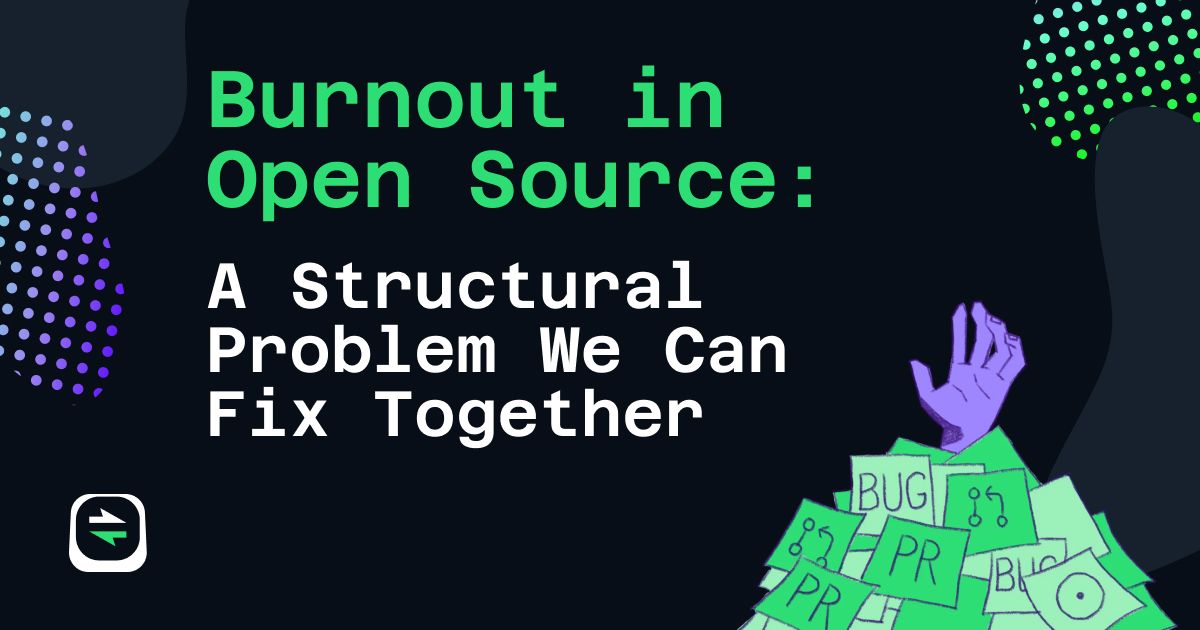
Burnout in Open Source: A Structural Problem We Can Fix Together | Open Source Pledge
Report on Burnout in Open Source Software
Time to leave.
Sustainable Open Source: The Maintainers Perspective or: How I Learned to Stop Caring and Love Open Source
