Collection
reading list

Updated 2d
Collection
Updated 2d
Media over QUIC Overview
This document provides a high-level overview of the Media over QUIC (MoQ) protocol suite. It describes the architecture, data model, transport protocol, streaming formats, and security mechanisms that together enable scalable low-latency media delivery over the Internet. The document explains how these components relate to each other and how they are composed to create interoperable media applications.
designing a storage engine for AT Protocol backlinks - charlotte!
economical full-network-scale application-agnostic data storage
ATOM: AT Protocol Over MoQ Transport
This document specifies how the Authenticated Transfer (AT) Protocol can leverage Media over QUIC Transport (MOQT) for efficient data synchronization across decentralized social networks. The AT Protocol's firehose event stream and repository synchronization mechanisms map naturally to MOQT's publish/subscribe model, enabling scalable relay infrastructure, priority-based delivery, and improved resilience for large-scale social data distribution. This specification addresses the challenges of the current WebSocket- based transport and demonstrates how MOQT's relay architecture, group-based caching, and multiplexed streams provide significant benefits for AT Protocol deployments at scale.
The Noise Protocol Framework
Noise is a framework for crypto protocols based on Diffie-Hellman key agreement. Noise can describe protocols that consist of a single message as well as interactive protocols.
User Controlled Authorization Network (UCAN) Specification
User-Controlled Authorization Network (UCAN) is a [trustless], secure, [local-first], user-originated, distributed authorization scheme. This document provides ...
Overview: An Ode to the Granovetter Diagram
E: Cryptographic Capabilities for Distributed Smart Contracting
Uncertain Judgements: Eliciting Experts' Probabilities
Elicitation is the process of extracting expert knowledge about some unknown quantity or quantities, and formulating that information as a probability distribution. Elicitation is important in situations, such as modelling the safety of nuclear installations or assessing the risk of terrorist attacks, where expert knowledge is essentially the only source of good information. It also plays a major role in other contexts by augmenting scarce observational data, through the use of Bayesian statistical methods. However, elicitation is not a simple task, and practitioners need to be aware of a wide range of research findings in order to elicit expert judgements accurately and reliably. Uncertain Judgements introduces the area, before guiding the reader through the study of appropriate elicitation methods, illustrated by a variety of multi-disciplinary examples. This is achieved by: Presenting a methodological framework for the elicitation of expert knowledge incorporating findings from both statistical and psychological research. Detailing techniques for the elicitation of a wide range of standard distributions, appropriate to the most common types of quantities. Providing a comprehensive review of the available literature and pointing to the best practice methods and future research needs. Using examples from many disciplines, including statistics, psychology, engineering and health sciences. Including an extensive glossary of statistical and psychological terms. An ideal source and guide for statisticians and psychologists with interests in expert judgement or practical applications of Bayesian analysis, Uncertain Judgements will also benefit decision-makers, risk analysts, engineers and researchers in the medical and social sciences.
Crest factor
Crest factor is a parameter of a waveform, such as alternating current or sound, showing the ratio of largest value to the more typical value. More specifically, crest factor is the peak amplitude of the waveform divided by the root mean square (RMS) value of the waveform. The minimum possible crest factor is 1 or 1:1.
Democratic digital infrastructure for civil society · Theta
How civil society and Danish foundations can support digital democracy
Open Social Web ID - in commons
Approaching a shared method of single sign-on for the entire open social web.
DASL: FISL — Finding Internet Structures & Links
FISL is an HTTP lookup API that maps CIDs to locations, so that a client with a CID can find out where to retrieve it from and who announced it. A client sends a CID, and the index returns the URLs where content can be retrieved, along with the identity of the publisher when known. FISL specifies only the query interface, so it works with any indexing system that supplies location records.

DASL: ATFISL — Content Discovery with the AT Protocol
ATFISL is a content discovery system for CIDs built with the AT Protocol. Publishers announce download locations for CIDs by publishing records to their AT Protocol repositories. Indexers aggregate these records into a lookup table from CIDs to live locations. ATFISL is complemented by FISL which defines an HTTP query API for ATFISL records.


An entire Social Network in 1.6GB (GraphD Part 2)
Roaring Bitmaps offer an even more efficient way to store and query an entire social graph, fitting the entire network of 5.5M users and 164M+ follows into a ~1.6GB SQLite DB on disk.
Sharing a safety tool: announcing policyserv
Matrix, the open protocol for secure decentralised communications

Bryan Newbold: Protocol engineering
A protocol engineer at the social-media platform Bluesky describes building an open protocol around a fast-growing social media platform.

Making MLS more decentralized
It’s no secret that we at Phoenix R&D are big fans of the Messaging Layer Security (MLS) protocol, having helped it to come into existence. It’s a versatile group key agreement and messaging protocol that’s used to power both asynchronous and real-time applications. MLS is
Personal sync servers for composable data
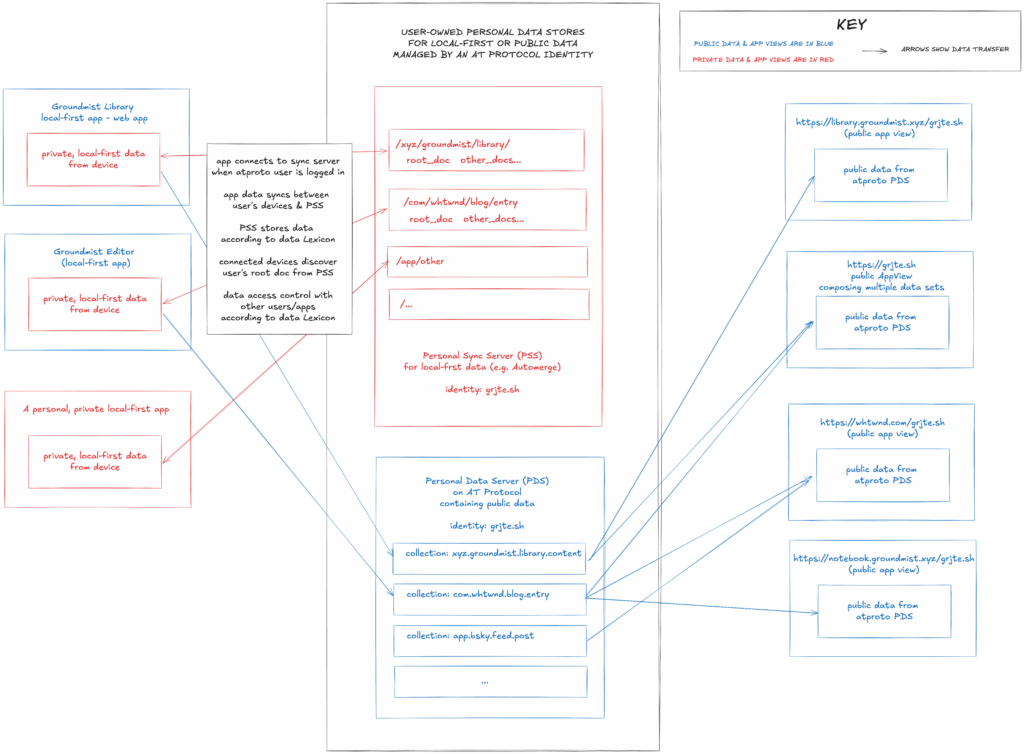
Exploring the possibilities of interoperability and composability for local-first software & data by using a personal sync server tied to an atproto identity