
Stackelberg Mean Field Games: convergence and existence results to the problem of Principal with multiple Agents in competition
In a situation of moral hazard, this paper investigates the problem of Principal with $n$ Agents when the number of Agents $n$ goes to infinity. There is competition between the Agents expressed by the fact that they optimize their utility functions through a Nash equilibrium criterion. Each Agent is offered by the Principal a contract which is divided into a Markovian part involving the state/production of the Agent and a non--Markovian part involving the states/productions of all the other Agents. The Agents are in interactions. These interactions are characterized by common noise, the empirical distribution of states/productions and controls, and the contract which is not assumed to be a map of the empirical distribution. By the help of the mean field games theory, we are able to formulate an appropriate $limit$ problem involving a Principal with a $representative$ Agent. We start by solving the problem of both the Principal and the $representative$ Agent in this $limit$ problem. Then, when $n$ goes to infinity, we show that the problem of Principal with $n$ Agents converges to the $limit$ problem of Principal with a $representative$ Agent. A notable result is that, despite allowing a general type of contracts, it is approximately optimal for the Principal to offer contracts to the $n$ Agents that are maps of the empirical distribution of states/productions and controls of the Agents.

Scalable Neural Incentive Design with Parameterized Mean-Field Approximation
Designing incentives for a multi-agent system to induce a desirable Nash equilibrium is both a crucial and challenging problem appearing in many decision-making domains, especially for a large number of agents $N$. Under the exchangeability assumption, we formalize this incentive design (ID) problem as a parameterized mean-field game (PMFG), aiming to reduce complexity via an infinite-population limit. We first show that when dynamics and rewards are Lipschitz, the finite-$N$ ID objective is approximated by the PMFG at rate $\mathcal{O}(\frac{1}{\sqrt{N}})$. Moreover, beyond the Lipschitz-continuous setting, we prove the same $\mathcal{O}(\frac{1}{\sqrt{N}})$ decay for the important special case of sequential auctions, despite discontinuities in dynamics, through a tailored auction-specific analysis. Built on our novel approximation results, we further introduce our Adjoint Mean-Field Incentive Design (AMID) algorithm, which uses explicit differentiation of iterated equilibrium operators to compute gradients efficiently. By uniting approximation bounds with optimization guarantees, AMID delivers a powerful, scalable algorithmic tool for many-agent (large $N$) ID. Across diverse auction settings, the proposed AMID method substantially increases revenue over first-price formats and outperforms existing benchmark methods.
A tale of a Principal and many many Agents
In this paper, we investigate a moral hazard problem in finite time with lump$-$sum and continuous payments, involving infinitely many Agents with mean field type interactions, hired by one Principal. By reinterpreting the mean$-$field game faced by each Agent in terms of a mean field forward backward stochastic differential equation (FBSDE for short), we are able to rewrite the Principal's problem as a control problem of McKean$-$Vlasov SDEs. We review one general approache to tackle it, introduced recently in [1, 43, 44, 45, 46] using dynamic programming and Hamilton$-$Jacobi$-$Bellman (HJB for short) equations, and mention a second one based on the stochastic Pontryagin maximum principle, which follows [10]. We solve completely and explicitly the problem in special cases, going beyond the usual linear$-$quadratic framework. We finally show in our examples that the optimal contract in the $N-$players' model converges to the mean$-$field optimal contract when the number of agents goes to $+\infty$, thus illustrating in our specific setting the general results of [8].
Non-equilibrium active noise enhances generative memory in diffusion models
Generative diffusion models have emerged as powerful tools for sampling high-dimensional distributions, yet they typically rely on white gaussian noise and noise schedules to destroy and reconstruct information. Here, we demonstrate that driving the generative process out of equilibrium using active, temporally correlated noise sources fundamentally alters the information thermodynamics of the system. We show that coupling the data to an active non-Markovian bath creates a `memory effect' where high-level semantic information (such as class identity or molecular metastability) is stored in the temporal correlations of auxiliary degrees of freedom. Using Fisher information analysis, we prove that this active mechanism significantly retards the rate of information decay compared to passive Brownian motion. Crucially, this memory effect facilitates an earlier and more robust symmetry breaking (speciation) during the reverse generative process, allowing the system to resolve multi-scale structures, reminiscent of metastable states in molecular configurations that are washed out in the typical noising processes. Our results suggest that non-equilibrium protocols, inspired by active matter physics, offer a thermodynamically distinct and potentially advantageous pathway for recovering high-dimensional energy landscapes using generative diffusion.
Will we have a theory for in-the-wild AI agents? - undisciplinary
Thoughts after writing a sociology-meets-physics-meets-agents paper I just put out a preprint out on a theory of role emergence in multi-agent systems (soci…
A Collectivist, Economic Vision for AI
Information technology is in the midst of a revolution in which omnipresent data collection and machine learning are impacting the human world as never before. The word “intelligence” is being used as a North Star for the development of this technology, with human cognition viewed as a baseline. This view neglects the fact that humans are social animals and that much of our intelligence is social and cultural in origin. Moreover, failing to properly situate aspects of intelligence at the social level contributes to the treatment of the societal consequences of technology as an afterthought. The path forward is not merely more data and compute, and not merely more attention paid to cognitive or symbolic representations, but a thorough blending of economic and social concepts with computational and inferential concepts at the level of algorithm design. , The recent focus of AI has been on the exploitation of massive data to mimic and augment human cognitive capabilities. A complementary focus is provided by the social and economic aspects of intelligence.

Agentic AI Needs a Systems Theory
The endowment of AI with reasoning capabilities and some degree of agency is widely viewed as a path toward more capable and generalizable systems. Our position is that the current development of agentic AI requires a more holistic, systems-theoretic perspective in order to fully understand their capabilities and mitigate any emergent risks. The primary motivation for our position is that AI development is currently overly focused on individual model capabilities, often ignoring broader emergent behavior, leading to a significant underestimation in the true capabilities and associated risks of agentic AI. We describe some fundamental mechanisms by which advanced capabilities can emerge from (comparably simpler) agents simply due to their interaction with the environment and other agents. Informed by an extensive amount of existing literature from various fields, we outline mechanisms for enhanced agent cognition, emergent causal reasoning ability, and metacognitive awareness. We conclude by presenting some key open challenges and guidance for the development of agentic AI. We emphasize that a systems-level perspective is essential for better understanding, and purposefully shaping, agentic AI systems.
Social physics in the age of artificial intelligence
Artificial intelligence (AI) systems are rapidly becoming more capable, autonomous, and deeply embedded in social life. As humans increasingly interact, cooperate, and compete with AI, we move from purely human societies to hybrid human-AI societies whose collective dynamics cannot be captured by existing behavioural models alone. Drawing on evolutionary game theory, cultural evolution, and Large Language Models (LLMs) powered simulations, we argue that these developments open a new research agenda for social physics centred on the co-evolution of humans and machines. We outline six key research directions. First, modelling the evolutionary dynamics of social behaviours (e.g. cooperation, fairness, trust) in hybrid human-AI populations. Second, understanding machine culture: how AI systems generate, mediate, and select cultural traits. Third, analysing the co-evolution of language and behaviour when LLMs frame and participate in decisions. Fourth, studying the evolution of AI delegation: how responsibilities and control are negotiated between humans and machines. Fifth, formalising and comparing the distinct epistemic pipelines that generate human and AI behaviour. Sixth, modelling the co-evolution of AI development and regulation in a strategic ecosystem of firms, users, and institutions. Together, these directions define a programme for using social physics to anticipate and steer the societal impact of advanced AI.
Group size effects and collective misalignment in LLM multi-agent systems
Multi-agent systems of large language models (LLMs) are rapidly expanding across domains, introducing dynamics not captured by single-agent evaluations. Yet, existing work has mostly contrasted the behavior of a single agent with that of a collective of fixed size, leaving open a central question: How does group size shape dynamics? Here, we move beyond this dichotomy and systematically explore outcomes across the full range of group sizes. We focus on multi-agent misalignment, building on recent evidence that interacting LLMs playing a simple coordination game can generate collective biases absent in individual models. First, we show that collective bias is a deeper phenomenon than previously assessed: Interaction can amplify individual biases, introduce new ones, or override model-level preferences. Second, we demonstrate that group size affects the dynamics in a nonlinear way, revealing model-dependent dynamical regimes. Finally, we develop a mean-field analytical approach and show that, above a critical population size, simulations converge to deterministic predictions that expose the basins of attraction of competing equilibria. These findings establish group size as a key driver of multi-agent dynamics and highlight the need to consider population-level effects when deploying LLM-based systems at scale.
Role differentiation as ignition of a collective information...
Informational active matter shows how measurement-informed decisions produce collective order, so far in systems that reach consensus. We design collective information engines structured by...
Physics of Agents: Statistical Mechanics Predicts Collective Behavior of AI Agents
AI agents increasingly operate as part of interacting systems rather than in isolation. As agents exchange information and jointly make decisions, their interactions can improve collective reasoning but may also produce herding, polarization, or amplify shared biases. Understanding and predicting these collective dynamics is therefore important for designing effective and aligned multi-agent systems. Here, we study over 10,000 communities of language-model agents that repeatedly exchange messages and revise their opinions across objective mathematics questions and subjective political statements. Despite substantial diversity in possible behavior, the individual and group dynamics can be represented by three characteristic regimes: indifference, polarization, and consensus. AI agents start indifferent and build conviction as they interact. On objective questions, communication improves collective accuracy, while on subjective questions it often drifts group opinions toward the right in the political spectrum. We explain these observations with a statistical-mechanics formalism in which agents stochastically favor lower social pressure. Given only initial opinions, our model predicts individual trajectories, outperforms all standard baselines, generalizes to unseen community graphs, and reproduces the observed group archetype distributions. Our fitted model parameters reveal the mechanics underlying our key observations: i) communities operate below the critical social temperature, which explains conviction buildup; ii) attractive ties outweigh repulsive ones, which favors consensus; and iii) agents holding the correct answer exert the strongest pull, which drives truth-seeking. Overall, our results demonstrate that collective behavior of AI agents, like that of other complex systems, follows compact and predictive dynamical laws.
When Is Collective Intelligence a Lottery? Multi-Agent Scaling Laws for Memetic Drift in LLMs
Multi-agent systems powered by large language models (LLMs) are increasingly deployed in settings that shape consequential decisions, both directly and indirectly. Yet it remains unclear whether their outcomes reflect collective reasoning, systematic bias, or mere chance. Recent work has sharpened this question with naming games, showing that even when no individual agent favors any label a priori, populations rapidly break symmetry and reach consensus. Here, we reveal the mechanism by introducing a minimal model, Quantized Simplex Gossip (QSG), and trace the microscopic origin of this agreement to mutual in-context learning. In QSG, agents maintain internal belief states but learn from one another's sampled outputs, so one agent's arbitrary choice becomes the next agent's evidence and can compound toward agreement. By analogy with neutral evolution, we call this sampling-driven regime memetic drift. QSG predicts a crossover from a drift-dominated regime, where consensus is effectively a lottery, to a selection regime, where weak biases are amplified and shape the outcome. We derive scaling laws for drift-induced polarization as a function of population size, communication bandwidth, in-context adaptation rate, and agents' internal uncertainty, and we validate them in both QSG simulations and naming-game experiments with LLM populations. Together, these results provide a framework for studying the collective mechanisms of social representation formation in multi-agent systems.
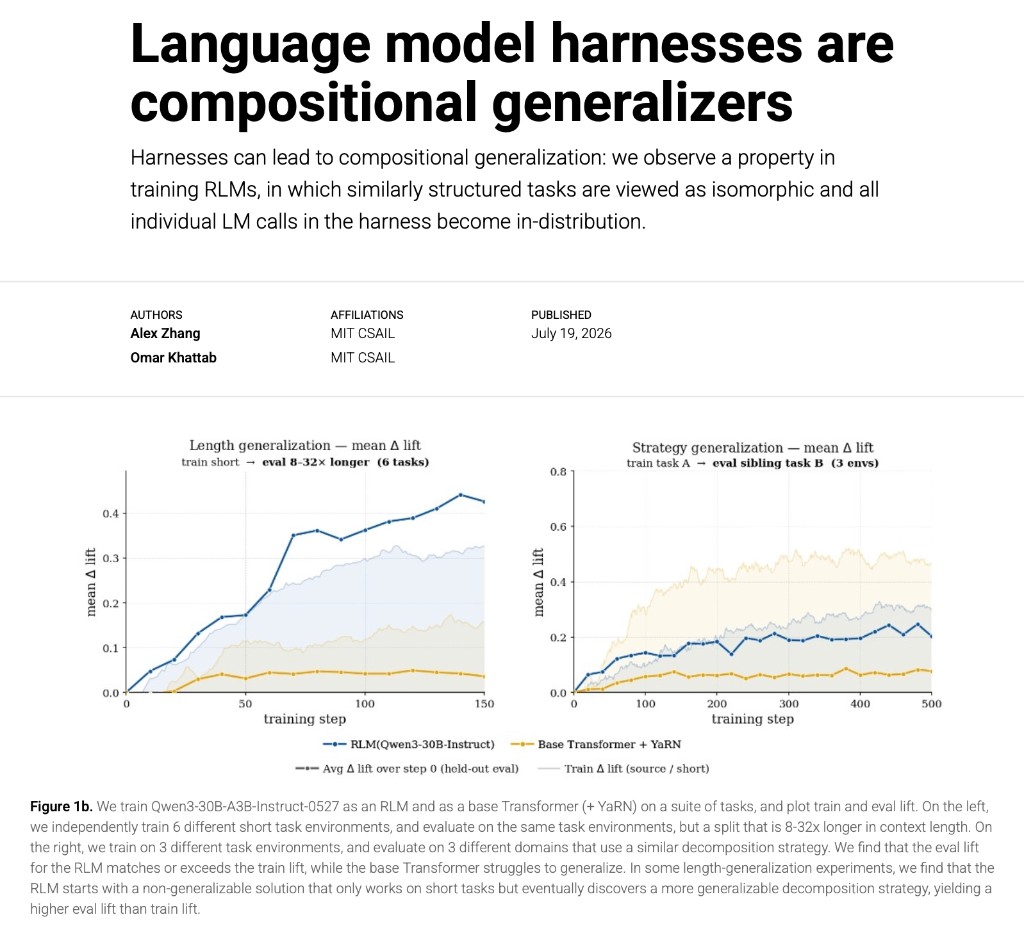
Language model harnesses are compositional generalizers
Harnesses can lead to compositional generalization: we observe a property in training RLMs, in which similarly structured tasks are viewed as isomorphic and all individual LM calls in the harness become in-distribution.
QPequi
In the language of modern physics, gauge theories are the grammar of interaction. They tell us that the laws of nature are not merely equations describing fields and particles, but the manifestation of a deep principle: certain transformations can be performed everywhere in space and time without changing the physical content of the theory. The mathematical name for this principle is local symmetry, and it lies at the heart of our most successful physical frameworks—from electromagnetism to the Standard Model of particle physics. Gauge invariance tells us what must remain unchanged when we shift our mathematical descriptions, and in doing so, it dictates what kinds of interactions and fields must exist.
Heterogeneous participation and allocation skews: when is choice "worth it"?
A core ethos of the Economics and Computation (EconCS) community is that people have complex private preferences and information of which the central planner is unaware, but which an appropriately designed mechanism can uncover to improve collective decisionmaking. This ethos underlies the community's largest deployed success stories, from stable matching systems to participatory budgeting. I ask: is this choice and information aggregation ``worth it''? In particular, I discuss how such systems induce \textit{heterogeneous participation}: those already relatively advantaged are, empirically, more able to pay time costs and navigate administrative burdens imposed by the mechanisms. I draw on three case studies, including my own work -- complex democratic mechanisms, resident crowdsourcing, and school matching. I end with lessons for practice and research, challenging the community to help reduce participation heterogeneity and design and deploy mechanisms that meet a ``best of both worlds'' north star: \textit{use preferences and information from those who choose to participate, but provide a ``sufficient'' quality of service to those who do not.}

