Neural scaling law
In machine learning, a neural scaling law is an empirical scaling law that describes how neural network performance changes as key factors are scaled up or down. These factors typically include the number of parameters, training dataset size, and training cost. Some models also exhibit performance gains by scaling inference through increased test-time compute (TTC), extending neural scaling laws beyond training to the deployment phase.

Scaling Laws Across Model Architectures: A Comparative Analysis of...
The scaling of large language models (LLMs) is a critical research area for the efficiency and effectiveness of model training and deployment. Our work investigates the transferability and...

Deep Learning Scaling is Predictable, Empirically
Deep learning (DL) creates impactful advances following a virtuous recipe: model architecture search, creating large training data sets, and scaling computation. It is widely believed that growing training sets and models should improve accuracy and result in better products. As DL application domains grow, we would like a deeper understanding of the relationships between training set size, computational scale, and model accuracy improvements to advance the state-of-the-art. This paper presents a large scale empirical characterization of generalization error and model size growth as training sets grow. We introduce a methodology for this measurement and test four machine learning domains: machine translation, language modeling, image processing, and speech recognition. Our empirical results show power-law generalization error scaling across a breadth of factors, resulting in power-law exponents---the "steepness" of the learning curve---yet to be explained by theoretical work. Further, model improvements only shift the error but do not appear to affect the power-law exponent. We also show that model size scales sublinearly with data size. These scaling relationships have significant implications on deep learning research, practice, and systems. They can assist model debugging, setting accuracy targets, and decisions about data set growth. They can also guide computing system design and underscore the importance of continued computational scaling.

Learning to Limit Data Collection via Scaling Laws: A Computational Interpretation for the Legal Principle of Data Minimization
Modern machine learning systems are increasingly characterized by extensive personal data collection, despite the diminishing returns and increasing societal costs of such practices. Yet, data minimisation is one of the core data protection principles enshrined in the European Union's General Data Protection Regulation ('GDPR') and requires that only personal data that is adequate, relevant and limited to what is necessary is processed. However, the principle has seen limited adoption due to the lack of technical interpretation. In this work, we build on literature in machine learning and law to propose FIDO, a Framework for Inhibiting Data Overcollection. FIDO learns to limit data collection based on an interpretation of data minimization tied to system performance. Concretely, FIDO provides a data collection stopping criterion by iteratively updating an estimate of the performance curve, or the relationship between dataset size and performance, as data is acquired. FIDO estimates the performance curve via a piecewise power law technique that models distinct phases of an algorithm's performance throughout data collection separately. Empirical experiments show that the framework produces accurate performance curves and data collection stopping criteria across datasets and feature acquisition algorithms. We further demonstrate that many other families of curves systematically overestimate the return on additional data. Results and analysis from our investigation offer deeper insights into the relevant considerations when designing a data minimization framework, including the impacts of active feature acquisition on individual users and the feasability of user-specific data minimization. We conclude with practical recommendations for the implementation of data minimization.

How To Scale Your Model
Training LLMs often feels like alchemy, but understanding and optimizing the performance of your models doesn't have to. This book aims to demystify the science of scaling language models: how TPUs (and GPUs) work and how they communicate with each other, how LLMs run on real hardware, and how to parallelize your models during training and inference so they run efficiently at massive scale. If you've ever wondered “how expensive should this LLM be to train” or “how much memory do I need to serve this model myself” or “what's an AllGather”, we hope this will be useful to you.
Beyond neural scaling laws: beating power law scaling via data pruning
Widely observed neural scaling laws, in which error falls off as a power of the training set size, model size, or both, have driven substantial performance improvements in deep learning. However, these improvements through scaling alone require considerable costs in compute and energy. Here we focus on the scaling of error with dataset size and show how in theory we can break beyond power law scaling and potentially even reduce it to exponential scaling instead if we have access to a high-quality data pruning metric that ranks the order in which training examples should be discarded to achieve any pruned dataset size. We then test this improved scaling prediction with pruned dataset size empirically, and indeed observe better than power law scaling in practice on ResNets trained on CIFAR-10, SVHN, and ImageNet. Next, given the importance of finding high-quality pruning metrics, we perform the first large-scale benchmarking study of ten different data pruning metrics on ImageNet. We find most existing high performing metrics scale poorly to ImageNet, while the best are computationally intensive and require labels for every image. We therefore developed a new simple, cheap and scalable self-supervised pruning metric that demonstrates comparable performance to the best supervised metrics. Overall, our work suggests that the discovery of good data-pruning metrics may provide a viable path forward to substantially improved neural scaling laws, thereby reducing the resource costs of modern deep learning.

Scaling Laws for Neural Language Models
We study empirical scaling laws for language model performance on the cross-entropy loss. The loss scales as a power-law with model size, dataset size, and the amount of compute used for training, with some trends spanning more than seven orders of magnitude. Other architectural details such as network width or depth have minimal effects within a wide range. Simple equations govern the dependence of overfitting on model/dataset size and the dependence of training speed on model size. These relationships allow us to determine the optimal allocation of a fixed compute budget. Larger models are significantly more sample-efficient, such that optimally compute-efficient training involves training very large models on a relatively modest amount of data and stopping significantly before convergence.

The AI Scaling Problem
Distillation Scaling Laws
We propose a distillation scaling law that estimates distilled model performance based on a compute budget and its allocation between the…

Rescaled Influence Functions: Accurate Data Attribution in High Dimension
How does the training data affect a model's behavior? This is the question we seek to answer with *data attribution*. The leading practical approaches to data attribution are based on *influence functions* (IF). IFs utilize a first-order Taylor approximation to efficiently predict the effect of removing a set of samples from the training set without retraining the model, and are used in a wide variety of machine learning applications. However, especially in the high-dimensional regime (# params $\geq \Omega($# samples$)$), they are often imprecise and tend to underestimate the effect of sample removals, even for simple models such as logistic regression. We present *rescaled influence functions* (RIF) -- a tool for data attribution which can be used as a drop-in replacement for influence functions, with little computational overhead but significant improvement in accuracy. We compare IF and RIF on a range of real-world datasets, showing that RIFs offer significantly better predictions in practice, and present a theoretical analysis explaining this improvement. Finally, we present a simple class of data poisoning attacks that would fool IF-based detections but would be detected by RIF.
Does equivariance matter at scale?
Given large datasets and sufficient compute, is it beneficial to design neural architectures for the structure and symmetries of each problem? Or is it more efficient to learn them from data? We study empirically how equivariant and non-equivariant networks scale with compute and training samples. Focusing on a benchmark problem of rigid-body interactions and on general-purpose transformer architectures, we perform a series of experiments, varying the model size, training steps, and dataset size. We find evidence for three conclusions. First, equivariance improves data efficiency, but training non-equivariant models with data augmentation can close this gap given sufficient epochs. Second, scaling with compute follows a power law, with equivariant models outperforming non-equivariant ones at each tested compute budget. Finally, the optimal allocation of a compute budget onto model size and training duration differs between equivariant and non-equivariant models.

Data Shapley in One Training Run
Data Shapley offers a principled framework for attributing the contribution of data within machine learning contexts. However, the traditional notion of Data Shapley requires re-training models on various data subsets, which becomes computationally infeasible for large-scale models. Additionally, this retraining-based definition cannot evaluate the contribution of data for a specific model training run, which may often be of interest in practice. This paper introduces a novel concept, In-Run Data Shapley, which eliminates the need for model retraining and is specifically designed for assessing data contribution for a particular model of interest. In-Run Data Shapley calculates the Shapley value for each gradient update iteration and accumulates these values throughout the training process. We present several techniques that allow the efficient scaling of In-Run Data Shapley to the size of foundation models. In its most optimized implementation, our method adds negligible runtime overhead compared to standard model training. This dramatic efficiency improvement makes it possible to perform data attribution for the foundation model pretraining stage. We present several case studies that offer fresh insights into pretraining data's contribution and discuss their implications for copyright in generative AI and pretraining data curation.
Scaling Laws for Autoregressive Generative Modeling
We identify empirical scaling laws for the cross-entropy loss in four domains: generative image modeling, video modeling, multimodal image$\leftrightarrow$text models, and mathematical problem solving. In all cases autoregressive Transformers smoothly improve in performance as model size and compute budgets increase, following a power-law plus constant scaling law. The optimal model size also depends on the compute budget through a power-law, with exponents that are nearly universal across all data domains. The cross-entropy loss has an information theoretic interpretation as $S($True$) + D_{\mathrm{KL}}($True$||$Model$)$, and the empirical scaling laws suggest a prediction for both the true data distribution's entropy and the KL divergence between the true and model distributions. With this interpretation, billion-parameter Transformers are nearly perfect models of the YFCC100M image distribution downsampled to an $8\times 8$ resolution, and we can forecast the model size needed to achieve any given reducible loss (ie $D_{\mathrm{KL}}$) in nats/image for other resolutions. We find a number of additional scaling laws in specific domains: (a) we identify a scaling relation for the mutual information between captions and images in multimodal models, and show how to answer the question "Is a picture worth a thousand words?"; (b) in the case of mathematical problem solving, we identify scaling laws for model performance when extrapolating beyond the training distribution; (c) we finetune generative image models for ImageNet classification and find smooth scaling of the classification loss and error rate, even as the generative loss levels off. Taken together, these results strengthen the case that scaling laws have important implications for neural network performance, including on downstream tasks.


Position: Don't Just "Fix it in Post": A Science of AI Must Study Training Dynamics
What would it mean to have a scientific understanding of AI? Models are not static objects: they are snapshots of time-evolving processes shaped by data, objectives, architectures, and optimization dynamics. Yet much of AI research treats models as fixed artifacts, analyzing behaviors after training rather than asking why they emerge. This position paper argues that a science of AI must move beyond post-hoc fixes and study the training dynamics that produce model behavior. Such a science should support progressively stronger forms of understanding: predicting outcomes from early training signals, intervening when trajectories go wrong, and ultimately designing training procedures that more reliably produce desired properties. Scaling laws have made prediction routine for loss; the challenge is extending this success to capabilities, biases, robustness, and safety-relevant behaviors. We articulate requirements for such theories grounded in the history and philosophy of science, examine progress in mechanistic interpretability, fairness, memorization, and simplicity bias, and identify concrete open problems.

Part of the datacounterfactuals.org reading lists. Research on scaling laws describing how model performance changes with data, parameters, and compute. Foundational work for understanding data requirements and compute-optimal training.
Part of the datacounterfactuals.org reading lists. Research on data provenance, dataset documentation, licensing and attribution audits, and technical source-attribution methods for understanding which data sources are available, permitted, or responsible for model behavior.
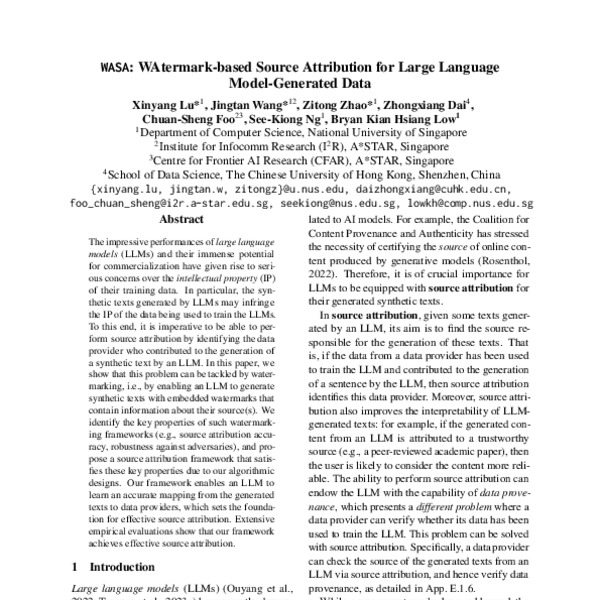
WASA: WAtermark-based Source Attribution for Large Language Model-Generated Data
SILO Language Models: Isolating Legal Risk In a Nonparametric Datastore

Datasheets for Datasets
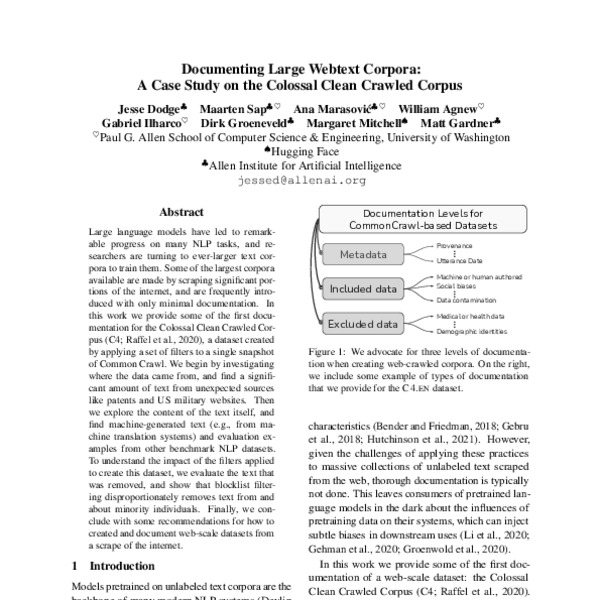
Documenting Large Webtext Corpora: A Case Study on the Colossal Clean Crawled Corpus

A large-scale audit of dataset licensing and attribution in AI