Open Data DC
On this site, the District of Columbia government shares hundreds of datasets. The District invites you to browse the data, download it as a file, analyze it with your tools, or build apps using our APIs.

Open Data DC
On this site, the District of Columbia government shares hundreds of datasets. The District invites you to browse the data, download it as a file, analyze it with your tools, or build apps using our APIs.
Dremel: interactive analysis of web-scale datasets: Proceedings of the VLDB Endowment: Vol 3, No 1-2
Dremel is a scalable, interactive ad-hoc query system for analysis of read-only nested data. By combining multi-level execution trees and columnar data layout, it is capable of running aggregation queries over trillion-row tables in seconds. The system ...

Designing Data-Intensive Applications
Data is at the center of many challenges in system design today. Difficult issues need to be figured out, such as scalability, consistency, reliability, efficiency, and... - Selection from Designing Data-Intensive Applications [Book]
Using anticlustering to partition data sets into equivalent parts.
Coresets for Data-efficient Training of Machine Learning Models
Incremental gradient (IG) methods, such as stochastic gradient descent and its variants are commonly used for large scale optimization in machine learning. Despite the sustained effort to make IG methods more data-efficient, it remains an open question how to select a training data subset that can theoretically and practically perform on par with the full dataset. Here we develop CRAIG, a method to select a weighted subset (or coreset) of training data that closely estimates the full gradient by maximizing a submodular function. We prove that applying IG to this subset is guaranteed to converge to the (near)optimal solution with the same convergence rate as that of IG for convex optimization. As a result, CRAIG achieves a speedup that is inversely proportional to the size of the subset. To our knowledge, this is the first rigorous method for data-efficient training of general machine learning models. Our extensive set of experiments show that CRAIG, while achieving practically the same solution, speeds up various IG methods by up to 6x for logistic regression and 3x for training deep neural networks.

CompactLTJ: Space & Time Efficient Leapfrog Triejoin on Graph Databases
Leapfrog Triejoin (LTJ) is arguably the most practical and popular worst-case-optimal (wco) algorithm for solving basic graph patterns in graph databases. Its main drawback is that it needs the database triples (subject, predicate, object) represented as paths in a trie, for each of the six orders of subject, predicate, and object. The resulting blowup in space makes most systems disregard LTJ or implement it only partially, which makes their corresponding algorithms non-wco. In this paper we show that, by using compact data structures, it is possible to build an index that at the same time matches the query time performance of the fastest classic wco index, and uses a fraction of the space of non-wco indices (which are much slower). Concretely, we make use of compact tree representations to store functional tries using one bit per trie edge, instead of one pointer, and further reduce the space by storing partial tries. Our most compact variant uses 5–6 times less space than classic wco implementations and 2–3 times less than classic non-wco systems. At solving queries, it is on par with the fastest classic wco system, and 30–40 times faster than non-wco systems. We further incorporate improved query resolution strategies into CompactLTJ variants, which makes it considerably faster than classic wco systems as well, on queries that do not output too many results. Finally, we show how CompactLTJ can incorporate dynamism without altering its performance, even under very demanding update regimes. We leave a public fully-functional implementation of CompactLTJ that can be directly used by practitioners.

Datasheets for Datasets
The machine learning community currently has no standardized process for documenting datasets, which can lead to severe consequences in high-stakes domains. To address this gap, we propose...

Datasets Guide | Unsloth Documentation
Learn how to create & prepare a dataset for fine-tuning.

Your Data Fits in Memory (GraphD Part 1)
We need a fast way to query multiple potentially large sets of data on-demand at interactive speeds. Sometimes the easiest solution to a hard problem is to build the right tool for the job.
Data exchange: getting to the core | ACM Transactions on Database Systems
Data exchange is the problem of taking data structured under a source schema and creating an instance of a target schema that reflects the source data as accurately as possible. Given a source instance, there may be many solutions to the data exchange ...

Learning to Limit Data Collection via Scaling Laws: A Computational Interpretation for the Legal Principle of Data Minimization
Modern machine learning systems are increasingly characterized by extensive personal data collection, despite the diminishing returns and increasing societal costs of such practices. Yet, data minimisation is one of the core data protection principles enshrined in the European Union's General Data Protection Regulation ('GDPR') and requires that only personal data that is adequate, relevant and limited to what is necessary is processed. However, the principle has seen limited adoption due to the lack of technical interpretation. In this work, we build on literature in machine learning and law to propose FIDO, a Framework for Inhibiting Data Overcollection. FIDO learns to limit data collection based on an interpretation of data minimization tied to system performance. Concretely, FIDO provides a data collection stopping criterion by iteratively updating an estimate of the performance curve, or the relationship between dataset size and performance, as data is acquired. FIDO estimates the performance curve via a piecewise power law technique that models distinct phases of an algorithm's performance throughout data collection separately. Empirical experiments show that the framework produces accurate performance curves and data collection stopping criteria across datasets and feature acquisition algorithms. We further demonstrate that many other families of curves systematically overestimate the return on additional data. Results and analysis from our investigation offer deeper insights into the relevant considerations when designing a data minimization framework, including the impacts of active feature acquisition on individual users and the feasability of user-specific data minimization. We conclude with practical recommendations for the implementation of data minimization.
🚀 Announcing readwise-vector-db: Supercharge Your Readwise Library with Local, Semantic Search
Collection

Updated 6mo
Part of the datacounterfactuals.org reading lists. Research on coreset selection and efficient data subset methods.
mobile data collection and study apps

dc: data provenance and source attribution
Part of the datacounterfactuals.org reading lists. Research on data provenance, dataset documentation, licensing and attribution audits, and technical source-attribution methods for understanding which data sources are available, permitted, or responsible for model behavior.
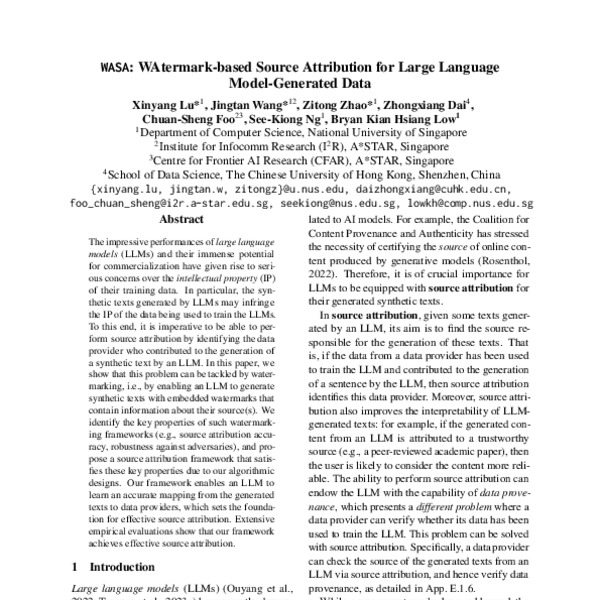
WASA: WAtermark-based Source Attribution for Large Language Model-Generated Data
SILO Language Models: Isolating Legal Risk In a Nonparametric Datastore
Datasheets for Datasets
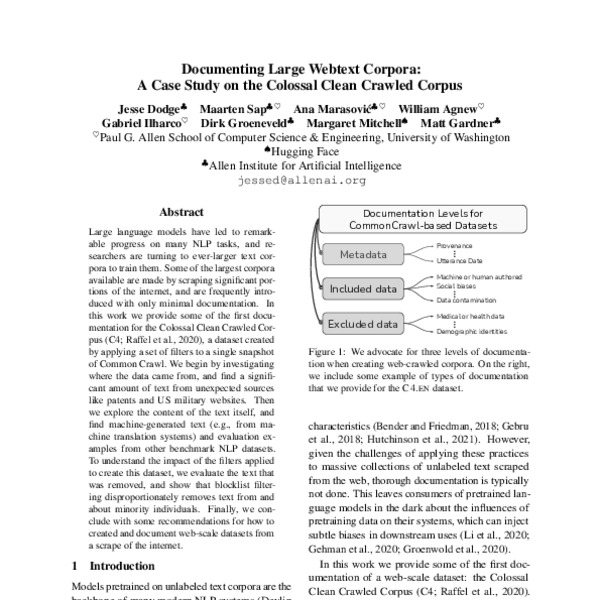
Documenting Large Webtext Corpora: A Case Study on the Colossal Clean Crawled Corpus

A large-scale audit of dataset licensing and attribution in AI
About the App

The Modern Electronic Lab Notebook (ELN) - LabArchives

Tally Counter & Tracker Daily - Apps on Google Play
Mobile Data Collection and Collaboration App
ODK Collect
Field Book Documentation