Dataset Cartography: Mapping and Diagnosing Datasets with Training Dynamics
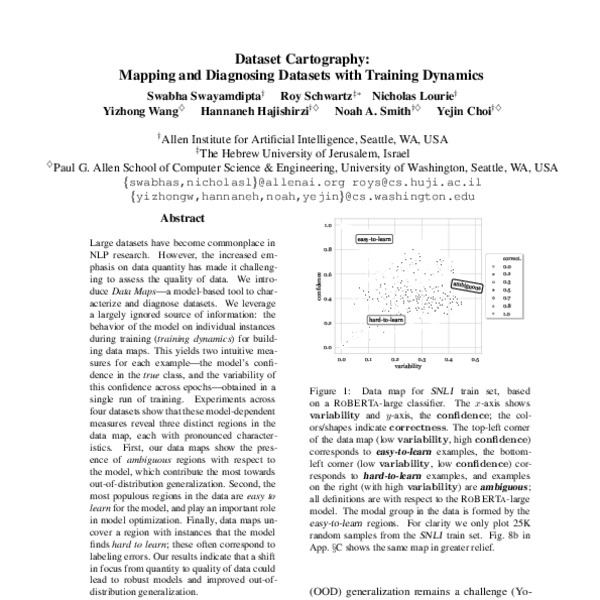
Large datasets have become commonplace in NLP research. However, the increased emphasis on data quantity has made it challenging to assess the quality of data. We introduce Data Maps—a model-based tool to characterize and diagnose datasets. We leverage a largely ignored source of information: the behavior of the model on individual instances during training (training dynamics) for building data maps. This yields two intuitive measures for each example—the model's confidence in the true class, and the variability of this confidence across epochs—obtained in a single run of training. Experiments on four datasets show that these model-dependent measures reveal three distinct regions in the data map, each with pronounced characteristics. First, our data maps show the presence of “ambiguous” regions with respect to the model, which contribute the most towards out-of-distribution generalization. Second, the most populous regions in the data are “easy to learn” for the model, and play an important role in model optimization. Finally, data maps uncover a region with instances that the model finds “hard to learn”; these often correspond to labeling errors. Our results indicate that a shift in focus from quantity to quality of data could lead to robust models and improved out-of-distribution generalization.
Position: Don't Just "Fix it in Post": A Science of AI Must Study Training Dynamics
What would it mean to have a scientific understanding of AI? Models are not static objects: they are snapshots of time-evolving processes shaped by data, objectives, architectures, and optimization dynamics. Yet much of AI research treats models as fixed artifacts, analyzing behaviors after training rather than asking why they emerge. This position paper argues that a science of AI must move beyond post-hoc fixes and study the training dynamics that produce model behavior. Such a science should support progressively stronger forms of understanding: predicting outcomes from early training signals, intervening when trajectories go wrong, and ultimately designing training procedures that more reliably produce desired properties. Scaling laws have made prediction routine for loss; the challenge is extending this success to capabilities, biases, robustness, and safety-relevant behaviors. We articulate requirements for such theories grounded in the history and philosophy of science, examine progress in mechanistic interpretability, fairness, memorization, and simplicity bias, and identify concrete open problems.

The Learning Dispatch | Carl Hendrick | Substack
Making sense of how learning happens. https://www.carlhendrick.com/. Click to read The Learning Dispatch, by Carl Hendrick, a Substack publication with tens of thousands of subscribers.

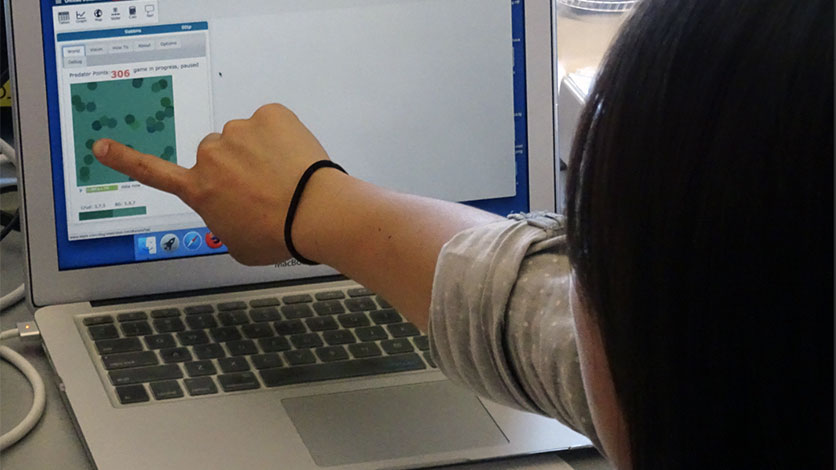
Dynamic Data Science
<p>Use our Common Online Data Analysis Platform (CODAP) to explore dynamic data science activities and gain fluency in data moves to examine large datasets.</p>

Datasheets for Datasets
The machine learning community currently has no standardized process for documenting datasets, which can lead to severe consequences in high-stakes domains. To address this gap, we propose...

Learning From Data - Online Course (MOOC)
This is an introductory course in machine learning (ML) that covers the basic theory, algorithms, and applications. ML is a key technology in Big Data, and in many financial, medical, commercial, and scientific applications. It enables computational systems to adaptively improve their performance with experience accumulated from the observed data. ML has become one of the hottest fields of study today, taken up by undergraduate and graduate students from more than 20 different majors at Caltech. This course balances theory and practice, and covers the mathematical as well as the heuristic aspects. The lectures below follow each other in a story-like fashion:
Brandon Stewart on Twitter / X
1/ New @Nature! We study how powerful institutions shape the information environment for LLMs. Commercial LLM training is opaque, so we trace a path from state-coordinated media -> training data -> model responses. pic.twitter.com/5LdFvzbFaf— Brandon Stewart (@b_m_stewart) May 13, 2026

AI Data Centers Will Be Obsolete (Geometric Reasoning Explained)
Selecting synthetic data for successful simulation-based transfer learning in dynamical biological systems
Accurate prediction of the temporal dynamics of biological systems is crucial for informing timely and effective interventions, e.g., in ecological or epidemiological contexts, or for treatment adjustments in therapy. While machine learning has proven its capabilities in generalizing the underlying non-linear dynamics of such systems, unlocking its predictive power is often restrained by the limited availability of large, curated datasets. To supplement real-world data, informing machine learning by transfer learning with synthetic data derived from simulations using ordinary differential equations has emerged as a promising solution. However, the success of this approach highly depends on the designed characteristics of the synthetic data.

Revisiting Methods for Finding Influential Examples
Several instance-based explainability methods for finding influential training examples for test-time decisions have been proposed recently, including Influence Functions, TraceIn, Representer...

Frontier Pre-training at Microsoft AI | Microsoft AI
In June, we announced MAI-Thinking-1, a general-purpose foundation model post-trained on top of MAI-Base-1 with strong reasoning performance. We’ve recently completed pre-training our new state-of-the-art model, MAI-Base-2, an MoE foundation model with 80 billion active and 2.8 trillion total parameters.

Open Data DC
On this site, the District of Columbia government shares hundreds of datasets. The District invites you to browse the data, download it as a file, analyze it with your tools, or build apps using our APIs.

Library — cameron.stream
How LoRA matches full training performance more broadly than expected.
Learn anything with the /teach skill
Part of the datacounterfactuals.org reading lists. Research on using training dynamics to diagnose, rank, or explain examples.