SoK: Data Minimization in Machine Learning
Data minimization (DM) describes the principle of collecting only the data strictly necessary for a given task. It is a foundational principle across major data protection regulations like GDPR...

SoK: Data Minimization in Machine Learning
Data minimization (DM) describes the principle of collecting only the data strictly necessary for a given task. It is a foundational principle across major data protection regulations like GDPR...
Data Minimisation: a Language-Based Approach (Long Version)
Data minimisation is a privacy-enhancing principle considered as one of the pillars of personal data regulations. This principle dictates that personal data collected should be no more than...
The Data Minimization Principle in Machine Learning
The principle of data minimization aims to reduce the amount of data collected, processed or retained to minimize the potential for misuse, unauthorized access, or data breaches. Rooted in...
Monitoring Data Minimisation
Data minimisation is a privacy enhancing principle, stating that personal data collected should be no more than necessary for the specific purpose consented by the user. Checking that a program...
Data Minimisation in Communication Protocols: A Formal Analysis...
With the growing amount of personal information exchanged over the Internet, privacy is becoming more and more a concern for users. One of the key principles in protecting privacy is data...
Data Minimization for GDPR Compliance in Machine Learning Models
The EU General Data Protection Regulation (GDPR) mandates the principle of data minimization, which requires that only data necessary to fulfill a certain purpose be collected. However, it can often be difficult to determine the minimal amount of data required, especially in complex machine learning models such as neural networks. We present a first-of-a-kind method to reduce the amount of personal data needed to perform predictions with a machine learning model, by removing or generalizing some of the input features. Our method makes use of the knowledge encoded within the model to produce a generalization that has little to no impact on its accuracy. This enables the creators and users of machine learning models to acheive data minimization, in a provable manner.
A data minimization model for embedding privacy into software systems
Modern software systems (social networking, banking and shopping applications) are becoming increasingly dependent on our data. These systems need data to provide various economic and social benefits to users as well as businesses. However, the extensive use of personal data in systems poses a threat to user privacy. Therefore, privacy laws expect software systems to practice Data Minimization (DM), to minimize data in software systems. This has put software developers in a dilemma to minimize user data to provide user privacy and maximize user data for enhanced system functionality. Following the design science research approach, in this research we propose and evaluate a methodology that enables developers to make their decisions to minimize user data in software systems through understanding data. The methodology encourage developers to think of the ways they would use data in a system design focusing on the storage and sharing of data. Developers in the three experiments conducted to evaluate the methodology agreed that it enables them to think of the ways they use data in system designs and it helps them to make decisions to minimize using data in a system design. Developers also showed positive intention to use the proposed methodology within system development activities.
Configurable Per-Query Data Minimization for Privacy-Compliant Web APIs
The purpose of regulatory data minimization obligations is to limit personal data to the absolute minimum necessary for a given context. Beyond the initial data collection, storage, and...
From Principle to Practice: Vertical Data Minimization for Machine Learning
Aiming to train and deploy predictive models, organizations collect large amounts of detailed client data, risking the exposure of private information in the event of a breach. To mitigate this,...
Open Data DC
On this site, the District of Columbia government shares hundreds of datasets. The District invites you to browse the data, download it as a file, analyze it with your tools, or build apps using our APIs.

Data Reboot: 10 Reasons why we need to change how we approach data in today’s society
Stefaan G. Verhulst and Julia Stamm, The Data Tank

Learning to Limit Data Collection via Scaling Laws: A Computational Interpretation for the Legal Principle of Data Minimization
Modern machine learning systems are increasingly characterized by extensive personal data collection, despite the diminishing returns and increasing societal costs of such practices. Yet, data minimisation is one of the core data protection principles enshrined in the European Union's General Data Protection Regulation ('GDPR') and requires that only personal data that is adequate, relevant and limited to what is necessary is processed. However, the principle has seen limited adoption due to the lack of technical interpretation. In this work, we build on literature in machine learning and law to propose FIDO, a Framework for Inhibiting Data Overcollection. FIDO learns to limit data collection based on an interpretation of data minimization tied to system performance. Concretely, FIDO provides a data collection stopping criterion by iteratively updating an estimate of the performance curve, or the relationship between dataset size and performance, as data is acquired. FIDO estimates the performance curve via a piecewise power law technique that models distinct phases of an algorithm's performance throughout data collection separately. Empirical experiments show that the framework produces accurate performance curves and data collection stopping criteria across datasets and feature acquisition algorithms. We further demonstrate that many other families of curves systematically overestimate the return on additional data. Results and analysis from our investigation offer deeper insights into the relevant considerations when designing a data minimization framework, including the impacts of active feature acquisition on individual users and the feasability of user-specific data minimization. We conclude with practical recommendations for the implementation of data minimization.
Rethinking data and rebalancing digital power
What is a more ambitious vision for data use and regulation that can deliver a positive shift in the digital ecosystem towards people and society?

Operationalizing the Legal Principle of Data Minimization for...
Article 5(1)(c) of the European Union's General Data Protection Regulation (GDPR) requires that "personal data shall be [...] adequate, relevant, and limited to what is necessary in relation to...
Collection

Updated 6mo
Part of the datacounterfactuals.org reading lists. Research on data minimization: reducing data collection, retention, and feature disclosure while preserving utility, with links across privacy by design, GDPR, ML, experimentation, scaling laws, and data streams.
dc: data provenance and source attribution
Part of the datacounterfactuals.org reading lists. Research on data provenance, dataset documentation, licensing and attribution audits, and technical source-attribution methods for understanding which data sources are available, permitted, or responsible for model behavior.
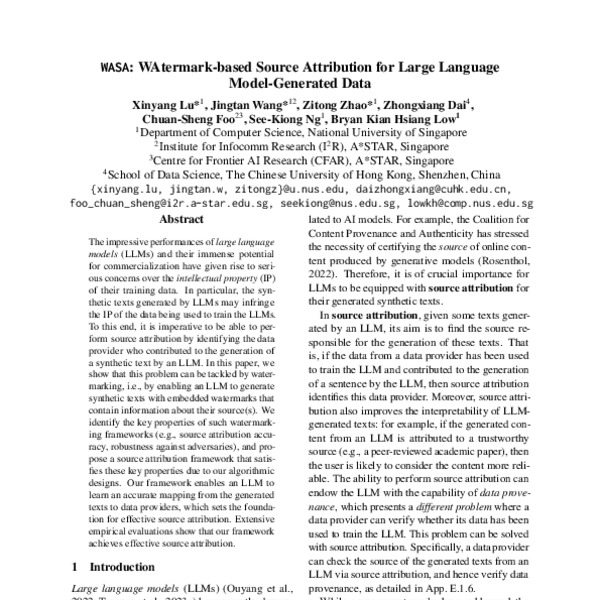
WASA: WAtermark-based Source Attribution for Large Language Model-Generated Data
SILO Language Models: Isolating Legal Risk In a Nonparametric Datastore
Datasheets for Datasets
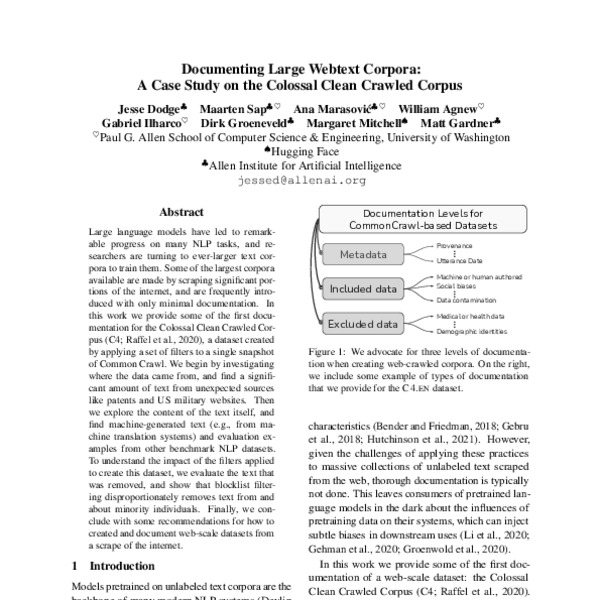
Documenting Large Webtext Corpora: A Case Study on the Colossal Clean Crawled Corpus

A large-scale audit of dataset licensing and attribution in AI