Collection
Tools for Thought

Updated 1mo
Cognitive tools, knowledge infrastructure, and curation practices
Collection
Updated 1mo
Cognitive tools, knowledge infrastructure, and curation practices
Hello, Operator!
Part of the WonderOS project, this is presented as the operating manual that would come with the reader’s first machine running WonderOS. It is an exercise in exploring how people familiar with mainstream personal computing devices and systems would become computer literate in an itemized environment. It is written as though the reader is familiar with today’s mainstream operating systems, and is exploring their first itemized OS.
phylo — Mammalia — minomobi
Life in Weeks
My life, where each week I’ve been alive is a little box, inspired by this post by Tim Urban. When meaningful things happen (for both better and worse) I make a note of it so I can remember how much of life is influenced by these factors. If you’d like to create your own version of this, it’s basically a data file, a template, and a blog post mashed together on Jekyll blog hosted on Netlify.
Lichen
Build a knowledge base with friends, for your hobbies, activism, or anything else!Each wiki is yours, built on ATProto, data is stored on your personal data server.
/ are.na practise | Are.na
notes on, resources for, and reflections upon using this tool. sort of a meta-ch…7B%22facet%22%3A%22SCORE%22%2C%22dir%22%3A%22DESC%22%7D%7D), specific to channel
Algebrica | A Mathematical Knowledge Base
Algebrica.org is a platform dedicated to providing mathematical knowledge in an environment free from distractions.

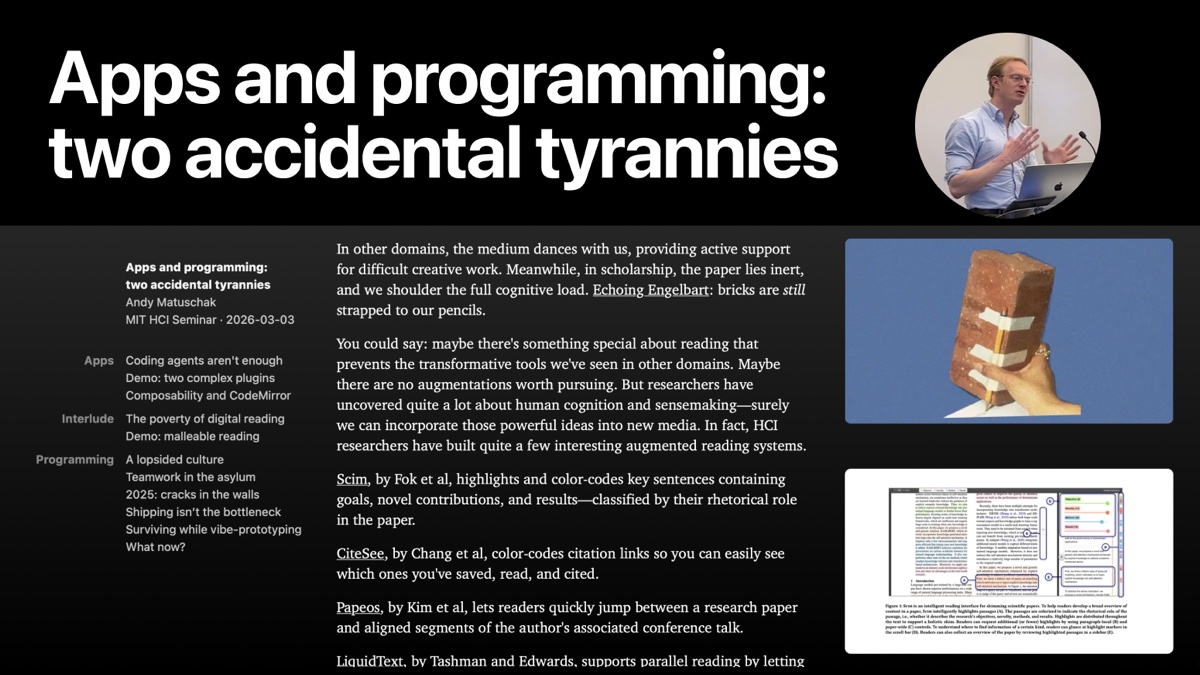
Apps and programming: two accidental tyrannies
On coding agents, malleable software, and the future of interface invention
RRGI · Discourse Graph — lens switch

Creative Reading: Scaffolding Reading for Transformation
Reading augmentation systems increasingly help readers process text at scale. While these tools address real constraints of time and cognitive load, they often implicitly frame reading as information transmission, or "reading to discard," delegating interpretation and effort to the machine. Yet this delegation changes the outcome of reading. For example, in scholarly reading, deciding what a research text implies and why it matters is central to the work of scholarly production. We propose creative reading as an alternative goal: reading augmentation that supports readers in creating both readings and themselves as readers. By putting literary and narrative theories into conversation with scholarly sensemaking and creativity support, we present a provocation-oriented design space for valuing the process of reading as a way of preserving a plurality of readings and transforming readers over time.

Prof. Judy Fan: Cognitive Tools for Making the Invisible Visible
57 Ideas & Questions about Cognitive Infrastructures