Collection
AI and Tech Policy

Updated 3d
To do with how folks are thinking about emerging tech policy
Collection
Updated 3d
To do with how folks are thinking about emerging tech policy
Incomplete Contracting and AI Alignment
As part of the Digital Library's transition to Open Access, new features for researchers are available in the Premium Edition. Click here to learn more.

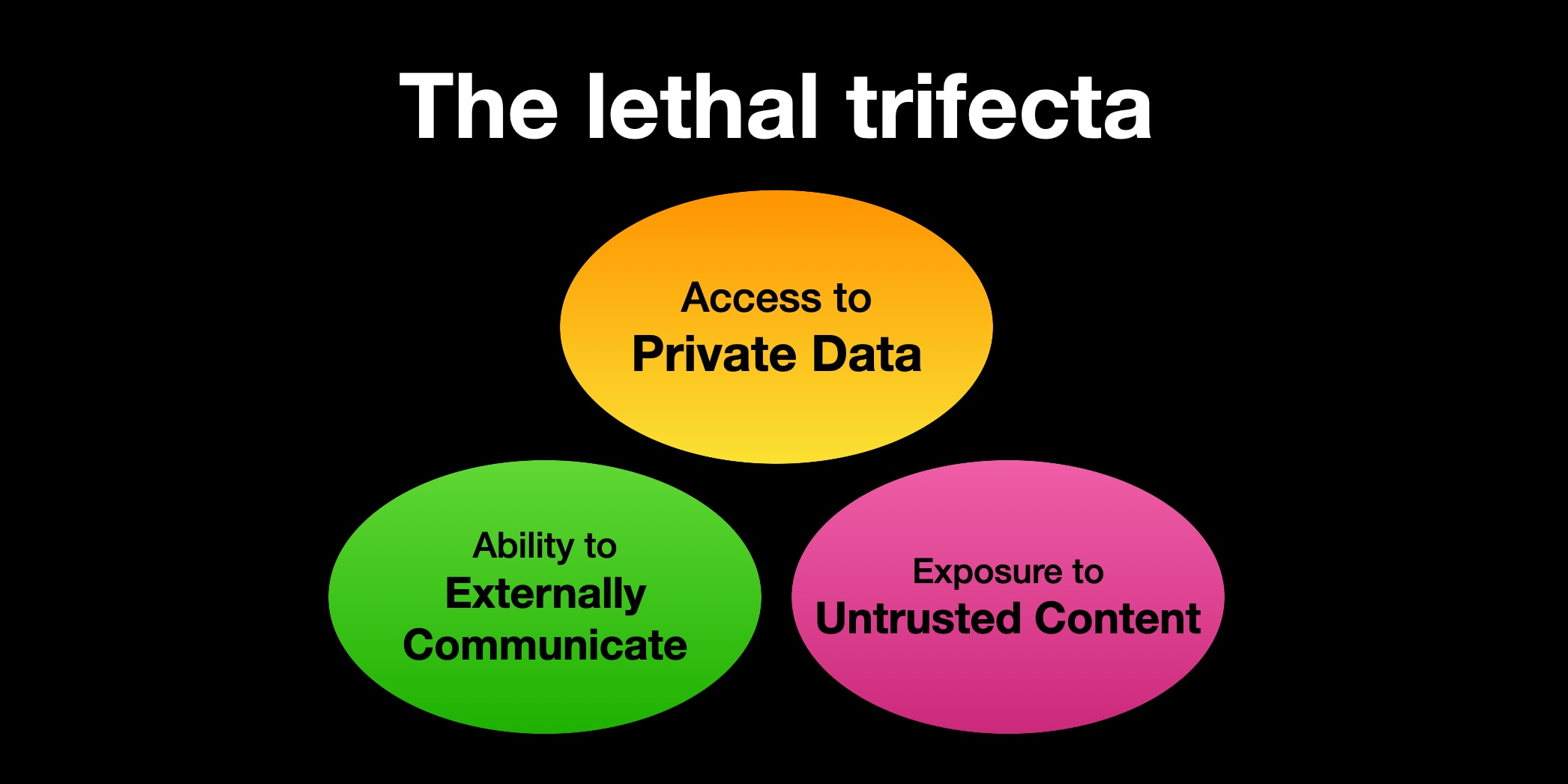
The lethal trifecta for AI agents: private data, untrusted content, and external communication
If you are a user of LLM systems that use tools (you can call them “AI agents” if you like) it is critically important that you understand the risk of …
Report
MIT’s Ad Hoc Committee on AI Use in Teaching, Learning, and Research Training
Silicon Valley Is Turning Into Its Own Worst Fear
We asked a group of writers to consider the forces that have shaped our lives in 2017. Here, science fiction writer Ted Chiang looks at capitalism, Silicon Valley, and its fear of superintelligent AI.

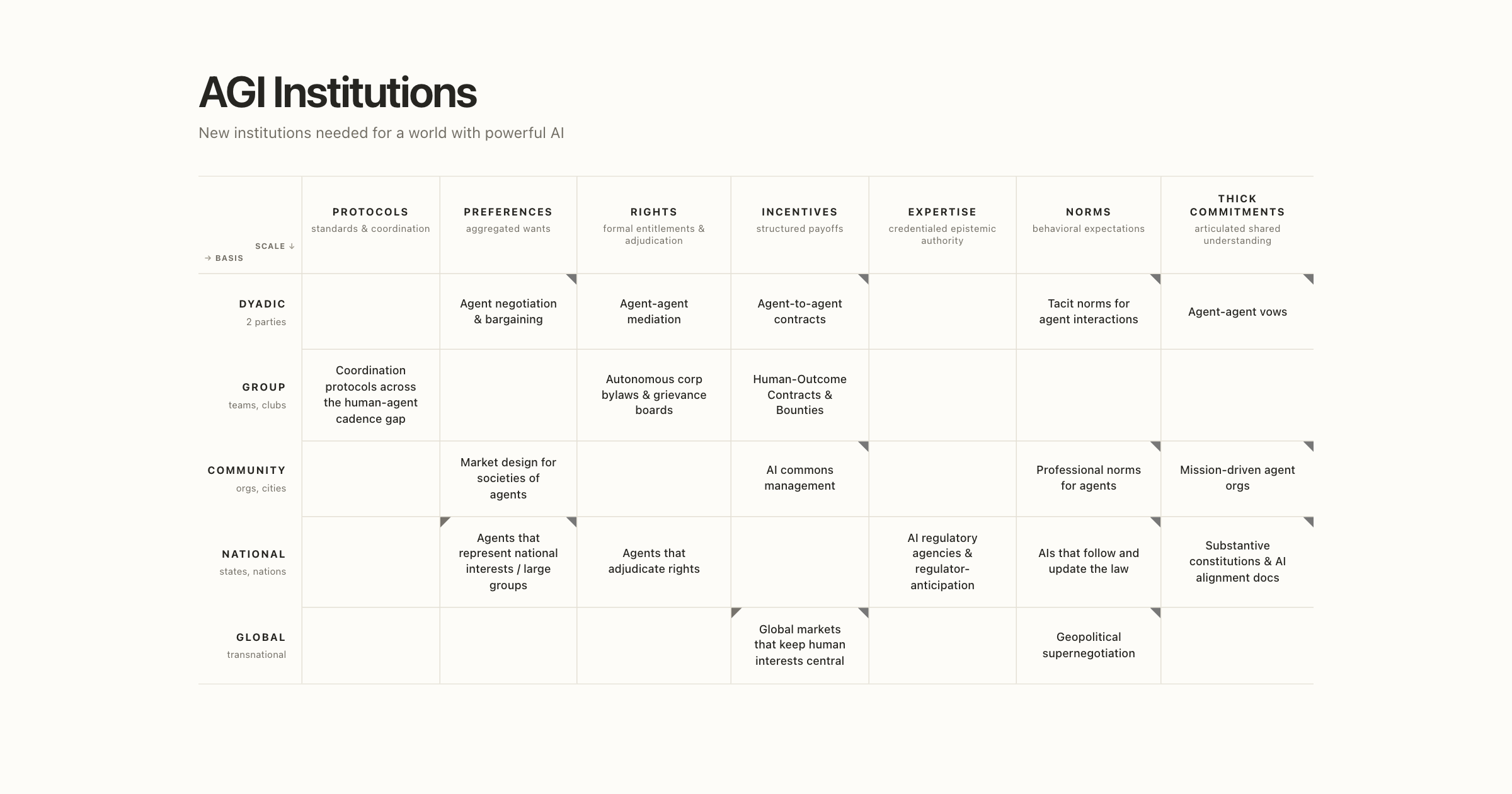
Existing Human Institutions — AGI Institutions Wiki
How existing human institutions handle coordination across scales — and how autonomous AI agents break them. Maps protocols, preferences, rights, incentives, expertise, norms, and thick commitments from dyadic to global.
Tom Costello on Twitter / X
Apropos of everything here’s my uninformed idea for alignment: homeostatic mechanisms (control systems / cybernetics) that force a system to optimize for satiation and normal-range variation (rather than maximization) across a set of goals such that, if any one of them were…— Tom Costello (@tomstello_) September 9, 2026
AI chatbots are becoming experts at changing people's minds. What's their secret?
ChatGPT and other AIs use a flood of facts, and the occasional lie, to persuade humans

Value misalignments in X’s feed algorithm is a reflection of value tensions in engagement
Social media feed algorithms rank content that is purported to be preferred by users, but the engagement behaviors that drive these algorithms are (at best) indirect proxies for users’ explicitly self-stated values. Are the resulting feeds value aligned, and if not, why? We investigate this question by annotating the basic human values expressed in participants’ X (Twitter) feeds (N = 715 US users), analyzing the relationship between the posts’ value expressions and the posts’ amplification in the ranked “For You” Page feed, and then comparing the amplified values to users’ own values. We observe that the inventory of posts from followed accounts reflects users’ self-stated values—but that there is an overall negative correlation (misalignment) between users’ explicit values and the value expressions the algorithm is more likely to amplify. We turn to engagement behavior to understand this misalignment and observe that users’ engagement behaviors can be misaligned with their stated values—likely causing the algorithm to learn and reflect these misaligned values. We also detect partisan differences consistent with this theory: While the algorithm amplifies values negatively correlated with both Democrats’ and Republicans’ self-stated values, they are more misaligned for Democrats. And in fact replying, a heavily weighted form of engagement, is associated with values that are less aligned for both Democrats’ and Republicans’ self-stated values, and is even more misaligned for Democrats. Taken together, these findings offer a glimpse into the tensions between the values that people hold and those that provoke reactions, and how these value tensions can produce misaligned outcomes.

Digital Freedom
Roberta Fischli & Thomas Beschorner argue that our digital future is not preprogrammed: it’s about time we start thinking about what it should look like.
Can Claude Consent to its own Constitution? AI Constitutionalism and the Paradox of Constituent Power
Frontier AI systems are trained on “constitutions” and model specifications that shape their values, reasoning, and conduct. Debate over these documents has foc

The Future, Made in China
Beijing is competing with the U.S. for tech supremacy. Who wins will have huge political implications.

Separating AI’s Technological Problems From its Capitalism Problems
Nathan E. Sanders and Bruce Schneier say integrating a technology as disruptive as AI responsibly requires deep structural reforms.
‘AI gravity’ is pulling you toward dependency. Here’s how to push back | MIT Sloan
AI systems hold the promise of competitive advantage, but they can usher in cognitive decline among workers, says MIT Sloan School of Management’s Eric So. Learn how to protect cognitive capital.

EMERGENCE WORLD: A Laboratory for Evaluating Long-horizon Agent Autonomy — Emergence AI
Most evaluations of AI agents look like exams: a discrete task, a clean environment, a score in minutes or hours. Emergence World is built for the opposite question—what happens when you let agents run continuously, in a shared environment with real-world signals, for weeks. It is a research platfor

Opinion | These A.I. Policies Will Hurt Our Business. We Should Do Them Anyway.
The risks posed by A.I. are too great to forgo any regulation, even for those who stand to gain tremendously from the technology’s rise.

Microsoft Struggling With Hundreds of AI-Discovered Security Bugs — ProPublica
Anthropic’s Mythos has flagged bugs faster than Microsoft can fix them. Documents reviewed by ProPublica reveal the tech giant's “mad dash” behind the scenes to patch holes before hackers can find and exploit them.

Join the Congressional Innovation Fellowship — TechCongress
Make an impact at the highest level of government through our Congressional Innovation Fellowship!

This Tool Unmasks the Shadowy World of Ads that Track Your Location
It's usually very difficult to investigate the advertising industry. A new tool called DecryptAds aims to make it much easier with a massive dataset anyone can query.

Responsible Innovation at the Frontier - Americans for Responsible Innovation
ARI’s blueprint for federal AI governance is designed to promote safe frontier AI development in America. The blueprint is built around three governance functions any federal proposal should incorporate.

Artificial intelligence and personal finance
Artificial intelligence (AI) is transforming how consumers access and use financial information, education and advice for personal financial decision making. While consumers’ increasing use of AI tools and AI-generated content for personal finance brings opportunities in terms of accessibility, personalisation and decision making, it also increases risks related to bias, hallucinations, commercial influence, data privacy and exclusion, with uncertain benefits on long-term financial well-being. This policy paper provides policymakers and stakeholders with an overview of current trends, opportunities and risks in the use of AI in personal finance and in the design and delivery of financial education. It also proposes a set of financial literacy competencies to support the use of AI in personal financial decision making.
