Collection
Scientific Discovery

Updated 13d
To do with posts about scientific discovery and the science of discovery
Collection
Updated 13d
To do with posts about scientific discovery and the science of discovery
Bending the Curve: How AI is Transforming Scientific Discovery
Discover how researchers use LLMs and specialized AI models like AlphaFold as complementary tools to accelerate innovation and expand the scientific frontier.

Claude Science (beta)
Claude Science is your AI workbench for scientific research. Works through your research like a skilled scientist, running the analysis and tracing every step. Spend less time stitching pipelines together, and more time on the science.
EurekaBench: Measuring Agentic Ability to Discover New Scientific Insights
When Isaac Newton discovered the law of gravitation, he did so through an iterative process of analyzing observed data such as planetary patterns, finding the underlying mechanisms by describing patterns in mathematical equations, and refining his theory against the Moon's orbit, revealing the startling insight that the same force governs both falling apples and orbiting planets. Would it be possible for AI agents to make similar discoveries? To measure this ability, we introduce EurekaBench, a cross-domain benchmark that tests AI agents' ability to conduct long-horizon experiments and discover mechanisms that explain observations. We evaluate these mechanisms by the scientific insights that can be derived from them. EurekaBench contains an expert-verified set of 26 long-horizon tasks across neuroscience, computer science, chemistry, astrophysics, geophysics, and plasma physics, with a total of 306 scientific insights that the discovered mechanisms are expected to support. Our evaluation framework tests three axes of scientific discovery: agents' ability to follow known scientific constraints, the predictive accuracy of the discovered mechanisms, and whether these mechanisms yield scientific insights or inform future research. Our results show that current AI agents often overly fixate on predictive accuracy optimization, surpassing human scientists, while falling substantially short in deriving scientific insights.

Augmenting Research Ideation with Data: An Empirical Investigation...
Recent advancements in large language models (LLMs) demonstrate strong potential for generating novel research ideas, yet such ideas often struggle with feasibility and effectiveness. In this...
Hypothesis generation and updating in large language models
Large language models (LLMs) increasingly help people solve problems, from debugging code to repairing machinery. This process requires generating plausible hypotheses from partial descriptions,...
Statistical Foundations of LLM-based A/B Testing: A Surrogacy...
Organizations and researchers show increasing interest in using large language models (LLMs) in place of human participants in A/B tests, in the hope of experimenting faster and at lower cost. We...
LLM-guided headline rewriting for clickability enhancement without...
Enhancing reader engagement while preserving informational fidelity is a central challenge in controllable text generation for news media. Optimizing news headlines for reader engagement is often...
Causal Inference with Unstructured Treatments
Causal inference usually concerns a scalar treatment, yet in many problems the treatment is unstructured: a text, an image, or a sequence of clinical decisions. Consider an instructor writing a...
EXPRESS: Evaluating Novel Unstructured Treatments with Generative AI: A Causal Prediction Framework
Modern marketing increasingly requires managers to deploy new content at scale, often with limited opportunity for prior testing. As a result, decisions about what to launch become strategic managerial choices under uncertainty rather than purely creative exercises. While generative AI makes the creation of new content fast and highly scalable, it simultaneously expands the set of options managers must evaluate, making reliable content selection increasingly difficult. We develop a framework for causal prediction that enables managers to evaluate and deploy novel marketing content generated by AI. The framework uses pretrained large language models to represent previously deployed content and learn how its features causally relate to outcomes. Using a rejection-sampling procedure, the framework screens new content proposed by generative AI to avoid extrapolation beyond what historical data can reliably support. In a large-scale email marketing application (3.3 million observations across 34 campaigns), the framework improves out-of-sample prediction and real-world deployment performance relative to standard approaches, enabling outcome-guided generation of higher-performing AI-generated content. The framework establishes a threshold based on how closely new content resembles past campaigns, separating cases where causal prediction is reliable from cases where direct experimentation is warranted. The framework has important implications for marketing decision making in a rapidly evolving environment where generative AI is transforming content creation and deployment.

Artificial intelligences and human scientists exhibit...
We investigate the effectiveness of artificial intelligences (AI)-specifically large language models (LLMs)-relative to human scientists at high-level cognitive tasks in social science such as...
Propagation and preservation of AI-discovered problem-solving strategies in human culture
Intelligent machines have the potential to uncover problem-solving strategies beyond human discovery. Emerging evidence from competitive gameplay, such as Go and chess, demonstrates that AI systems are evolving from mere tools to sources of cultural innovation adopted by humans. However, the conditions under which intelligent machines transition from tools to drivers of persistent cultural change remain unclear. We identify three key dimensions that modulate machine influence on human problem-solving: the discovered strategies must be non-trivial, learnable, and offer a clear advantage. Using a cultural transmission experiment, we demonstrate that when these conditions are met, machine-discovered strategies can be transmitted, understood, and preserved by human populations, leading to enduring cultural shifts. Conversely, using agent-based simulations, we show how machine influence is constrained in the absence of these conditions. These findings provide a framework for understanding how machines can persistently expand human cognitive skills and underscore the need to consider their broader implications for human cognition and cultural evolution.

Searching for explanations: How the Internet inflates estimates of internal knowledge.
Early science acceleration experiments with GPT-5
AI models like GPT-5 are an increasingly valuable tool for scientists, but many remain unaware of the capabilities of frontier AI. We present a collection of short case studies in which GPT-5 produced new, concrete steps in ongoing research across mathematics, physics, astronomy, computer science, biology, and materials science. In these examples, the authors highlight how AI accelerated their work, and where it fell short; where expert time was saved, and where human input was still key. We document the interactions of the human authors with GPT-5, as guiding examples of fruitful collaboration with AI. Of note, this paper includes four new results in mathematics (carefully verified by the human authors), underscoring how GPT-5 can help human mathematicians settle previously unsolved problems. These contributions are modest in scope but profound in implication, given the rate at which frontier AI is progressing.
Bridging the human–AI knowledge gap through concept discovery and transfer in AlphaZero
AI systems have attained superhuman performance across various domains. If the hidden knowledge encoded in these highly capable systems can be leveraged, human knowledge and performance can be advanced. Yet, this internal knowledge is difficult to extract. Due to the vast space of possible internal representations, searching for meaningful new conceptual knowledge can be like finding a needle in a haystack. Here, we introduce a method that extracts new chess concepts from AlphaZero, an AI system that mastered chess via self-play without human supervision. Our method excavates vectors that represent concepts from AlphaZero’s internal representations using convex optimization, and filters the concepts based on teachability (whether the concept is transferable to another AI agent) and novelty (whether the concept contains information not present in human chess games). These steps ensure that the discovered concepts are useful and meaningful. For the resulting set of concepts, prototypes (chess puzzle–solution pairs) are presented to experts for final validation. In a preliminary human study, four top chess grandmasters (all former or current world chess champions) were evaluated on their ability to solve concept prototype positions. All grandmasters showed improvement after the learning phase, suggesting that the concepts are at the frontier of human understanding. Despite the small scale, our result is a proof of concept demonstrating the possibility of leveraging knowledge from a highly capable AI system to advance the frontier of human knowledge; a development that could bear profound implications and shape how we interact with AI systems across many applications.

Accelerating scientific discovery with Co-Scientist
Scientific discovery is driven by scientists generating novel hypotheses for complex problems that undergo rigorous experimental validation. To augment this process, we introduce Co-Scientist, a multi-agent AI system built on Gemini for structured scientific thinking and hypothesis generation. Co-Scientist aims to help scientists discover new original knowledge. Conditioned on their research objectives and prior scientific evidence, it formulates demonstrably novel research hypotheses for experimental verification. The system's design involves agents continuously generating, critiquing and refining hypotheses accelerated by scaling test-time compute. Key contributions include: (1) a multi-agent architecture with an asynchronous task execution framework for flexible compute scaling; (2) a tournament evolution process for self-improving hypotheses generation. Automated evaluations show continued benefits of test-time compute scaling, improving hypothesis quality over time. While general purpose, we focus the validation in three biomedical applications: drug repurposing, novel target discovery, and explaining mechanisms of anti-microbial resistance. Specifically, Co-Scientist helped identify new drug repurposing candidates and synergistic combination therapies for acute myeloid leukemia, which were validated through in vitro experiments. These real-world validations demonstrate the potential of Co-Scientist to accelerate scientific discovery and usher in an era of AI empowered scientists.
Reimagining research papers as interactive and reliable AI agents
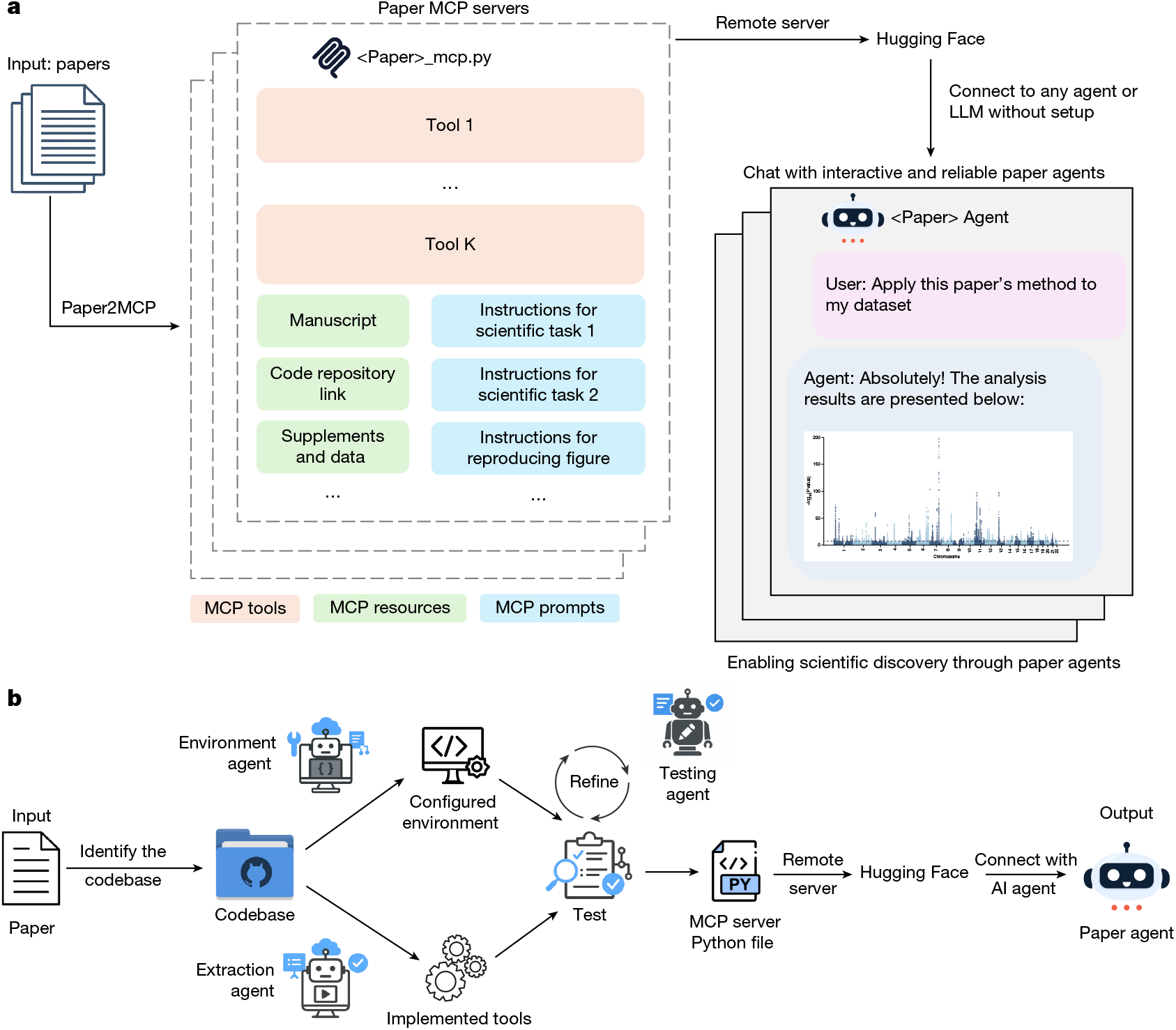
Here we introduce Paper2Agent, an automated framework that converts research papers into artificial intelligence (AI) agents. Paper2Agent transforms research output from passive artefacts into active systems that accelerate use and discovery. Conventional research papers require readers to understand and adapt the paper’s code, data and methods to their work, creating barriers to dissemination and reuse. Paper2Agent addresses this challenge by converting a paper into an AI agent that functions as a virtual corresponding author, exposing its manuscript, supplementary materials, datasets, code and workflows as active, agent-native knowledge rather than static text. It analyses the paper and codebase using multiple agents to construct a model context protocol (MCP) server, then generates and runs tests to refine and increase robustness of the MCP. These paper MCPs can be connected to a chat agent (such as Claude Code) to carry out complex scientific queries through natural language while invoking tools and workflows from the paper. We demonstrate Paper2Agent’s effectiveness through case studies. Paper2Agent created an agent that leveraged AlphaGenome1 to interpret genomic variants and agents based on Scanpy2 and TISSUE (transcript imputation with spatial single-cell uncertainty estimation)3 to conduct single-cell and spatial transcriptomics analyses. We validate that these agents reproduce the results of the original papers and carry out novel user queries. Paper2Agent created multiple agents that collaborate to prioritize a causal gene for psoriasis. By turning static papers into interactive AI agents, Paper2Agent introduces a paradigm for knowledge dissemination and a collaborative ecosystem of AI co-scientists.
Scaling Discovery through Test-Time Communication
Science advances not in isolation but through collaboration, yet existing agentic systems capture little of this. Whether communicating agents help remains an open question with mixed prior results. We show that test-time communication can substantially outperform independent parallel attempts on challenging tasks, where sharing a breakthrough can push the whole group forward. We first study the effect of scaling multi-agent test-time communication, where agents have no predefined roles and communicate via a shared directory, on ARC-AGI-3, a benchmark requiring novel problem solving. We find that a team of $k$ communicating agents, team@$k$, matches the success rate of $4k$ independent agents, and this advantage grows with $k$, suggesting gains compound with scale. The effect is not merely efficiency: a task that no single agent can solve, a team of agents can solve reliably. Furthermore, these gains transfer to research-oriented tasks, given sufficient compute. On polyomino packing, communicating agents outperform best@$k$ and exceed the prior best-known score. On MNIST classifier compression, communication surpasses the best-known human solution. A team of four agents produced a 1,957-byte classifier submission achieving 99.4% test accuracy, smaller than both the best-known human solution and the best single-agent result. These gains are not unconditional. Independent agents may outperform communication when compute is limited or when a clear measure of progress is absent. However, under sufficient compute and clear feedback, multi-agent communication consistently yields stronger results.
Arthur Turrell on Twitter / X
Today @Google, we published work led by @m_codreanu on AI in Science, drawing on 15 million Gemini interactions, 2,600 specialised AI models & a 600-scientist survey. What did we find about how AI is changing science? Read on... pic.twitter.com/VqO2xxcm02— Arthur Turrell (@arthurturrell) September 15, 2026

The Alien Space of Science: Sampling Coherent but Cognitively...
Scientific discovery is constrained not only by what is true, but by what is cognitively available to the researchers currently exploring a field. Many directions are coherent in light of the...