Collection
Ideas in Monoculture

Updated 9d
Collection
Updated 9d
Silicon Valley Is Turning Into Its Own Worst Fear
We asked a group of writers to consider the forces that have shaped our lives in 2017. Here, science fiction writer Ted Chiang looks at capitalism, Silicon Valley, and its fear of superintelligent AI.

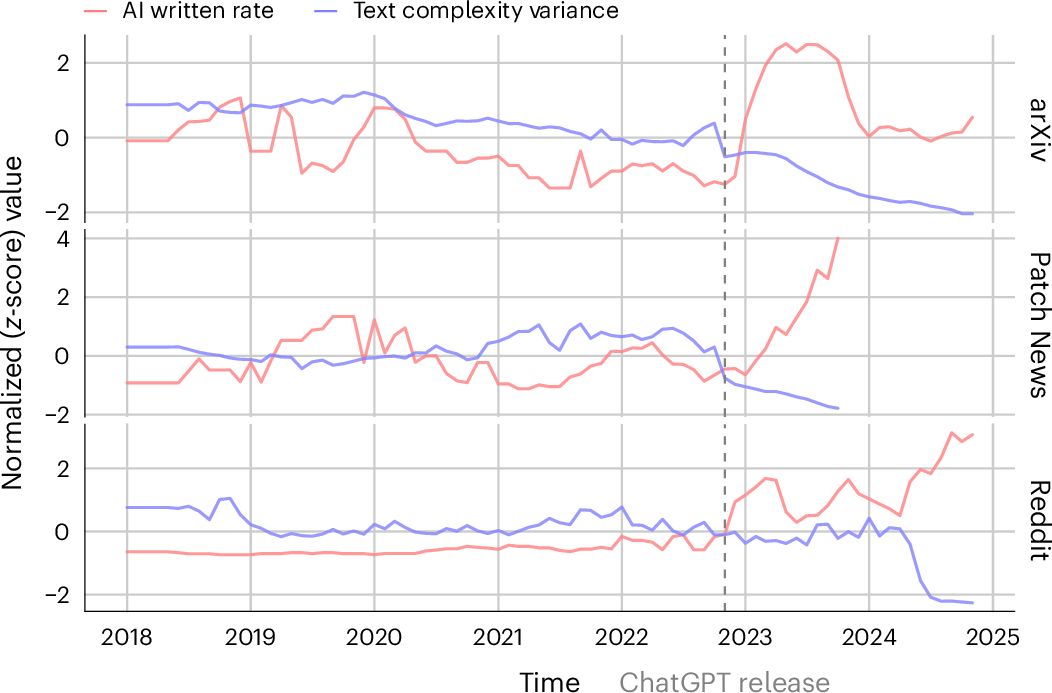
The shrinking landscape of linguistic diversity in the age of large language models
Language is far more than a communication tool; it encodes a wealth of information about a person’s identity, psychological state and social context, providing valuable insights for diverse fields including psychology, marketing and healthcare. Across three studies spanning seven datasets in different domains and over 880,000 texts, we show that the widespread adoption of large language models (LLMs) as writing assistants is linked to declines in linguistic diversity, interfering with the societal and psychological insights language provides. While core content is retained when LLMs polish and rewrite texts, LLMs also homogenize writing styles, reducing writing-complexity variance by a statistically significant 21–50% across datasets and models (P ≤ 0.05), and amplify patterns associated with dominant characteristics while suppressing others, emphasizing conformity over individuality. These trends hold across different LLMs, prompts and contexts, with potential implications for diagnostic processes, personalization efforts, hiring assessments and cultural preservation.
You and Your Research
Transcription of the Bell Communications Research Colloquium Seminar 7 March 1986
Value misalignments in X’s feed algorithm is a reflection of value tensions in engagement
Social media feed algorithms rank content that is purported to be preferred by users, but the engagement behaviors that drive these algorithms are (at best) indirect proxies for users’ explicitly self-stated values. Are the resulting feeds value aligned, and if not, why? We investigate this question by annotating the basic human values expressed in participants’ X (Twitter) feeds (N = 715 US users), analyzing the relationship between the posts’ value expressions and the posts’ amplification in the ranked “For You” Page feed, and then comparing the amplified values to users’ own values. We observe that the inventory of posts from followed accounts reflects users’ self-stated values—but that there is an overall negative correlation (misalignment) between users’ explicit values and the value expressions the algorithm is more likely to amplify. We turn to engagement behavior to understand this misalignment and observe that users’ engagement behaviors can be misaligned with their stated values—likely causing the algorithm to learn and reflect these misaligned values. We also detect partisan differences consistent with this theory: While the algorithm amplifies values negatively correlated with both Democrats’ and Republicans’ self-stated values, they are more misaligned for Democrats. And in fact replying, a heavily weighted form of engagement, is associated with values that are less aligned for both Democrats’ and Republicans’ self-stated values, and is even more misaligned for Democrats. Taken together, these findings offer a glimpse into the tensions between the values that people hold and those that provoke reactions, and how these value tensions can produce misaligned outcomes.

‘AI gravity’ is pulling you toward dependency. Here’s how to push back | MIT Sloan
AI systems hold the promise of competitive advantage, but they can usher in cognitive decline among workers, says MIT Sloan School of Management’s Eric So. Learn how to protect cognitive capital.

The Hitchhiker's Guide to Monoculture
Large language models (LLMs) often produce homogeneous outputs, raising concerns that AI coding assistants may lead to convergence in the software artifacts that developers create. Whether this occurs in practice is unclear because developers interactively prompt, evaluate, modify, and reject model outputs, and because outputs vary with prompt and repository context. I examine code homogenization using Kaggle contest submissions from 2019 to mid-2026. I first document widespread convergence toward the random seed value 42, consistent with LLMs reinforcing a longstanding convention in programming culture. I then study homogenization more broadly, at two levels of aggregation and abstraction. At the submission level, I measure the average pairwise similarity of submissions within contests. At the contest level, I measure the conceptual span of submitted code, motivating distinct measures for each: TF-IDF representations, which capture surface syntax, and Voyage 3 code embeddings, which capture code intent and semantics. The results demonstrate substantial syntactic homogenization at both the individual and collective levels: individual submissions have become more alike in literal syntax and code structure, while the latent dimensionality of syntactic variation has narrowed. In contrast, I find little evidence of semantic homogenization, individually and collectively. Average semantic distance remains essentially flat, and the contest-level latent dimensional span of semantic approaches remains stable. These findings suggest that AI coding assistants are certainly standardizing implementation details, yet they have not yet produced evidence of homogenization in the approaches and problem-solving strategies coders employ.

AI and the Collapse of the www
This paper studies market design for generative AI intermediation. AI answer systems can improve user experience while diverting visits that finance publisher content and generate source-level quality signals. I show that an AI platform that underinternalizes future content reproduction retains too little referral traffic and can make costly open-web information subcritical, even with truthful content, accurate answers, and rational users. The mechanism can be self-reinforcing: less source-level measurement weakens conventional search, inducing further AI reliance. Sustainable repair requires replacing displaced revenue and deleted measurement through visitor-replacement royalties, audited provenance, human-information audits, and keystone-topic compensation.

Knowledge Collapse
AI companies are racing to mechanize mathematics. Where does that leave human understanding?
Picking on the Same Person: Does Algorithmic Monoculture lead to Outcome Homogenization?
As the scope of machine learning broadens, we observe a recurring theme of algorithmic monoculture: the same systems, or systems that share components (e.g. datasets, models), are deployed by multiple decision-makers. While sharing offers advantages like amortizing effort, it also has risks. We introduce and formalize one such risk, outcome homogenization: the extent to which particular individuals or groups experience the same outcomes across different deployments. If the same individuals or groups exclusively experience undesirable outcomes, this may institutionalize systemic exclusion and reinscribe social hierarchy. We relate algorithmic monoculture and outcome homogenization by proposing the component sharing hypothesis: if algorithmic systems are increasingly built on the same data or models, then they will increasingly homogenize outcomes. We test this hypothesis on algorithmic fairness benchmarks, demonstrating that increased data-sharing reliably exacerbates homogenization and individual-level effects generally exceed group-level effects. Further, given the current regime in AI of foundation models, i.e. pretrained models that can be adapted to myriad downstream tasks, we test whether model-sharing homogenizes outcomes across tasks. We observe mixed results: we find that for both vision and language settings, the specific methods for adapting a foundation model significantly influence the degree of outcome homogenization. We also identify societal challenges that inhibit the measurement, diagnosis, and rectification of outcome homogenization in deployed machine learning systems.
Traditional Social Media as a Prison - What’s Happening on My Feed?
Social media apps have become a vehicle for community building, world news, and political campaigns. As app owners have enmeshed themselves more with the state, the carceral logics that haunt marginalized communities offline, became a part of their digital realities online.
The Local Connection Crisis: New Data on What Communities Need
Trails and public spaces — Rafael M. Batista
A reply to Kenny Peng and colleagues on designing social media around trails — and why the campground or the piazza may be the better analogy.
AI's Catastrophic Risk Isn't Rogue Machines, It's Cognitive Surrender
For many, AI introduces the suspicion that self-investment is inherently a losing proposition, writes recent graduate Evan Liu.
AI and democracy: the right to resist optimization
Taiwan's cyber-ambassador Audrey Tang on why the real danger of AI isn't that machines imitate humans, but that humans adapt to machines.

Experimental Study of Inequality and Unpredictability in an Artificial Cultural Market
Hit songs, books, and movies are many times more successful than average, suggesting that “the best” alternatives are qualitatively different from “the rest”; yet experts routinely fail to predict which products will succeed. We investigated this paradox experimentally, by creating an artificial “music market” in which 14,341 participants downloaded previously unknown songs either with or without knowledge of previous participants' choices. Increasing the strength of social influence increased both inequality and unpredictability of success. Success was also only partly determined by quality: The best songs rarely did poorly, and the worst rarely did well, but any other result was possible.

Homebound: The Long-Term Rise in Time Spent at Home Among U.S. Adults
The changes in daily life induced by the COVID-19 pandemic brought renewed attention to longstanding concerns about social isolation in the United States. Despite the links between the physical setting for individuals' daily lives and their connections with family, friends, and the various institutions of collective life, trends in where American adults spend their time have been largely overlooked as researchers have focused on how and with whom they spend their time. This article analyzes data from the American Time Use Survey over a timeframe spanning nineteen years and argues that the changes in Americans' daily routines induced by the COVID era should be seen as an acceleration of a longer-term trend: the rise of time spent at home. Results show that from 2003 to 2022, average time spent at home among American adults has risen by one hour and 39 minutes in a typical day. Time at home has risen for every subset of the population and for virtually all activities. Preliminary analysis indicates that time at home is associated with lower levels of happiness and less meaning, suggesting the need for enhanced empirical attention to this major shift in the setting of American life.

Our Civic Signals research | New_ Public
The Civic Signals are 14 indicators of healthy online spaces, based on years of research into what makes online communities work.
ABC Australia has a YouTube series called “You Can’t Ask That” in which they bring in people from various marginalized/stereotyped groups who have volunteered to answer “inappropriate” questions. I’m sure they aren’t fully representative but they do foster empathy & I think they’re generally great.

Muslim women on hijabs, gender inequality, abuse and faith | You Can't Ask That | Full Episode
youtu.be
