Collection
Social Norms and Cultural Evolution

Updated 3d
A collection of ideas to do with social norms, cultural evolution, and how we learn from others
Collection
Updated 3d
A collection of ideas to do with social norms, cultural evolution, and how we learn from others
Incomplete Contracting and AI Alignment
As part of the Digital Library's transition to Open Access, new features for researchers are available in the Premium Edition. Click here to learn more.

The governance & behavioral challenges of generative artificial intelligence’s hypercustomization capabilities
Generative artificial intelligence (GenAI) is changing human–machine interactions and the broader information ecosystem. Much as social media algorithms personalize online experiences, GenAI applications can align with user preferences to customize the way individuals interact with information. However, through training, fine-tuning, and prompting, GenAI applications can introduce a new level of customization: hypercustomization. By dynamically tailoring responses to an individual’s explicit and implicit preferences, hypercustomization can reinforce biases, false beliefs, or misconceptions. As a result, it can heighten significant societal challenges, such as the spread of misinformation and political and social polarization. In this article, we explore the risks associated with hypercustomization and the governance and behavioral challenges that might impede effective risk mitigation. These challenges include a lack of transparency in GenAI applications, opacity of the nature of their interactions with users, users’ overreliance on these systems, and the inefficacy of warning messages. We also provide recommendations for overcoming these challenges.

Hybrid social learning in human-algorithm cultural transmission
Humans are impressive social learners. Researchers of cultural evolution have studied the many biases shaping cultural transmission by selecting who we copy from and what we copy. One hypothesis is that with the advent of superhuman algorithms a hybrid type of cultural transmission, namely from algorithms to humans, may have long-lasting effects on human culture. We suggest that algorithms might show (either by learning or by design) different behaviours, biases and problem-solving abilities than their human counterparts. In turn, algorithmic-human hybrid problem solving could foster better decisions in environments where diversity in problem-solving strategies is beneficial. This study asks whether algorithms with complementary biases to humans can boost performance in a carefully controlled planning task, and whether humans further transmit algorithmic behaviours to other humans. We conducted a large behavioural study and an agent-based simulation to test the performance of transmission chains with human and algorithmic players. We show that the algorithm boosts the performance of immediately following participants but this gain is quickly lost for participants further down the chain. Our findings suggest that algorithms can improve performance, but human bias may hinder algorithmic solutions from being preserved. This article is part of the theme issue ‘Emergent phenomena in complex physical and socio-technical systems: from cells to societies’.

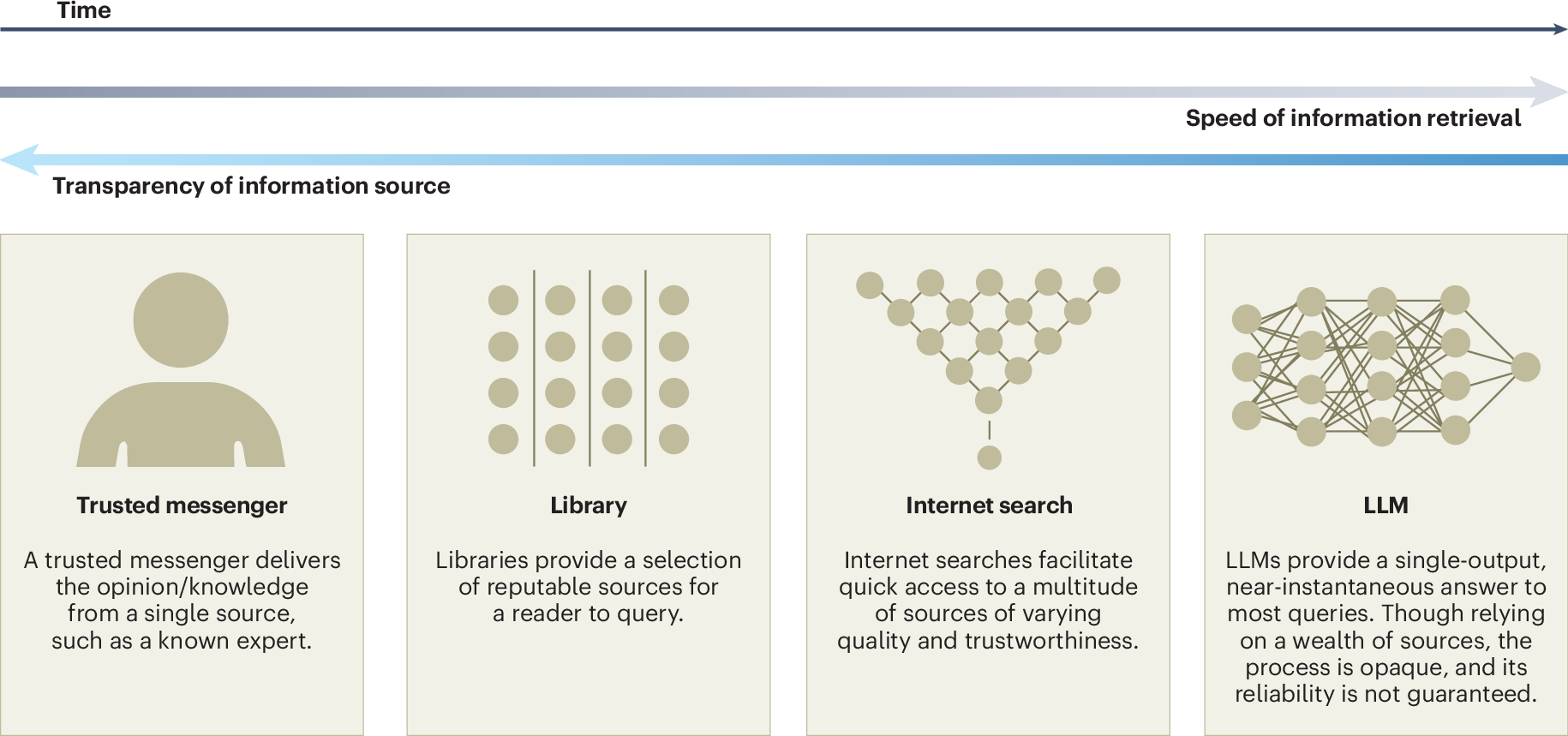
How large language models can reshape collective intelligence
Collective intelligence underpins the success of groups, organizations, markets and societies. Through distributed cognition and coordination, collectives can achieve outcomes that exceed the capabilities of individuals—even experts—resulting in improved accuracy and novel capabilities. Often, collective intelligence is supported by information technology, such as online prediction markets that elicit the ‘wisdom of crowds’, online forums that structure collective deliberation or digital platforms that crowdsource knowledge from the public. Large language models, however, are transforming how information is aggregated, accessed and transmitted online. Here we focus on the unique opportunities and challenges this transformation poses for collective intelligence. We bring together interdisciplinary perspectives from industry and academia to identify potential benefits, risks, policy-relevant considerations and open research questions, culminating in a call for a closer examination of how large language models affect humans’ ability to collectively tackle complex problems.
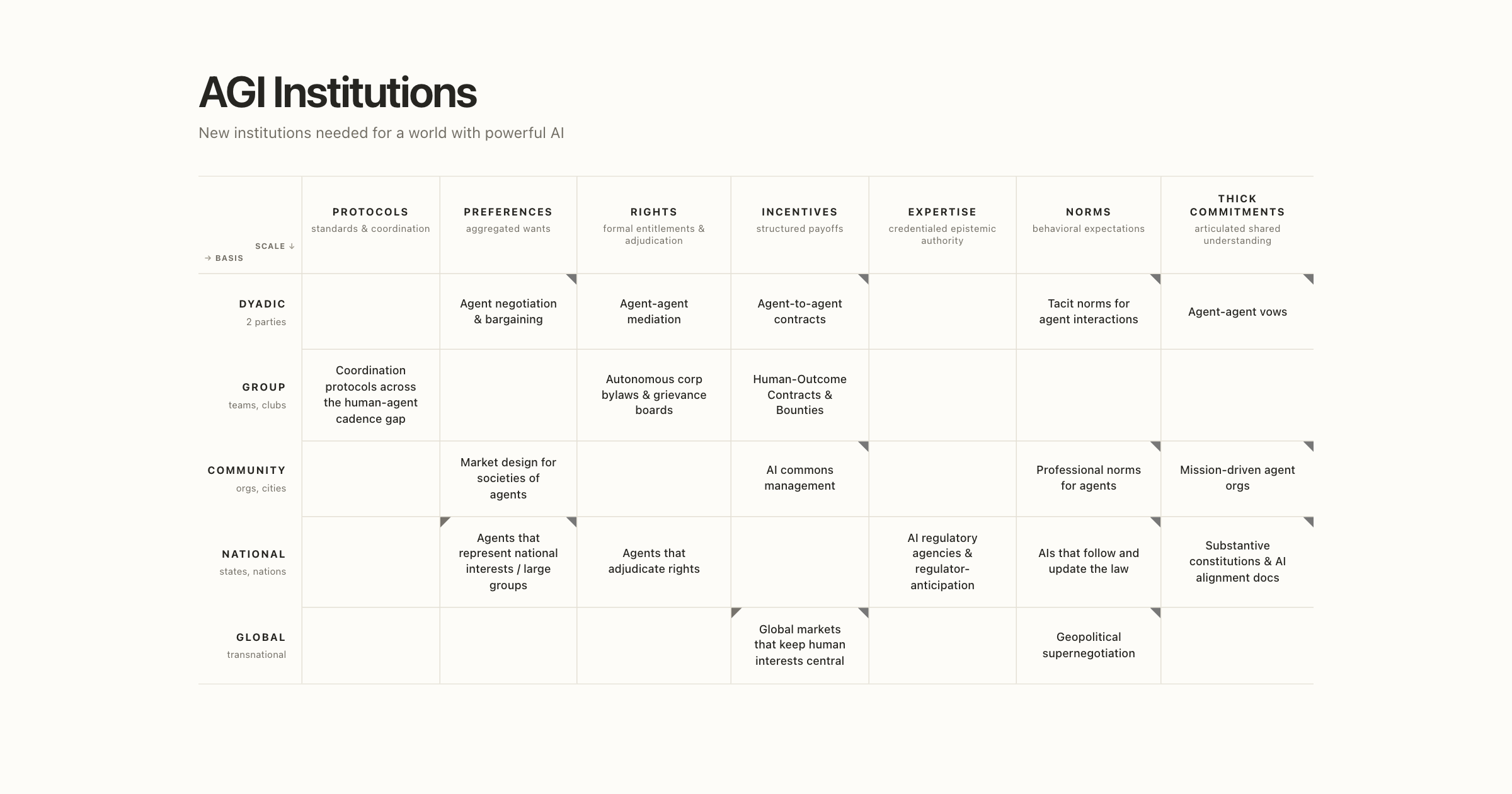
Existing Human Institutions — AGI Institutions Wiki
How existing human institutions handle coordination across scales — and how autonomous AI agents break them. Maps protocols, preferences, rights, incentives, expertise, norms, and thick commitments from dyadic to global.
Social-Information Seeking in Development: The Child as Experimental Psychologist
Research has established that children are “naive psychologists,” adept at understanding and navigating the social world from an early age. However, most of this work has focused on how children process information that they acquire incidentally, for example, by passively observing others’ actions. Here, we draw on literature framing children as intuitive scientists who actively seek information and test hypotheses to propose a view of children as naive experimental psychologists. From this perspective, children play an active role in selecting and pursuing relevant social information (e.g., about agents’ goals, traits, or relationships), whereby their search strategies are influenced both by context and task demands, as well as their prior beliefs, concepts, and domain-specific naive theories. We argue that the particular challenges associated with learning and reasoning about other minds may necessitate that children leverage their active learning competences, and we outline how the social domain uniquely constrains and shapes the learning process. We review existing research on social-information seeking in children and adults and identify directions for future research, emphasizing that children’s developing social cognition should be understood in terms of the active, exploratory role they take in learning about and participating in the social world.
EMERGENCE WORLD: A Laboratory for Evaluating Long-horizon Agent Autonomy — Emergence AI
Most evaluations of AI agents look like exams: a discrete task, a clean environment, a score in minutes or hours. Emergence World is built for the opposite question—what happens when you let agents run continuously, in a shared environment with real-world signals, for weeks. It is a research platfor

Sciences perceived as precise and consensual are more trusted
Research focused on the United States shows that people’s trust in science varies considerably between disciplines. Existing explanations of these trust gaps stress the role of ideology: when people perceive scientists of a particular discipline to be ideologically like-minded, they tend to trust them more. Here, we report two findings: first, trust gaps between disciplines also exist in France—a representative sample of the French population (N = 1012) trusted researchers in biology and physics more than researchers studying climate science, economics, or sociology. Second, the more precise and consensual participants perceive scientific findings to be, the more they tend to trust the scientists (across and within disciplines). While these findings are correlational, they align with a non-ideological explanation of trust in science: the rational impression account. This account proposes that people can come to trust scientists by relying on basic cognitive inference processes, which tend to be generally rational.
Norms in the Wild: How to Diagnose, Measure, and Change Social Norms
Abstract. Norms in the Wild takes a unique look at social norms, answering questions about diagnosis (how can we tell that a shared practice is a social no

Social Norms
Social norms, the informal rules that govern behavior in groups andsocieties, have been extensively studied in the social sciences.Anthropologists have described how social norms function in differentcultures (Geertz 1973), sociologists have focused on their socialfunctions and how they motivate people to act (Durkheim 1895 [1982],1950 [1957]; Parsons 1937; Parsons & Shils 1951; James Coleman1990; Hechter & Opp 2001), and economists have explored howadherence to norms influences market behavior (Akerlof 1976; Young1998a). More recently, also legal scholars have touted social norms asefficient alternatives to legal rules, as they may internalizenegative externalities and provide signaling mechanisms at little orno cost (Ellickson 1991; Posner 2000).
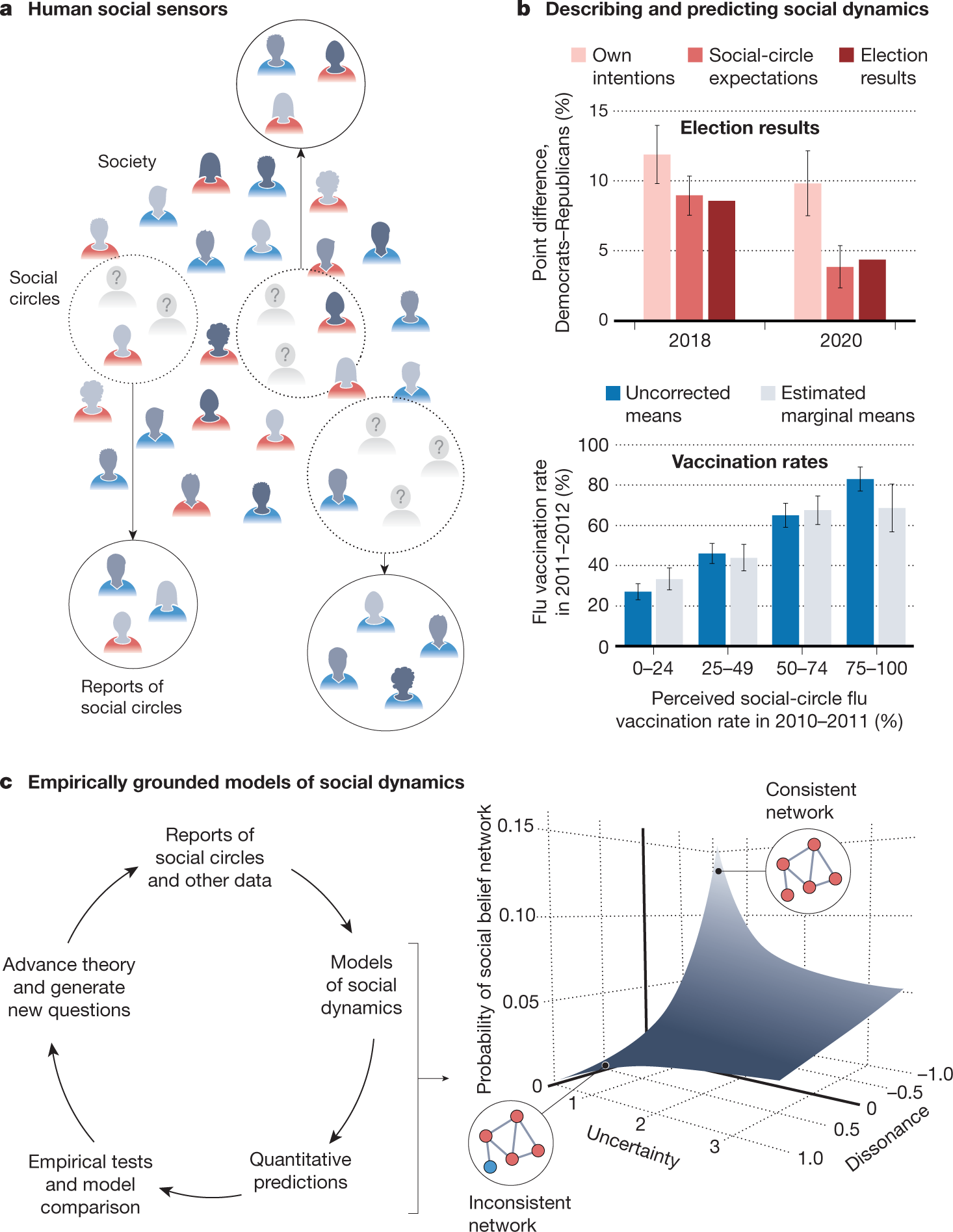
Human social sensing is an untapped resource for computational social science
The ability to ‘sense’ the social environment and thereby to understand the thoughts and actions of others allows humans to fit into their social worlds, communicate and cooperate, and learn from others’ experiences. Here we argue that, through the lens of computational social science, this ability can be used to advance research into human sociality. When strategically selected to represent a specific population of interest, human social sensors can help to describe and predict societal trends. In addition, their reports of how they experience their social worlds can help to build models of social dynamics that are constrained by the empirical reality of human social systems.
A sampling model of social judgment.
Social Sampling Explains Apparent Biases in Judgments of Social Environments
How people assess their social environments plays a central role in how they evaluate their life circumstances. Using a large probabilistic national sample, we investigated how accurately people estimate characteristics of the general population. For most characteristics, people seemed to underestimate the quality of others’ lives and showed apparent self-enhancement, but for some characteristics, they seemed to overestimate the quality of others’ lives and showed apparent self-depreciation. In addition, people who were worse off appeared to enhance their social position more than those who were better off. We demonstrated that these effects can be explained by a simple social-sampling model. According to the model, people infer how others are doing by sampling from their own immediate social environments. Interplay of these sampling processes and the specific structure of social environments leads to the apparent biases. The model predicts the empirical results better than alternative accounts and highlights the importance of considering environmental structure when studying human cognition.
Indirect reciprocity undermines indirect reciprocity destabilizing large-scale cooperation
Previous models suggest that indirect reciprocity (reputation) can stabilize large-scale human cooperation [K. Panchanathan, R. Boyd, Nature 432 , 499–502 (2004)]. The logic behind these models and experiments [J. Gross et al. , Sci. Adv. 9 , eadd8289 (2023) and O. P. Hauser, A. Hendriks, D. G. Rand, M. A. Nowak, Sci. Rep. 6 , 36079 (2016)] is that a strategy in which individuals conditionally aid others based on their reputation for engaging in costly cooperative behavior serves as a punishment that incentivizes large-scale cooperation without the second-order free-rider problem. However, these models and experiments fail to account for individuals belonging to multiple groups with reputations that can be in conflict. Here, we extend these models such that individuals belong to a smaller, “local” group embedded within a larger, “global” group. This introduces competing strategies for conditionally aiding others based on their cooperative behavior in the local or global group. Our analyses reveal that the reputation for cooperation in the smaller local group can undermine cooperation in the larger global group, even when the theoretical maximum payoffs are higher in the larger global group. This model reveals that indirect reciprocity alone is insufficient for stabilizing large-scale human cooperation because cooperation at one scale can be considered defection at another. These results deepen the puzzle of large-scale human cooperation.

Estimating peer effects in noisy, low-rank networks via network smoothing
Peer effect estimation requires precise network measurement, yet most empirical networks are noisy, rendering standard estimators inconsistent. To address measurement error in networks, we propose a method to estimate peer effects in networks whose expected adjacency matrix is low-rank. Our key result shows that peer effects over a true unobserved network are asymptotically equivalent to peer effects over the expected adjacency matrix. This result reduces peer effect estimation in noisy networks to low-rank matrix estimation targeting the expected adjacency matrix. We develop our theory for weighted networks observed with additive noise, but simulations suggest approach can be applied more generally when there is a low-rank estimation method suited to a particular noise structure. We demonstrate via simulations that our approach applies to egocentric samples, aggregated relational data, and networks with missing edges, each requiring a different low-rank estimation method.

A Model of Protests, Revolution, and Information
A collective action or revolt succeeds only if sufficiently many people participate. We study how potential revolutionaries’ ability to coordinate is affected by what they learn from different sources. We first examine how people learn about the likelihood of a revolution’s success by talking to those around themselves, which can either work in favor or against the success of an uprising, depending on the prior beliefs of the agents, the homogeneity of preferences in the population, and the number of contacts. We extend the analysis by examining the effects of homophily on learning: people are more likely to meet others who have similar preferences, undercutting learning. We introduce variants of our model to discuss other ways of learning about the support for a revolution. We discuss why holding mass protests before a revolt provides more informative signals of people’s willingness to actively participate than other less costly forms of communication (e.g., via social media). We also show how outcomes of revolutions in one region can inform citizens of another region and thus trigger (or discourage) neighboring revolutions. We also discuss the role of governments in avoiding revolutions and learning about their citizens’ concerns; in particular, by observing the strength of protests and counter-protests.

Understanding Social Media Recommendation Algorithms
Access the PDF version of this essay by clicking the icon to the right.

The Majority Illusion in Social Networks
Social behaviors are often contagious, spreading through a population as individuals imitate the decisions and choices of others. A variety of global phenomena, from innovation adoption to the emergence of social norms and political movements, arise as a result of people following a simple local rule, such as copy what others are doing. However, individuals often lack global knowledge of the behaviors of others and must estimate them from the observations of their friends' behaviors. In some cases, the structure of the underlying social network can dramatically skew an individual's local observations, making a behavior appear far more common locally than it is globally. We trace the origins of this phenomenon, which we call "the majority illusion," to the friendship paradox in social networks. As a result of this paradox, a behavior that is globally rare may be systematically overrepresented in the local neighborhoods of many people, i.e., among their friends. Thus, the "majority illusion" may facilitate the spread of social contagions in networks and also explain why systematic biases in social perceptions, for example, of risky behavior, arise. Using synthetic and real-world networks, we explore how the "majority illusion" depends on network structure and develop a statistical model to calculate its magnitude in a network.
Empirical evidence of Large Language Model's influence on human spoken communication
From the printing press to social media, innovations in communication technology have repeatedly reshaped how ideas spread through human culture. Chatbots powered by generative artificial intelligence constitute a new medium, encoding cultural patterns in their neural representations and disseminating them in conversations with hundreds of millions of people. Whether these patterns transmit into human language, and ultimately shape human culture, is a fundamental question. While fully quantifying the causal impact of a chatbot like ChatGPT on human culture is challenging, lexical shifts in human spoken communication may offer an early indicator. Here we show that words preferentially generated by ChatGPT, such as delve, showcase, boast, intricacies and meticulous, increased abruptly in spontaneous human speech. A synthetic-control analysis of 737,083 hours of conversation from 824,634 podcast episodes, screened for unscripted speech, causally links this shift to ChatGPT's release. The measurable influence on spontaneous speech suggests that humans internalize the lexical choices of large language models (LLMs). A preregistered experiment (N = 496) confirms they do, as a brief chatbot interaction led participants to adopt its words as their own, persisting past a distractor task and confirmed in forced lexical choice, indicating entrenchment in the active vocabulary. Together these results show that machines trained on human data now feed their own traits back into human language, integrating LLMs into the ongoing processes of cultural evolution.. This coupling raises concerns about linguistic homogenization and the capacity of a few major AI providers for latent cultural influence at scale.
