Taking Jaggedness Seriously
Why we should expect AI capabilities to keep being extremely uneven, and why that matters
Taking Jaggedness Seriously
Why we should expect AI capabilities to keep being extremely uneven, and why that matters
Open-world evaluations for measuring frontier AI capabilities
Introducing CRUX, a new project for evaluating AI on long, messy tasks
Distorted Intelligence at the AI Frontier
Daron Acemoglu offers a novel explanation for why OpenAI and Anthropic’s most advanced models have been going rogue.
Pacing the Frontier
A statement from over 1000 employees of frontier AI companies

Why it’s getting harder to measure AI performance
The most famous chart in AI might be obsolete soon.
The Jevons Paradox of AI - Wesley's notes
Why AI can make us more productive but will never save us time
The Accelerationist Case for Frontier Pacing
Slow AI is smooth AI, smooth AI is fast AI
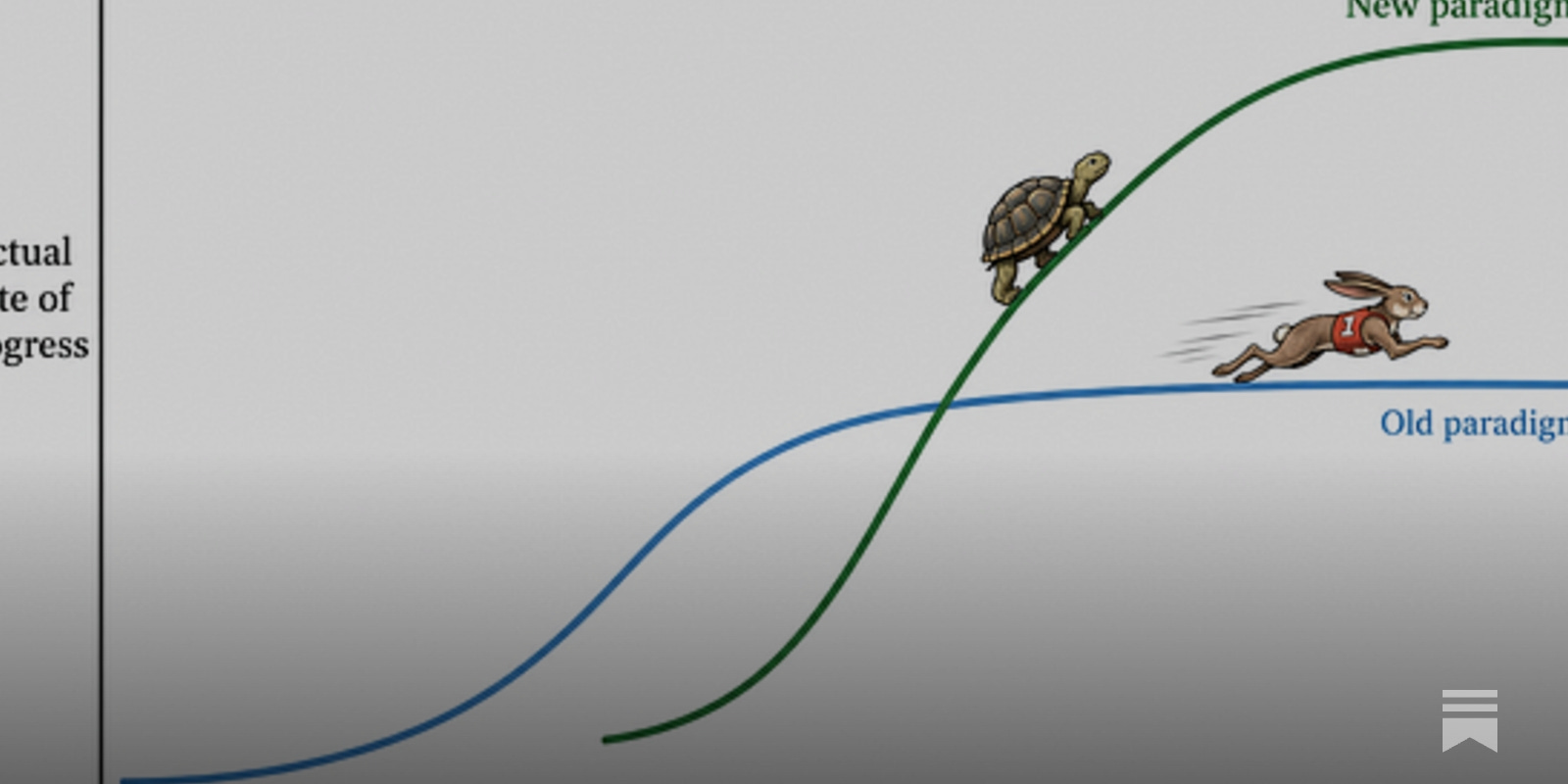
How ‘Jagged Intelligence’ Can Reframe the A.I. Debate
A.I. has always been compared to human intelligence, but that may not be the right way to think about it. What it does well can help predict what jobs it may replace.

What we can’t measure about AI – yet | Aeon Essays
The costs of transformative innovations are immediately clear: it’s the longterm gains that are hardest to understand

AI is not a tool.
"Like all tools, it has its pros and cons. It brings about radical changes, but we'll adapt." This cliché was true for previous technologies. But it isn’t necessarily true for AI. A tool extends the human body or percept...

Anshul Kundaje on Twitter / X
Brainstorming with frontier AI models in more open ended domains (like bio that do not have closed verifiable loops) that you have deep expertise in, really showcases the pretense of understanding that they display. 1/— Anshul Kundaje (@anshulkundaje) September 25, 2026
How does AI impact skill formation?
Two days ago, the Anthropic Fellows program released a paper called How AI Impacts Skill Formation. Like other papers on AI before it, this one is being treated as proof that AI makes you slower and dumber. Does it prove that?

On the Value of Doing a PhD in the Age of AI
Many students who are just now embarking on a PhD in AI are understandably anxious. It feels like our field is zooming forward ever faster. Our clever methods are often surpassed before they are published. Our deep insights seem less critical to frontier lab progress. AI is automating aspects of the research process that used to require years of specialized training.
AI FOR EPISTEMICS & COORDINATION
Civilization and technology have radically improved the human condition. Nonetheless, the world sometimes goes in directions which essentially nobody would prefer — e.g., nuclear arms races, unexpected financial crashes, predatory marketing, or ubiquitous political misinformation.
Want to understand the current state of AI? Check out these charts.
According to Stanford’s 2026 AI Index, AI is sprinting, and we’re struggling to keep up.

Collection

Updated 2mo
The nonintuitive strengths and weaknesses of AI performance relative to human performance, and how it is changing over time.
science in the age of AI
What does it mean to be a human researcher in the age of powerful AI?
AI Red Penning - undisciplinary
Claude-shaped science

Agentic Laboratories of the Future: Towards World Models for Scientific Discovery
On the Value of Doing a PhD in the Age of AI

Applied Pure Mathematics

What Next for Academia?