Collection
ai for science impacts

Updated 6h
Collection
Updated 6h
PhD students who write dissertation with AI less likely to stay in academia
US PhD graduates who used artificial intelligence were more likely to work in industry.

AI co-scientists are revolutionizing how research is done
Artificial-intelligence systems can generate hypotheses, design experiments and analyse data — but humans still need to decide what makes sense.
Thomas G. Dietterich on Twitter / X
We are seeing a new trend in submissions to @arxiv (and presumably to conferences and journals): Authors submitting papers whose contents they likely do not understand. 1/— Thomas G. Dietterich (@tdietterich) September 13, 2026
Terence Tao: AI companies are harming mathematics | New Scientist
AI firms are making new mathematical discoveries at a rapid pace, but not sticking around to help unpick the new proofs. That is not the way to advance our understanding, says mathematician Terence Tao

Thomas Wolf on Twitter / X
wtf is this way to handle mathematicians work and scientific communicationTLDR: Leven and Tristan worked over several months on one of the Millenium Prize Problems with various AIs to reach final interesting results. OpenAI apparently heard about it in the last days and… https://t.co/zNozwkFcFO pic.twitter.com/XcefJ17AQe— Thomas Wolf (@Thom_Wolf) September 8, 2026

Dimitris Papailiopoulos on Twitter / X
https://t.co/cpwPlGKWpD— Dimitris Papailiopoulos (@DimitrisPapail) August 8, 2026
The Tragedy of the Cognitive Commons: How AI Could Disrupt the Regeneration of Professional Expertise
Artificial intelligence is reshaping cognitive work, but Human Resource Development scholarship has treated this transformation as an organizational training challenge, leaving the collective regeneration of professional expertise unexamined. This conceptual paper introduces the Cognitive Commons framework, integrating commons theory, HRD scholarship, and distributed cognition to explain how rational AI adoption decisions can deplete the shared expertise pool professions require for renewal. The framework distinguishes Internalized Mastery (deep domain knowledge from sustained practice) from Distributed Mastery (orchestrating human-AI systems), and develops the Validation Tether: effective AI oversight depends on the expertise AI adoption may undermine. Early labor market and clinical evidence suggests possible disruption to expertise-regeneration pathways in highly AI-exposed sectors, though adoption is recent and the strongest signals come from leading sectors rather than all professions. Five factors determine occupational vulnerability, and governance arrangements may form across organizational, professional-association, and policy levels. The paper reframes expertise development as collective stewardship rather than organizational optimization, with implications for HRD theory and workforce policy.

Artificial intelligence and illusions of understanding in scientific research
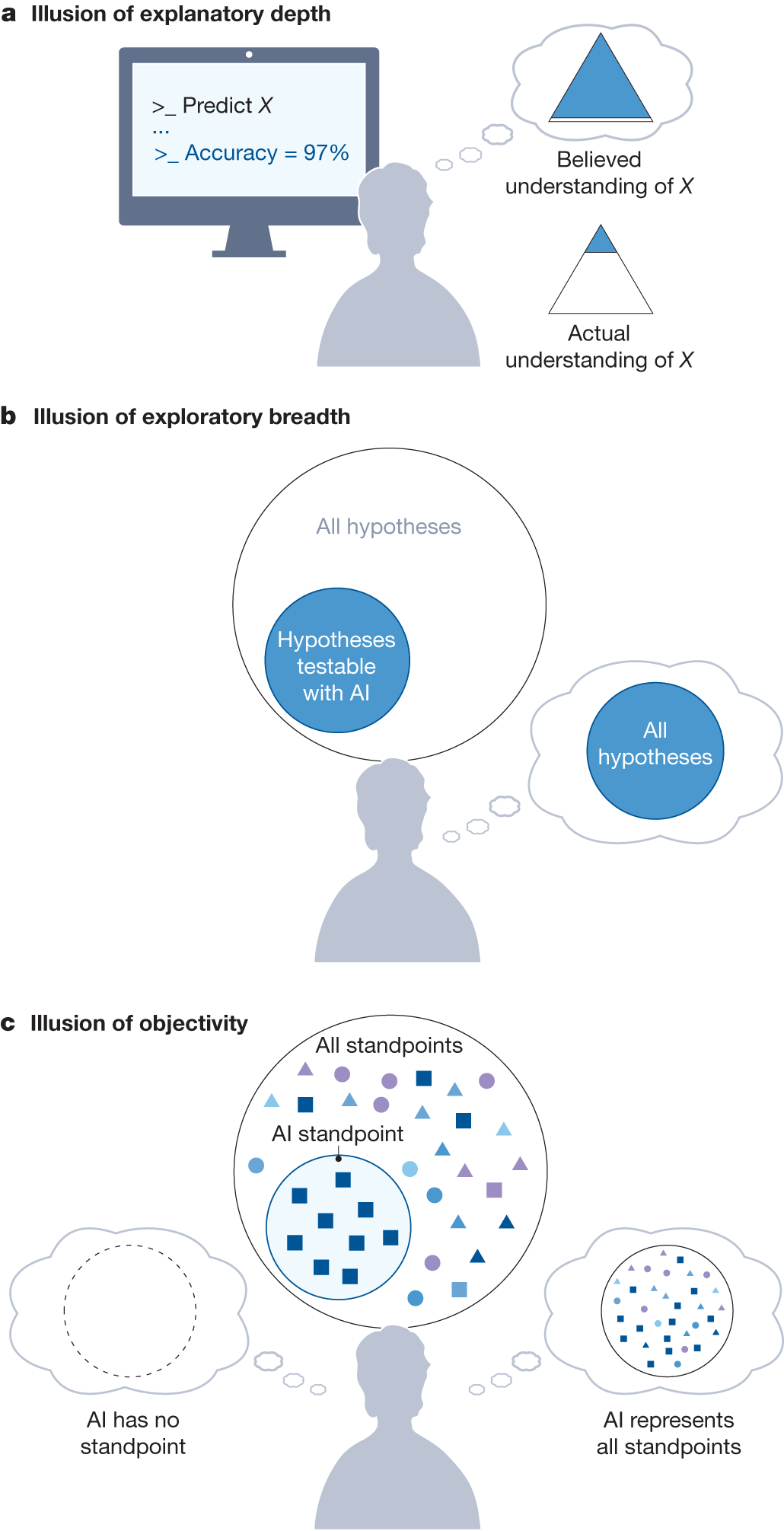
Scientists are enthusiastically imagining ways in which artificial intelligence (AI) tools might improve research. Why are AI tools so attractive and what are the risks of implementing them across the research pipeline? Here we develop a taxonomy of scientists’ visions for AI, observing that their appeal comes from promises to improve productivity and objectivity by overcoming human shortcomings. But proposed AI solutions can also exploit our cognitive limitations, making us vulnerable to illusions of understanding in which we believe we understand more about the world than we actually do. Such illusions obscure the scientific community’s ability to see the formation of scientific monocultures, in which some types of methods, questions and viewpoints come to dominate alternative approaches, making science less innovative and more vulnerable to errors. The proliferation of AI tools in science risks introducing a phase of scientific enquiry in which we produce more but understand less. By analysing the appeal of these tools, we provide a framework for advancing discussions of responsible knowledge production in the age of AI.
Scientific production in the era of Large Language Models
Large Language Models (LLMs) are rapidly reshaping scientific research. We analyze these changes in multiple, large-scale datasets with 2.1M preprints, 28K peer review reports, and 246M online accesses to scientific documents. We find: 1) scientists adopting LLMs to draft manuscripts demonstrate a large increase in paper production, ranging from 23.7-89.3% depending on scientific field and author background, 2) LLM use has reversed the relationship between writing complexity and paper quality, leading to an influx of manuscripts that are linguistically complex but substantively underwhelming, and 3) LLM adopters access and cite more diverse prior work, including books and younger, less-cited documents. These findings highlight a stunning shift in scientific production that will likely require a change in how journals, funding agencies, and tenure committees evaluate scientific works.
How AI Agents are transforming scientific discovery
AI agents are starting to reshape science, from proposing novel hypotheses to writing code. Learn what comes next for scientists and policymakers.
