Rudolph (Rudy) Fraser ⁂ CEO & Founder, building virtual 3rd places [ @blackskyweb.xyz ][ blacksky.community ] @mozilla.org Fellow 🦊 prev. @harvard.edu Fellow 🏴☠️ [ wethepeople.nyc ] Board @pactcollective.xyz TSC @lexicon.community Black crypto-anarchy Ⓐ
Ghost in the Shell (Ghost in the Shell, #1)
In the rapidly converging landscape of the 21st century…

Dangerous, Dirty, Violent, and Young: A Fugitive Family…
The son of Weather Underground radicals Bernardine Dohr…

The shockwave rider
Book 1: The Basic Straining Manual -- Book 2: The Delphi Coracle -- Book 3: Splicing the Brain Race


The hacker crackdown: law and disorder on the electronic frontier
A journalist investigates the past, present, and future…

The Fifth Season (The Broken Earth, #1)
This is the way the world ends. Again. Three terrible …


Society-in-the-loop: programming the algorithmic social contract
Recent rapid advances in Artificial Intelligence (AI) and Machine Learning have raised many questions about the regulatory and governance mechanisms for autonomous machines. Many commentators, scholars, and policy-makers now call for ensuring that algorithms governing our lives are transparent, fair, and accountable. Here, I propose a conceptual framework for the regulation of AI and algorithmic systems. I argue that we need tools to program, debug and maintain an algorithmic social contract, a pact between various human stakeholders, mediated by machines. To achieve this, we can adapt the concept of human-in-the-loop (HITL) from the fields of modeling and simulation, and interactive machine learning. In particular, I propose an agenda I call society-in-the-loop (SITL), which combines the HITL control paradigm with mechanisms for negotiating the values of various stakeholders affected by AI systems, and monitoring compliance with the agreement. In short, ‘SITL = HITL + Social Contract.’

Emergence: the connected lives of ants, brains, cities and software
In the tradition of Being Digital and The Tipping Point…

Positive Sum Worlds: Remaking Public Goods
An era of global protocols requires a visionary redefinition of public goods, in service of others.

Squad Wealth
The squad is the basic user class for the tools we need today as a society.

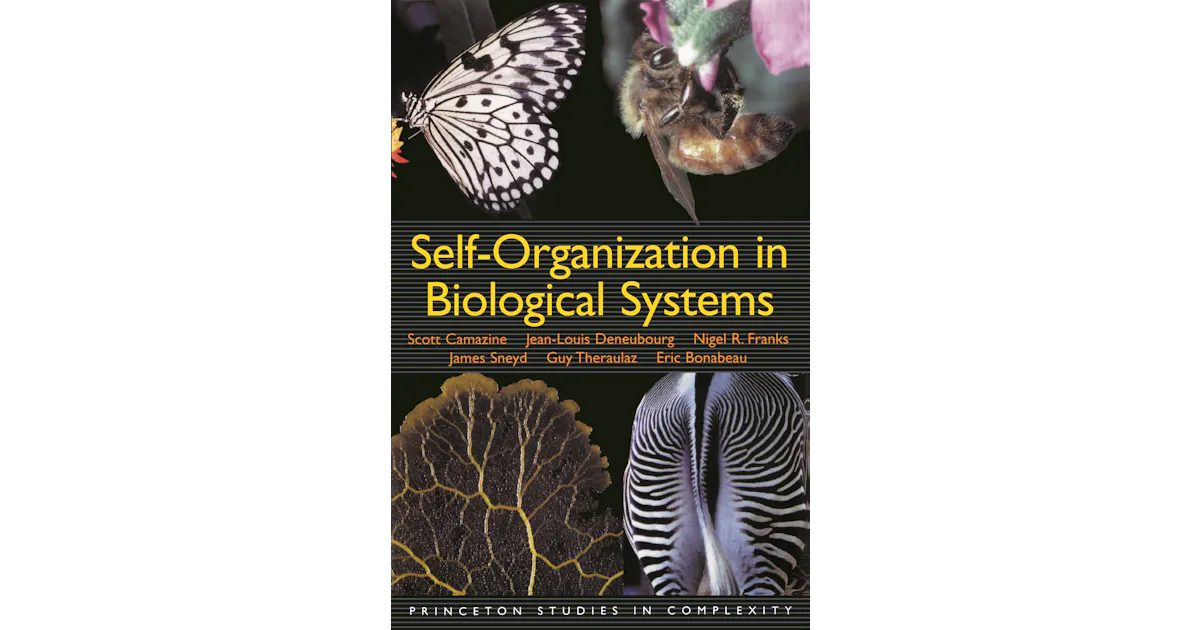
Self-Organization in Biological Systems
The synchronized flashing of fireflies at night. The spiraling patterns of an aggregating slime mold. The anastomosing network of army-ant trails. The coordinated movements of a school of fish. Researchers are finding in such patterns—phenomena that have fascinated naturalists for centuries—a fertile new approach to understanding biological systems: the study of self-organization. This book, a primer on self-organization in biological systems for students and other enthusiasts, introduces readers to the basic concepts and tools for studying self-organization and then examines numerous examples of self-organization in the natural world. Self-organization refers to diverse pattern formation processes in the physical and biological world, from sand grains assembling into rippled dunes to cells combining to create highly structured tissues to individual insects working to create sophisticated societies. What these diverse systems hold in common is the proximate means by which they acquire order and structure. In self-organizing systems, pattern at the global level emerges solely from interactions among lower-level components. Remarkably, even very complex structures result from the iteration of surprisingly simple behaviors performed by individuals relying on only local information. This striking conclusion suggests important lines of inquiry: To what degree is environmental rather than individual complexity responsible for group complexity? To what extent have widely differing organisms adopted similar, convergent strategies of pattern formation? How, specifically, has natural selection determined the rules governing interactions within biological systems? Broad in scope, thorough yet accessible, this book is a self-contained introduction to self-organization and complexity in biology—a field of study at the forefront of life sciences research.

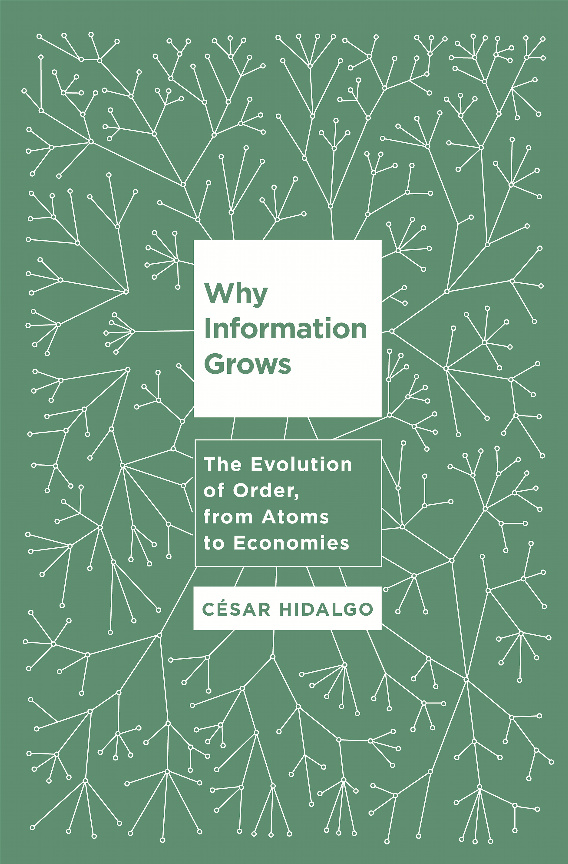
Why Information Grows
"Hidalgo has made a bold attempt to synthesize a large body of cutting-edge work into a readable, slender volume. This is the future of growth theory." -- F...

Create Your Private Forecasting Platform
Launch your own private forecasting instance with Metaculus. Combine the power of predictive analytics with internal expertise to address key strategic questions within your organization.