Collection
What the Picatrix actually is — Sources

Updated 4d
Academic sources for Sensemaker's answer on the Arabic Ghāyat al-Ḥakīm, its Latin Picatrix adaptation, contents, transmission, authorship, and reception.
Collection
Updated 4d
Academic sources for Sensemaker's answer on the Arabic Ghāyat al-Ḥakīm, its Latin Picatrix adaptation, contents, transmission, authorship, and reception.
Face of a Bird, Legs of an Eagle: The Hybrid Venus in Medieval Texts of Image Magic and the So-Called Talisman of Catherine de’ Medici
This article examines the imagery of the goddess Venus in medieval sources of astrological magic, focusing on a zoomorphic hybrid Venus characterized by avian features. Furthermore, the article examines the transmission of this motif into early modern printed sources and talismans. The most renowned among surviving items related to the hybrid Venus is the 18th-century medallion known as Catherine de Medici’s talisman, depicting on one side a classical Venus figure, and on the other, a seated Jupiter alongside a hybrid with the head and feet of a bird. In previous scholarship it has been argued that the hybrid figure, interpreted as Venus, derives from Cornelius Agrippa and the medieval magical compendium Picatrix. The study demonstrates that the same hybrid Venus appears in several other medieval sources predating Agrippa and independent of the Picatrix. These sources, explored in this article in detail, offer a new insight into the evolution of the zoomorphic Venus, providing a deeper understanding of the ways in which non-Christian and non-classical astrological iconography was transformed and found pathways within medieval literature. Based on the findings of this research, De sigillis attributed to Arnoldus Saxo, seems to provide the most direct model for depicting two distinct Venus figures within the same talisman. The article further argues that the avian hybrid Venus was a dynamic figure among non-classical hybrids, appearing in a relatively wide range of sources, including contexts where astrological hybrids were a rarity.
Traces of Necromantic Divinatory Practices in the Picatrix
In the famous medieval magical manual called the Picatrix, the unknown author describes the phenomenon of magic with the term nigromantia. As is well known, the original meaning of the Greek term necromantia has a more concise meaning. It is used for a special kind of divination, i.e., divination through the parts of a cadaver and the conjured spirit of the dead. Seemingly, in the Picatrix, no necromantic ritual can be found; moreover, the author stresses that his main goal is pious, i.e., to find the path leading to the ultimate source of the universe, the one and only God. In my article, I show that on some pages of the Picatrix, there are traces of divinatory practices that may be connected to the original meaning of the term nigromantia. In the third book of the manual, descriptions of some interesting rituals attributed to the pagan Sabeans of Harran and their teacher, the god Hermes can be found. During the practices, the magician involved conjured spirits of the heavenly bodies and powers as well. Because of this, by looking closely at and analyzing the given text, it is possible to piece together a complex web of necromantic and demonic divinatory rituals.

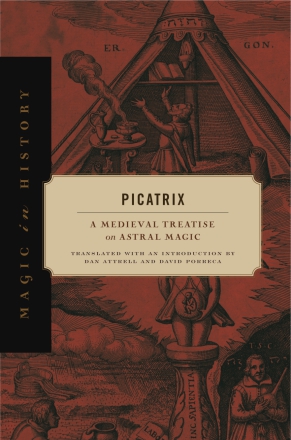
19.09.12 Attrell/Porreca (eds.), Picatrix: A Medieval Treatise on Astral Magic
Attrell, Dan, and David Porreca, trans. Picatrix: A Medieval Treatise on Astral Magic, Magic in History. University Park, PA: Pennsylvania State University Press, 2019. pp. xii, 372. $39.95 (hardback). ISBN: 978-0-271-08212-7 (hardback).
Magia en al-Andalus: Rasā’il ijwān al-Ṣafā’, Rutbat al-ḥakīm y Gāyat al-ḥakīm (Picatrix)
El artículo analiza la introducción de las Rasā’il ijwān al-Ṣafā’ en al-Andalus y la implicación de esta cuestión en la historia de la ciencia y la filosofía árabes. Más particularmente, se centra en el impacto de la enciclopedia de los Hermanos de la Pureza en dos obras importantes de la literatura de al-Andalus en el campo de las ciencias ocultas: la Rutbat al-ḥakīm y la Gāyat al-ḥakīm. Retoma el tema de la autoría y cronología de estas tres obras, destacando el hecho de que el corpus de las Rasā’il es el resultado final de un proceso de compilación históricamente largo y confirmando, a partir de algunos elementos nuevos, la identificación del autor de la Rutba y de la Gāya con Maslama al-Qurṭubī (m. 964). La comparación textual de estas tres obras y, en particular, el análisis de la Rutba, obra aún inédita, permite identificar a Maslama al-Qurṭubī como el transmisor genuino del corpus ijwāniano a al-Andalus.
Picatrix: A Medieval Treatise on Astral Magic Translated with an introduction by Dan Attrell and David Porreca
A manual for constructing talismans, mixing magical compounds, summoning planetary spirits, and determining astrological conditions, Picatrix is a cornerstone of Western esotericism. It offers important insights not only into occult practices and beliefs but also into the transmission of magical ideas from antiquity to the present. Dan Attrell and David Porreca’s English translation opens the world of this vital medieval treatise to modern-day scholars and lay readers.