Collection
Open
Terrain — Sources: Papers

Updated 1mo
The evidence base for terrain.pub. One card per research source note.
Collection
Updated 1mo
The evidence base for terrain.pub. One card per research source note.
Recuerdo de voto y distorsiones analíticas: el caso español tras las elecciones generales de 2023
The objective of this research is to analyze and identify patterns in the variables of vote recall and vote intention as recorded in the monthly barometers conducted by the Spanish Center for Sociological Research (CIS). The methodological approach employed is time series analysis. The empirical findings indicate that the average percentage of vote recall for the progressive parties, PSOE and Sumar, does not differ from their results in the most recent general elections. In contrast, the percentages for the PP and Vox are lower than their actual electoral outcomes. The study confirms the presence of vote concealment in the case of the PP, as well as the role of the concealment category as an intermediate state in vote transfers to and from Vox. Finally, the research highlights the importance of monitoring the electoral dynamics reflected in the vote recall variable and recommends assessing its potential use as a weighting variable.
A bitter victory and a sweet defeat: the July 2023 Spanish general election
This article examines the outcome of the July 2023 election in Spain. Despite the right- and far-right bloc winning a higher share of the votes, the two main incumbent parties on the left (PSOE and...

Partidismo negativo, derecha radical y voto: un análisis de su relación en el contexto de las elecciones generales españolas de 2023
Although the concept of partisan identification included a positive and a negative dimension as postulated by the Michigan model, the truth is that the latter dimension has received practically no attention. The present research aims to evaluate to what extent negative partisanship currently represents an explanatory factor of electoral behavior in Spain. Specifically, we study how, in the context of the Spanish general elections of July 2023, negative partisanship towards the radical right increased the probability of voting for the PSOE and whether, in turn, the rejection generated by the PSOE also promoted support for Vox. To test these hypotheses, we use data from the III National Survey of Political Polarization in Spain, elaborated by the Murcian Centre for Public Opinion Studies (CEMOP) in the middle of the election campaign. The results of the binary logistic regression models implemented show that negative partisanship towards the radical right represents a (novel) explanatory factor of the vote for the PSOE, but that Vox did not feed significantly on the rejection of the socialists —nor even of Sumar—.We also note the exceptional capacity of the radical right to arouse processes of negative identification, especially among women.
Public support for the <i>cordon sanitaire</i> : Descriptive evidence from Spain
Reactions to the rise of far-right parties that advocate democratic backsliding, and the dilution of socially liberal democratic norms present a dilemma for existing political parties. How should existing political parties respond to this challenge? A commonly adopted strategy is to apply a cordon sanitaire which excludes radical right-wing challengers from the government-forming process. Do voters support this policy? Leveraging data from Spain – where the mainstream right has accommodated the radical right-wing party, VOX, via numerous governing coalitions – I rely on individual citizens’ views on how parties should respond to rise of the far-right party, to answer this question. Empirically, the results show very low-level support for the cordon sanitaire in Spain. Indeed, the modal position of the electorate, regardless of their ideological position, is to treat the party just like any other. These results are not conditioned by the propensity of individuals to identify VOX as indeed being a “radical right” party. These descriptive findings suggest that whilst radical right-wing parties may present an inimical threat to democratic norms, citizens do not necessarily view the means of squashing this threat to be one of strategic exclusion. This likely explains why the mainstream right has been able to institutionalise VOX as a political ally: where strategic exclusion is not expected, the mainstream right need not fear violating an expectation that does not exist.

Décision n° 2022-197 PDR du 27 avril 2022
Proclamation des résultats de l'élection du Président de la République
The 2024 French legislative elections: maintaining elections, political crisis
The 2024 French legislative elections were called by President Macron following the severe defeat of his coalition in the 2024 European elections. Held on 30 June and 7 July after a 3-week campaign...

The small effects of political advertising are small regardless of context, message, sender, or receiver: Evidence from 59 real-time randomized experiments
Campaign persuasion operates with notable consistency across political parties, message tone, and information environment., Evidence across social science indicates that average effects of persuasive messages are small. One commonly offered explanation for these small effects is heterogeneity: Persuasion may only work well in specific circumstances. To evaluate heterogeneity, we repeated an experiment weekly in real time using 2016 U.S. presidential election campaign advertisements. We tested 49 political advertisements in 59 unique experiments on 34,000 people. We investigate heterogeneous effects by sender (candidates or groups), receiver (subject partisanship), content (attack or promotional), and context (battleground versus non-battleground, primary versus general election, and early versus late). We find small average effects on candidate favorability and vote. These small effects, however, do not mask substantial heterogeneity even where theory from political science suggests that we should find it. During the primary and general election, in battleground states, for Democrats, Republicans, and Independents, effects are similarly small. Heterogeneity with large offsetting effects is not the source of small average effects.

Left-Wing Governments and Far-Right Success
In recent decades, support for the far right has surged in many countries. One common explanation for this is that far-right support is a backlash against left-wing governments and their policies. We investigate the causal effect of the partisan make-up of governments on the electoral results of far-right parties. Evidence from over-time comparative data and a quasi-experimental analysis based on a regression discontinuity design in Spain indicates that far-right parties benefit electorally when the current government is on the left. In further analyses, we employ a novel regression discontinuity design (RDD)-based sampling strategy to examine original individual-level survey data from Spanish municipalities close to the discontinuity cutoff. These data show that the likely mechanism underlying the backlash effect is an ideological shift to the right among the electorate when left-wing parties govern. Overall, the far right benefits more when the mainstream left governs than when the mainstream right does.

Publication bias in the social sciences: Unlocking the file drawer
The file drawer is full. Should we worry? Experiments that produce null results face a higher barrier to publication than those that yield statistically significant differences. Whether this is a problem depends on how many null but otherwise valid results might be trapped in the file drawer. Franco et al. use a Time-sharing Experiments in the Social Sciences archive of nearly 250 peer-reviewed proposals of social science experiments conducted on nationally representative samples. They find that only 10 out of 48 null results were published, whereas 56 out of 91 studies with strongly significant results made it into a journal. Science , this issue p. 1502 , Fully half of peer-reviewed and implemented social science experiments are not published. , We studied publication bias in the social sciences by analyzing a known population of conducted studies—221 in total—in which there is a full accounting of what is published and unpublished. We leveraged Time-sharing Experiments in the Social Sciences (TESS), a National Science Foundation–sponsored program in which researchers propose survey-based experiments to be run on representative samples of American adults. Because TESS proposals undergo rigorous peer review, the studies in the sample all exceed a substantial quality threshold. Strong results are 40 percentage points more likely to be published than are null results and 60 percentage points more likely to be written up. We provide direct evidence of publication bias and identify the stage of research production at which publication bias occurs: Authors do not write up and submit null findings.

How the Cases You Choose Affect the Answers You Get: Selection Bias in Comparative Politics
This article demonstrates how the selection of cases for study on the basis of outcomes on the dependent variable biases conclusions. It first lays out the logic of explanation and shows how it is violated when only cases that have achieved the outcome of interest are studied. It then examines three well-known and highly regarded studies in the field of comparative politics, comparing the conclusions reached in the original work with a test of the arguments on cases selected without regard for their position on the dependent variable. In each instance, conclusions based on the uncorrelated sample differ from the original conclusions.
Why Are American Presidential Election Campaign Polls so Variable When Votes Are so Predictable?
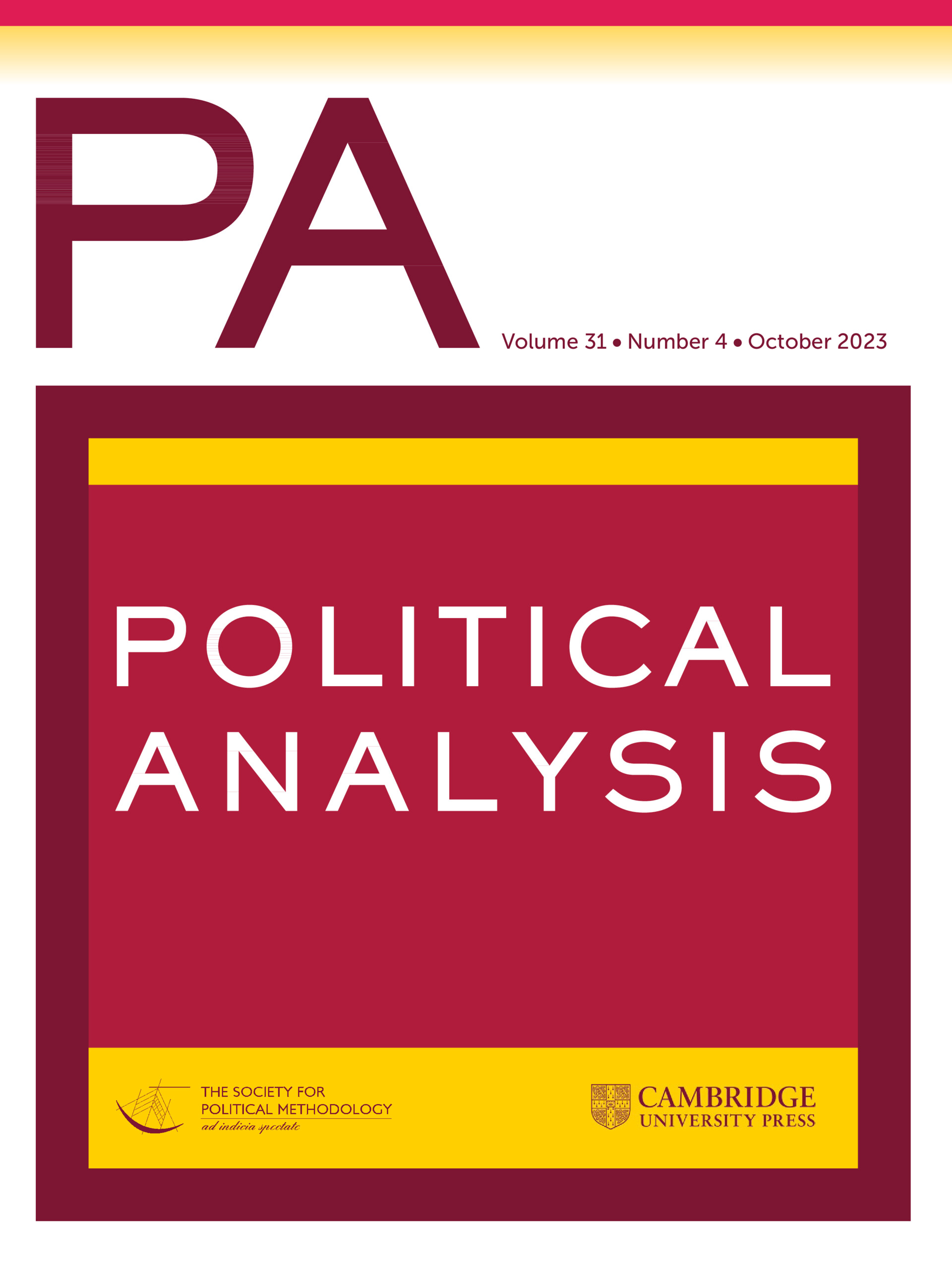
As most political scientists know, the outcome of the U.S. Presidential election can be predicted within a few percentage points (in the popular vote), based on information available months before the election. Thus, the general election campaign for president seems irrelevant to the outcome (except in very close elections), despite all the media coverage of campaign strategy. However, it is also well known that the pre-election opinion polls can vary wildly over the campaign, and this variation is generally attributed to events in the campaign. How can campaign events affect people's opinions on whom they plan to vote for, and yet not affect the outcome of the election? For that matter, why do voters consistently increase their support for a candidate during his nominating convention, even though the conventions are almost entirely predictable events whose effects can be rationally forecast? In this exploratory study, we consider several intuitively appealing, but ultimately wrong, resolutions to this puzzle, and discuss our current understanding of what causes opinion polls to fluctuate and yet reach a predictable outcome. Our evidence is based on graphical presentation and analysis of over 67,000 individual-level responses from forty-nine commercial polls during the 1988 campaign and many other aggregate poll results from the 1952–1992 campaigns. We show that responses to pollsters during the campaign are not generally informed or even, in a sense we describe, "rational." In contrast, voters decide which candidate to eventually support based on their enlightened preferences, as formed by the information they have learned during the campaign, as well as basic political cues such as ideology and party identification. We cannot prove this conclusion, but we do show that it is consistent with the aggregate forecasts and individual-level opinion poll responses. Based on the enlightened preferences hypothesis, we conclude that the news media have an important effect on the outcome of Presidential elections–-not due to misleading advertisements, sound bites, or spin doctors, but rather by conveying candidates' positions on important issues. Winner of the Pi Sigma Alpha Awardfor the best paper at the previous year's meetings of the Midwest Political Science Association. Replication data at the Harvard Dataverse: [https://doi.org/10.7910/DVN/I7GIKD](https://doi.org/10.7910/DVN/I7GIKD).