On AI as model organism for human learning
I've a pretty taste for paradox

AI That Evolves in the Wild | Edge.org
I’m interested not in domesticated AI—the stuff that people are trying to sell. I'm interested in wild AI—AI that evolves in the wild. I’m a naturalist, so that’s the interesting thing to me. Thirty-four years ago there was a meeting just like this in which Stanislaw Ulam said to everybody in the room—they’re all mathematicians—"What makes you so sure that mathematical logic corresponds to the way we think?" It’s a higher-level symptom. It’s not how the brain works. All those guys knew fully well that the brain was not fundamentally logical.
What Is Intelligence? Lessons from AI About Evolution, Computing, and Minds | Blaise Agüera y Arcas
The Octotypic Mind
Carcinization, Cognitive Prosthetics, and the Shape of Intelligence After AI
On AI as model organism for human learning
I've a pretty taste for paradox
Are We Betting on the Wrong Kind of Intelligence?
AI optimizes for the world as it was. Rewilding could be what prepares us for the world as it is.

Are We Thinking Correctly About AI Intelligence? | Quanta Magazine
Computer scientist Melanie Mitchell discusses why artificial intelligence doesn’t “think” or “reason” like humans, and how we can create better methods for measuring machine cognition.
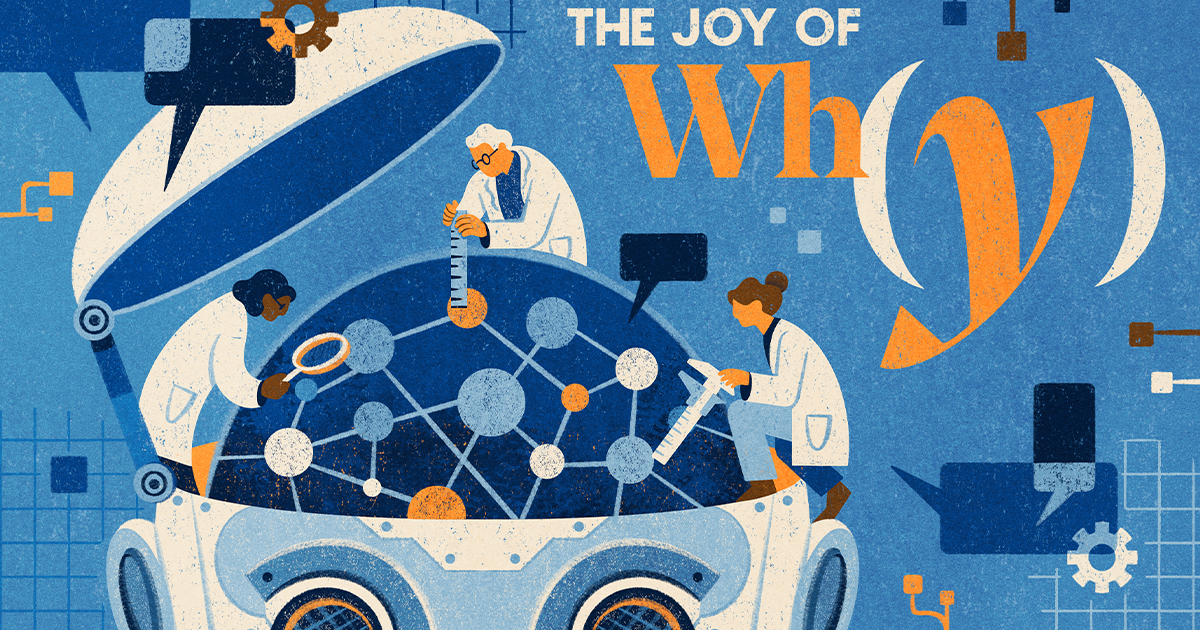
Thinking—Fast, Slow, and Artificial: How AI is Reshaping Human Reasoning and the Rise of Cognitive Surrender
People increasingly consult generative artificial intelligence (AI) while reasoning. As AI becomes embedded in daily thought, what becomes of human judgment? We

Nassim Nicholas Taleb on Twitter / X
The problem isn’t that AI is intelligent. It isn’t. The problem is that too many adults (but not all) are at once mechanistic, imitative, unimaginative, stupid, formulaic, influenceable, & gullible, arrogant beyond their skill set, & too expensive to maintain.— Nassim Nicholas Taleb (@nntaleb) October 24, 2026
Agentic AI and the next intelligence explosion
For decades, the artificial intelligence (AI) “singularity” has been heralded as a single, titanic mind bootstrapping itself to godlike intelligence, consolidating all cognition into a cold silicon point. But this vision is almost certainly wrong in its most fundamental assumption. If AI development follows the path of previous major evolutionary transitions or “intelligence explosions,” our current step-change in computational intelligence will be plural, social, and deeply entangled with its forebears (us!).

A more interesting upside of AI
Does AI provide anything to look forward to, if “super-intelligence” sounds boring?

Thinking Fast, Slow, Artificially: AI and Your Brain
AI can boost your decisions — or quietly undermine them. Wharton researchers introduce a new theory of cognition that every leader needs to understand.

AI Sycophancy and Decisions
We examine whether sycophantic AI advice distorts decisions. Our experiment involves 1,500 participants in 30 decision environments spanning core domains in eco
Study: Sycophantic AI can undermine human judgment
Subjects who interacted with AI tools were more likely to think they were right, less likely to resolve conflicts.

Sense-making reconsidered: large language models and the blind spot of embodied cognition
Large Language Models (LLMs) demonstrate a kind of linguistic competence that theories of embodied and enactive cognition have long deemed impossible for systems lacking the meaningful perspective of a living being, i.e., the capacity for sense-making. Facing up to this unexpected technological development requires confronting what I propose to call the “AI dilemma”: either frontier LLMs are capable of sense-making despite lacking biological embodiment, or the kind of linguistic competence they exhibit does not necessarily require sense-making. In their chapter on cognition, Frank, Thompson, and Gleiser (2024) maintain that no AI system comes close to realizing relevance, a position that derives much of its motivation from past practical failures. However, frontier LLMs have effectively overcome Dreyfus’ commonsense knowledge problem, such that their dismissal as categorically mindless risks undermining Frank et al.’s central claim that human cognition is deeply intertwined with lived experience. I therefore argue in favor of the alternative side of the AI dilemma: human-level linguistic competence of LLMs should be recognized as a novel non‑biological form of sense‑making, based on a technologically‑mediated embodiment whose enabling properties are in need of further theoretical analysis. This reorientation invites enactive theory to clarify which aspects of sense-making may be universal and which aspects are specifically contingent on organic life, thereby advancing its conceptual framework in dialogue with contemporary AI.
The Jevons Paradox of AI - Wesley's notes
Why AI can make us more productive but will never save us time
Collection

Updated 9mo
Moravec’s Paradox observes that evolution spent hundreds of millions of years optimizing sensorimotor skills, while abstract reasoning is a recent, thin veneer. Perception feels effortless; reasoning feels hard. For AI, it’s the reverse.
📚 AI (+ nuance)

Researching all aspects of artificial intelligence and its realized and potential implications
Malleable Software (by Boris) — Semble
darkshapes
AI* perception/usage (by あ) — Semble
All intelligence is collective intelligence (by Ronen Tamari) — Semble

A Collectivist, Economic Perspective on AI
Knowing less about AI makes people more open to having it in their lives – new research