

I just invented and played a game today with my family, and it worked great– it was fun and we learned an important lesson. Similar to the game “Monopoly” which shows that one person ends up monopolizing even though you think the rules are “fair,” the game of Oligarchy shows that the “free market” leads inexorably to one person getting all the money and everyone else going broke. And fast.
Game Theory | Open Yale Courses
This course is an introduction to game theory and strategic thinking. Ideas such as dominance, backward induction, Nash equilibrium, evolutionary stability, commitment, credibility, asymmetric information, adverse selection, and signaling are discussed and applied to games played in class and to examples drawn from economics, politics, the movies, and elsewhere.
Game Theory
Game theory is the study of the ways in which interactingchoices of economic agents produce outcomeswith respect to the preferences (or utilities) ofthose agents, where the outcomes in question might have been intendedby none of the agents. The meaning of this statement will not be clearto the non-expert until each of the italicized words and phrases hasbeen explained and featured in some examples. Doing this will be themain business of this article. First, however, we provide somehistorical and philosophical context in order to motivate the readerfor the technical work ahead.
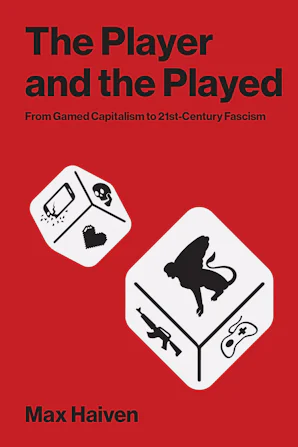
The Player and the Played
In an age when capitalism feels like an unwinnable game, extreme reactionary ideas and politics are on the rise. The Hunger Games, Game of Thrones, Squid Gam...
Radical markets: uprooting capitalism and democracy for a just society
Many blame today's economic inequality, stagnation, and political instability on the free market. The solution is to rein in the market, right? Radical Markets turns this thinking on its head. With a new foreword by Ethereum creator Vitalik Buterin and virtual reality pioneer Jaron Lanier as well as a new afterword by Eric Posner and Glen Weyl, this provocative book reveals bold new ways to organize markets for the good of everyone. It shows how the emancipatory force of genuinely open, free, and competitive markets can reawaken the dormant nineteenth-century spirit of liberal reform and lead to greater equality, prosperity, and cooperation. Only by radically expanding the scope of markets can we reduce inequality, restore robust economic growth, and resolve political conflicts. But to do that, we must replace our most sacred institutions with truly free and open competition Radical Markets shows how

Implicit Feudalism — Rushkoff Archive
Too many of us think it doesn’t matter when a platform like X/Twitter has a single, all-powerful owner. Most of our online worlds are simply run by what we hope are benevolent dictators. After all, we figure, if we don’t like what they’re doing or allowing, we can just leave, right? But in most cases we’re just jumping from one rich dude’s idea for how the world should be to another rich dude’s idea for how the world should be.

“We Own You” – Confessions of an Anonymous Free to Play Producer – TouchArcade
When it comes to discussions surrounding free to play, people often focus on monetization tactics based on their experiences as a player. Folks commonly get upset based on the disruption of the historical precedent that games should have a price tag, that you pay, then get the game.
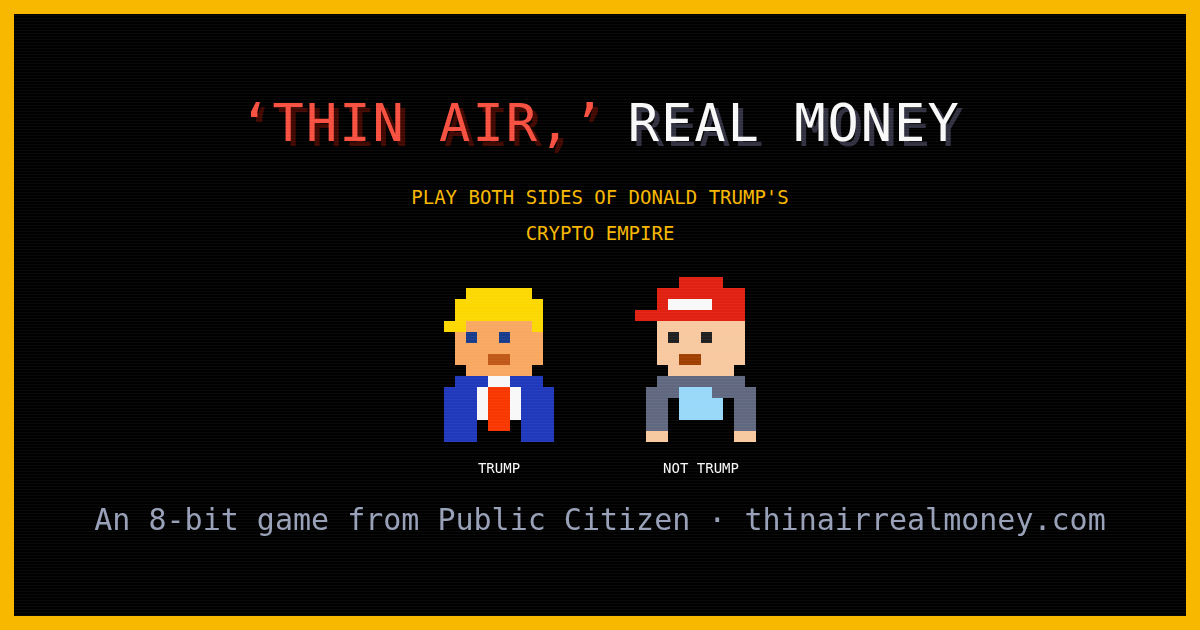
‘THIN AIR,’ REAL MONEY — The Trump Crypto Game
An 8-bit game about real money. Play as Trump: you only make money. Play as an investor: you only lose. Every figure is drawn from Public Citizen's report and the sources it cites.
Public Monopolies Are a Good Thing
Private monopolies are rightly criticized for being inefficient and unaccountable. But public monopolies are a different story — we should loudly and proudly say that democratically controlled public monopolies are a positive good.

Exploitative Game Design: Beyond the F2P Debate
The past few months have seen a torrent of articles about Free-to-Play business models, often discussed alongside issues of ethics in games (for example: 1, 2, 3, 4, 5). These pieces have addressed the effect on addiction-prone players or children, the possibility of corrupting artistic intent, the sheer amount of money being spent, and other advantages and dangers of F2P. While all of this is relevant, I fear that we’re focusing too much on F2P and glossing over the wider ethical issues in game design.
America’s new oligarchy
Under Trump an ultra-wealthy clique has infiltrated government, raising concerns about democratic integrity


The Myth of Capitalism Exposed
We need a revolution to cast off monopolies and restore entrepreneurial freedom. First of two excerpts from “The Myth of Capitalism.”

Artificial Intelligence, Algorithmic Pricing, and Collusion
Increasingly, algorithms are supplanting human decision-makers in pricing goods and services. To analyze the possible consequences, we study experimentally the behavior of algorithms powered by Artificial Intelligence (Q-learning) in a workhorse oligopoly model of repeated price competition. We find that the algorithms consistently learn to charge supracompetitive prices, without communicating with one another. The high prices are sustained by collusive strategies with a finite phase of punishment followed by a gradual return to cooperation. This finding is robust to asymmetries in cost or demand, changes in the number of players, and various forms of uncertainty.
Platform Monopolies - AVC
There’s an article in the NY Times Sunday Business Section today that lays out a very important question we have all been dancing around but will increasingly be dealing with. The article is nominally about Amazon’s fight with Hachette but it is really about internet platforms and monopolies. The author of the NY Times piece […]
In "The Player and the Played," @maxhaiven.bsky.social theorizes the connections between the financialization of the capitalist economy, the gamification of our lives, and the rising threat of a uniquely 21st-century form of fascistic politics: mitpress.mit.edu/9780262056045/the-player-and-… #OpenAccess
